

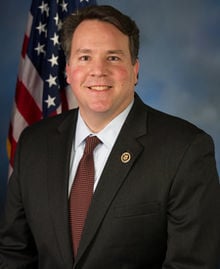
The House Ethics Committee is investigating U.S. Rep. Alex Mooney, R-W.Va.
The House Ethics panel announced on Tuesday that Mooney is under investigation and that it will announce a course of action regarding the investigation by Oct. 21.
The panel confirmed the independent, nonpartisan Office of Congressional Ethics, which is charged with reviewing allegations of misconduct regarding House members, had recommended it review the matter.
Although the House Ethics Committee declined in a statement and through chief counsel and staff director Tom Rust to confirm what Mooney is under investigation for, the four-term congressman’s campaign finance reports show a multiyear pattern of spending on meals and recreational activities that may violate federal law that prohibits using campaign funds for personal use.
In June, the national political news website Roll Call reported the ethics office was investigating whether Mooney misspent campaign funds on personal activities and failed to properly report required information in his Federal Election Commission filings.
A Gazette-Mail review of Mooney’s campaign finance reports found his campaign spent more than $86,000 on food and beverages from the start of 2015 through June, with the vast majority of those purchases coming at restaurants in Ranson near the four-bedroom Charles Town home Mooney purchased for $430,000 in 2015, according to Jefferson County records.
In an emailed statement Wednesday, Mooney campaign spokesman Mark Harris said that prior to the Office of Congressional Ethics inquiry, Mooney adopted multiple new procedures, amended past reports to ensure their accuracy and hired a company to ensure full legal compliance and accurate reporting.
“Congressman Mooney is fully cooperating in this matter. The Congressman will clear up this issue and as always fight for the people of West Virginia and their conservative values,” said Harris, who is a partner with the Pittsburgh-based political consulting firm ColdSpark.
The House Ethics Committee, whose membership is divided evenly among five Democrats and five Republicans, has the power to impose sanctions.
The committee must release Office of Congressional Ethics reports within 45 days unless the committee extends the period by another 45 days or establishes an investigative subcommittee.
The committee indicated in its statement that it was exercising its option to extend its investigation of Mooney by 45 days, noting the Office of Congressional Ethics had transmitted the matter to the committee on July 23.
Stories you might like
- ‘Discriminatory and deadly’: SOAR sues WV over moratorium on methadone clinics
- Huntington Police continue to ask for information after Ohio man charged in fatal shooting
- Incarcerated by grief: 5 years after woman found in well, second killer sentenced
- Boone County mother sentenced in 2024 death of emaciated daughter, Kyneddi Miller
Office of Congressional Ethics spokesman William Beaman declined to comment.
If the House Ethics Committee finds that a member of Congress under investigation did not violate any laws or rules, it will prepare a report to that effect to the House of Representatives. The committee may also recommend to the House disciplinary action that stops with a letter of disapproval or escalates to a fine, reprimand, censure (a more severe rebuke than a reprimand) and even expulsion.
But even House reprimands are rare. There have been only 11 House members reprimanded since 1976, according to the House Offices of History, Art & Archives.
The last reprimand was in 2020 of Rep. David Schweikert, R-Ariz., for campaign finance violations, reporting errors by authorized campaign committees, misuse of his budgeted representational allowance for unofficial purposes and pressuring official staff to perform campaign work. Schweikert agreed to admit to 11 rules violations, a reprimand and a $50,000 fine.
Concerns have been raised that Mooney’s campaign is subsidizing too many of his meals and recreational activities – such as more than $11,000 at resorts and hotels, more than $900 at wineries and cigar shops and more than $15,000 at a Charles Town church and its gift shop since Mooney became a member of Congress in 2015.
“[M]any of them give the appearance of being for personal use, vacations or personal meals or personal benefits like cigars and wineries,” Columbia University professor and campaign finance regulation expert Richard Briffault told the Gazette-Mail in July. “That would be an improper use of campaign funds.”
In August 2020, retired West Virginia State Tax Department worker Jerry Payne of Ripley submitted a complaint over Mooney’s campaign spending to the independent, nonpartisan Office of Congressional Ethics, which is charged with reviewing allegations of misconduct regarding House members.
“I just think they’re suspicious,” Payne said. “I don’t think you can account for them.”
Harris described the expenses in July as “routine” and “legitimate,” saying they legally constituted or supported fundraising efforts.
Payne’s August 2020 complaint examined Mooney campaign finance reports filed covering the start of 2017 through September 2019.
It reported expenditures for all restaurants, gas stations and grocery stores within 30 miles of Mooney’s personal residence totaled more than $34,000, with Mooney reimbursed more than $15,000 for gas, food and travel expenses during that span.
CLICK HERE to follow the Charleston Gazette-Mail and receive


