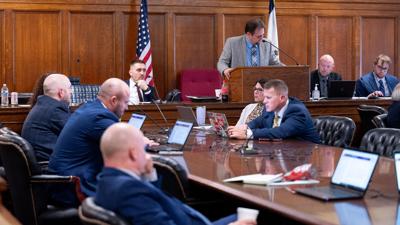
As West Virginia leaders question whether they’ll have to return $465 million to the federal government amid their annual budgeting process, they’re also closing in on passing legislation to limit the independence of the state watchdog unit that flagged increased risk of wasting the funding source in question.
SB 687 would give the Senate president and House of Delegates speaker control over a state position charged with auditing the state budget and government spending units, reporting misapplication of state funds and making recommendations on their findings.
Under Senate Bill 687, the state legislative auditor holding that position would exercise those duties as directed by the Senate president and House speaker.
In November, the Performance Evaluation and Research Division, a section of the Legislative Auditor’s Office, published a report finding the Justice administration’s Department of Education lacked the capacity or structure to monitor local school districts’ use of federal COVID relief education funds, elevating the risk of fraud, waste and abuse of the funds.
The Performance Evaluation and Research Division, known as PERD, noted the federal Department of Education had encouraged the state to reevaluate its monitoring capacity regarding federal Elementary and Secondary School Emergency Relief funding through the American Rescue Plan Act, a COVID relief package signed into law by President Joe Biden in 2021.
But the PERD found no evidence the state Department of Education adjusted its monitoring capacity, instead using one to three program monitors for the state’s 55 local education agencies.
The PERD noted over $467 million in Elementary and Secondary School Emergency Relief monies had yet to be spent ahead of the expiration deadline of Sept. 30, 2024, for those funds and that any unexpended funds remaining after the deadline would have to be returned to the U.S. Department of Education.
What’s driving state leaders’ focus on over $450 million implicated in what West Virginia House of Delegates Finance Committee Chairman Vernon Criss, R-Wood, called a potential “clawback situation” at a committee meeting last week is concern the state hasn’t met a federal “Maintenance of Effort” standard.
“Now we know why the Senate and House Leadership are working so hard to pass SB 687 to take over the Legislative Auditor’s office and to do away with independent, peer reviewed auditing standards,” West Virginia Democratic Party Chairman Mike Pushkin, D-Kanawha, said in a statement Thursday blaming Justice for mishandling COVID relief funds. “This is precisely why independent audits matter.”
The federal Department of Education did not respond to a request for comment.
Auditing standards in peril
Under SB 687, agency reviews overseen by the legislative auditor no longer would have to be overseen in accordance with Generally Accepted Government Auditing Standards as issued by the federal Government Accountability Office.
PERD Director John Sylvia recalled — to the House Government Organization Committee — that the division has operated under Generally Accepted Government Auditing Standards, known as GAGAS, since he joined the division in 1994.
“The most important component of GAGAS is independence,” Sylvia said.
Sylvia noted those standards require his division to test data.
“We don’t just take the word of the agency,” Sylvia said. “We don’t want to report what the agency wants you to hear.”
Those standards are the “preeminent standards for government auditing,” according to the U.S. Government Accountability Office, a watchdog agency examining how taxpayer dollars are spent.
Without GAGAS-required peer reviews, Sylvia said, the division could fall into a “detrimental” pattern of not knowing GAGAS as well. Sylvia recalled a poor first peer review under GAGAS before state statute required GAGAS, a mandate he said occurred in 2007.
But the House Government Organization Committee rejected an amendment proposed by Delegate Kayla Young, D-Kanawha, that would have restored a requirement that the Legislative Auditor’s Office’s regulatory board reviews would be under GAGAS. Committee Vice Chairman Pat McGeehan, R-Hancock, spoke against the proposed amendment, saying it “undercuts the purpose of the bill” without explaining how he thought it would do so.
The Governor’s Office did not respond to a request for comment on SB 687.
Bill could block publishing legislative auditor reports
SB 687 has sparked concern the Senate president and House speaker would have too much power over performance evaluations of agencies.
The House Government Organization Committee amended SB 687 to allow a recommendation of the Joint Standing Government Organization Committee, a panel of House and Senate lawmakers, to enable agency and regulatory board reviews.
But under SB 687, Senate president or House speaker direction would be required for the legislative auditor to audit the state budget — a duty that no longer would be continuous — to report misapplication of state funds, or to audit state government spending unit revenues and expenses.
SB 687 also would newly require approval from the Senate president or House speaker to allow presentations from departments up for agency review to the joint standing committee informing lawmakers of the department’s activities and financial situation.
SB 687 would require the legislative auditor to report findings and recommendations to the Post Audit Subcommittee, another joint panel of House and Senate legislators, and publish the report on the Post Audit Division’s website only after a department presentation.
Government Organization Committee counsel conceded SB 687’s language allows for the lack of a Senate president or House speaker-approved department presentation to keep legislative auditor reports from being published on the website.
That could mean lack of public exposure caused by the Senate president and House speaker for reports that call attention to financial and administrative issues among state agencies supported by taxpayer dollars.
The Government Organization Committee rejected another amendment proposal from Young that would have required Senate and House minority leader approval wherever Senate president and House speaker approval is also mandated. Young, a member of the Legislature’s Democratic superminority, argued her proposal would help ensure nonpartisanship for the Legislative Auditor’s Office.
But McGeehan said Joint Government and Finance Committee oversight in some areas eliminated a “need to get into this partisanship debate.”
Delegate: Bill ‘elevates us in code’
Sylvia said his division has five reports that have been completed but not released. Sylvia reported a “transition issue.” Aaron Allred retired from the legislative auditor position at the end of 2023, creating a vacancy that persists.
“I really don’t know why the ones that I do have are not being released,” Sylvia said.
SB 687 would eliminate a provision that the legislative auditor is to make post audits of the revenues and expenses of state government spending units at least once every two years if practicable.
Instead, SB 687 would require any division of the Legislative Auditor’s Office to review one or more state agencies each year and require each state agency be reviewed at least once every 15 years — and more frequently at the direction of the Senate president and House speaker, or by Joint Standing Government and Finance Committee recommendation.
McGeehan said the new status quo SB 687 would set, of state lawmakers being responsible for holding themselves accountable via audits, is as it should be.
“It elevates us in code over an important office,” McGeehan said. “I don’t know about some of my colleagues in the minority, but we tend to believe in hierarchy, and the people elected us. And we should be directing which agencies to be audited since we are supposed to be closest to the people.”