The West Virginia Senate unanimously passed legislation Thursday targeting, but not funding, the Flood Resiliency Trust Fund, which the Legislature has not moved to fund nearly three years after creating it.
Senate Bill 390, which now goes before the House of Delegates, instead would remove requirements designed to ensure disbursements from the fund benefit low-income communities and implement nature-based approaches to reducing flood damage in West Virginia.
SB 390, like sibling bill House Bill 4018 advancing in the House of Delegates, authorizes the state resiliency officer to manage funds from the long-empty Flood Resiliency Trust Fund, a move that could be rendered ineffectual without funding to distribute. The legislation was requested by Gov. Patrick Morrisey.
SB 390 would eliminate a requirement that at least half of all funds disbursed through the Flood Resiliency Trust Fund be disbursed to benefit low-income geographic areas and households.
It also would eliminate a similar requirement that at least half of such funds be disbursed to implement nature-based solutions, which state code defines as “sustainable planning, design, environmental management, and engineering practices that weave natural features or processes into the built environment to promote flood resiliency and preserve or enhance natural hydrologic function.”
Pew Charitable Trusts, a global public policy research group, and other flood resiliency proponents have encouraged nature-based approaches as an avenue toward more cost-effective flood mitigation. Nature-based strategies include river and stream restoration, levee removal and planting shrubs and trees near waterways.
Under SB 390, the state no longer would be required to direct at least a quarter of disbursements to implement nature-based solutions to acquiring single-family and multifamily residences in areas currently or projected to be subjected to significant flood impacts, assistance to residents relocating outside of a floodplain, and floodplain restoration activities on properties acquired through the Flood Resiliency Trust Fund.
SB 390 would remove a requirement that the state resiliency officer make Flood Resiliency Trust Fund disbursements to a political subdivision only if that political subdivision has adopted or will adopt within 24 months provision that include:
Town road and bridge standards consistent with state Department of Transportation standards
A flood hazard bylaw as a step toward securing participation in the federal National Flood Insurance Program
A local, federally compliant Hazard Mitigation Plan, which includes long-term strategies for protecting people and property from area disaster risks
A classification under a Federal Emergency Management Agency incentive program that encourages community floodplain management that prohibits new structures in mapped flood zones
Instead, the state resiliency officer only would have to consider those programs and measures when determining whether to move forward with Flood Resiliency Trust Fund disbursements to a political subdivision.
“[I]t gives us enough flexibility that we’re not so hamstrung into, you have to use 50% for this and 25% for this and another 50% for that,” Governor’s Office General Counsel Sean Whelan told the House Government Organization Committee at its Jan. 19 meeting, alluding to the nearly identical HB 4018.
SB 390’s Senate passage follows what in 2025 was West Virginia’s deadliest year in reported deaths attributed to flood events since 2016, when a deluge left 23 people dead and displaced more than 2,000 people. June flooding in Ohio and Marion counties left nine people dead following February flooding that left three dead in McDowell County.
The Senate passed SB 390 after little discussion Thursday, though Sens. Laura Wakim Chapman, R-Ohio, and Mark Maynard, R-Wayne, acknowledged flooding impacts in their districts in brief floor addresses.
“[T]he community is still reeling,” Chapman said. “Besides the loss of life which can never be recouped, there are still people who are rebuilding.”
Bill part of limited Morrisey flood resiliency planning scope
The advancement of SB 390 and HB 4018 comes amid the Morrisey administration’s plan to launch a pilot program to improve how West Virginia detects flood risks and warns the public about them.
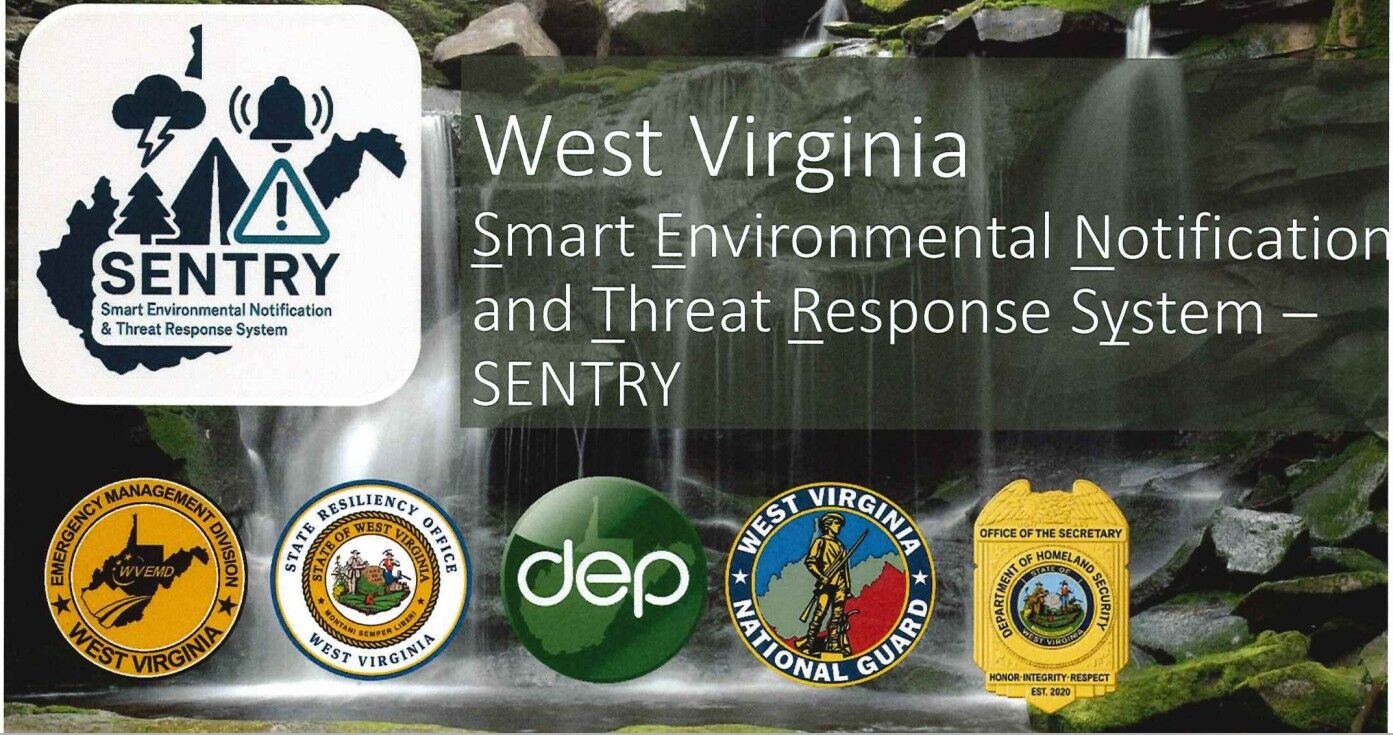
Called SENTRY (Smart Environmental Notification & Threat Response System), the pilot project is intended to reshape West Virginia’s flood warning prediction and notification capabilities within 36 months through installation of new rain, stream, soil saturation and weather gauges along with flash flood and dam risk analytics and public alerts driven by artificial intelligence.
SB 390 doesn’t set parameters for or even mention SENTRY. But State Resiliency Office Director Bob Martin spoke in favor of sibling bill HB 4018 before the House Government Organization Committee, saying it was needed to lift restrictions to better allow fund use for the planned $10 million SENTRY project and other potential projects.
Morrisey has proposed to the Legislature a $10 million transfer into the Flood Resiliency Trust Fund for SENTRY. But SENTRY’s scope is limited to flood warning and notification rather than prevention or recovery, and the planned $10 million allotment is only a quarter of the $40 million listed as a potential allocation for the fund in the 2023 law that created it, SB 677.
Then-Gov. Jim Justice recommended that the Legislature allocate $50 million to the fund in 2024, his final year in the office.
The limits in funding and scope that SB 390 would be part of have drawn criticism that the Morrisey administration and Legislature aren’t doing enough to strengthen West Virginia’s flood resiliency.
More than half of West Virginia’s critical infrastructure — including fire, police and power stations — was at risk of becoming inoperable due to flooding, according to a 2021 First Street Foundation study. West Virginia’s share of critical infrastructure deemed at risk of being inoperable due to flooding in that study was higher than any other state.
Published in 2024 by the State Resiliency Office, West Virginia's Flood Resiliency Plan is wide-ranging in scope, with five components: preparedness, response, recovery, hazard mitigation and resilience, which the plan defines in part as “[t]he capability to adapt to potential disruptions, seize opportunities, and effectively respond to outcomes.”
“While we support innovative tools that save lives, early warning alone is not flood resiliency,” the West Virginia Environmental Council said in its weekly legislative update published on Jan. 23, urging lawmakers to invest in flood prevention, stronger infrastructure and nature-based solutions that reduce flood impacts, and updated floodplain mapping.
Mike Tony covers energy and the environment. He can be reached at mtony@hdmediallc.com or 304-348-1236. Follow @Mike__Tony on X.