West Virginia legislators have thrown caution to the wind while tightening their embrace of coal.
The state Senate Energy, Industry and Mining Committee cast aside words of warning Monday from a wind industry representative that legislation they were considering would threaten over $1 billion in planned industry investments in the state.
At its first meeting of the 2025 regular legislative session, the committee approved that legislation, Senate Bill 439, which if enacted would repeal state code providing a pollution control facility designation to wind power projects for tax purposes.
Under that definition, up to 79% of the total value of wind turbines has been appraised at salvage value, a tax break set in 2007.
Representing San Francisco-headquartered wind developer Clearway Energy Group, Chris Hall of Charleston strategic communications firm Orion Strategies said Clearway projects to add wind power in Grant and Tucker counties comprise $1.2 billion in planned investments and an estimated 425 construction jobs.
Those investments and jobs would be “endangered” by SB 439, Hall cautioned.
“It would also, in our view, undercut the state’s reputation for being a stable, reliable business partner,” Hall said of SB 439 after asserting Clearway had invested $2.2 billion in the state with three projects operating in Mineral and Grant counties.
But members of the historically coal-favoring committee peppered Hall with questions and arguments suggesting the energy that comes from wind turbines isn’t reliable enough or job-intensive enough to merit the tax break SB 439 would repeal.
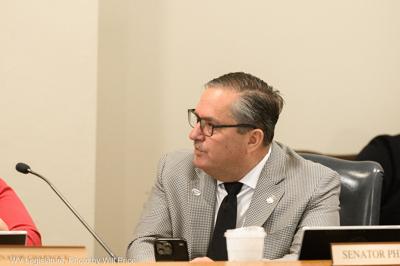
“You’ve got kids? You love them, don’t you? God forbid nothing would ever happen to any of them, anybody’s loved ones. But if they were on a life support system, do you want to depend on that windmill to keep that life support system running?” Sen. Rupie Phillips, R-Logan, a coal industry veteran and one of the Legislature’s most vocal renewable energy opponents, asked Hall.
“I don’t think anybody is arguing that we don’t continue to need baseload generation,” Hall responded, referring to power delivered at a steady rate as opposed to intermittent generation from wind and solar energy.
SB 439 now goes before the Senate Finance Committee.
A 2017 Marshall University Center for Business and Economic Research study found the calculated property tax per megawatt-hour of wind was $1.63 — nearly double that for coal.
Citing that study, Hall contended SB 439 would increase the cost of power by roughly $5 per megawatt-hour, meaning wind would be taxed, per SB 439 and the Marshall study, approximately eight times that of coal.
Hall also referenced President Donald Trump’s hostility toward the wind industry, alluding to Trump signaling he supports repealing tax credits for the industry Congress approved through the Inflation Reduction Act in 2022.
“I’m not sure what the wisdom [is] in trying to offset the property taxes in West Virginia, raise property taxes on a growing, thriving business in order to correct a federal issue that may change at any moment,” Hall said.
That argument didn’t sway Phillips.
“You can’t make it without all the subsidies,” Phillips claimed.
Sen. Craig Hart, R-Mingo, questioned why lawmakers should support the wind industry given its potential to help companies meet environmental, social and governance (ESG) goals, an investing approach that prioritizes investments that consider the environmental and social effects of an investment’s financial returns.
Sen. Joey Garcia, D-Marion, and Sen. Glenn Jeffries, R-Putnam, spoke in opposition to SB 439.
“Jobs are going down, energy costs are going up,” Garcia, assistant minority leader, said. “For that reason, I would oppose the motion.”
“What kind of message are we sending?” Jeffries said. “We’re going to lose, probably, most likely, $1.3 billion in economic investment, let alone what comes with that that hasn’t been announced yet in those counties where they’re at. Businesses look for stability. They want reliability. They want to know that there’s not changes coming. It’s not small money, it’s big money, it’s large money. It’s millions, it’s billions of dollars in investments.”
SB 439 was introduced by new Energy, Industry and Mining Committee Chairman Sen. Chris Rose, R-Monongalia. Rose drew over $4,000 from coal industry sources in campaign support last year, including $2,800 from Alliance Coal and $1,000 from Arch Coal.
Long history of legislation favoring coal
West Virginia lawmakers have a long history of enacting legislation favoring the long-declining coal industry.
In 2019, the Legislature approved a steam coal severance tax cut the Department of Revenue estimated would cost $64.1 million annually. In 2021, the Legislature approved requiring coal-fired power plants owned by public electric utilities to keep at least 30 days of coal supply under contract for the lifespan of those plants. Last year, the Legislature approved requiring state approval for coal-fired or other fossil fuel plants to be decommissioned or deconstructed.
“If we can create jobs, if we can create tax base by providing that energy, then we should do it,” Hall said. “So what you’re doing is, you’re not going to prevent the power from being built or being produced. If you don’t like renewable energy, you’re not going to stop it from being produced. But what you’re going to do is drive that investment to other states, and they’ll produce it there.”