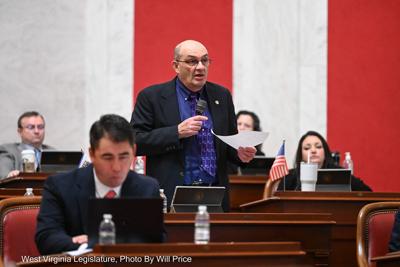
West Virginia Senate Energy, Industry and Mining Committee Chairman Randy Smith, R-Tucker, presided over his committee’s approval Thursday of a bill aimed at helping the state obtain authority to regulate wells used to inject carbon dioxide into deep rock formations for long-term underground storage.
WILL PRICE | West Virginia Legislative Photography
West Virginia Senate Energy, Industry and Mining Committee Chairman Randy Smith, R-Tucker, presided over his committee’s approval Thursday of a bill aimed at helping the state obtain authority to regulate wells used to inject carbon dioxide into deep rock formations for long-term underground storage.
WILL PRICE | West Virginia Legislative Photography
A West Virginia Senate panel has approved a bill aimed at shoring up the state’s position in pursuing authority to regulate wells used to inject carbon dioxide into deep rock formations for long-term underground storage.
The Senate Energy, Industry and Mining Committee on Thursday approved Senate Bill 596, a response to the United States Environmental Protection Agency asking the state to make changes to its code in pursuit of that regulatory authority.
The state Department of Environmental Protection has been seeking prime enforcement authority, or primacy, over the federal Class VI injection well program.
The Senate panel’s approval Thursday comes a day after its House of Delegates counterpart, the House Energy and Manufacturing Committee, approved its nearly identical version of the bill, House Bill 5045.
SB 596 now goes before the Senate Judiciary Committee.
Long-term underground storage through Class VI wells is aimed at reducing carbon dioxide emissions and slowing climate change. But West Virginia environmentalists have argued the DEP lacks the funding or staffing to take on the responsibility of primacy over Class VI wells.
Few states have Class VI primacy
Two states currently have such primacy: North Dakota and Wyoming. The EPA this month approved Louisiana to assume Class VI primacy effective Feb. 5.
The potential for a regional carbon dioxide pipeline buildout has raised concerns due to risks of induced seismicity and carbon dioxide leakage during storage.
SB 596 would increase the minimum amount of time a storage operator could be issued a certificate for fulfilling post-injection site care and site closure requirements after carbon dioxide injections from 10 to 50 years. But HB 5045 also would allow other time frames to be established on a site-specific basis.
Current West Virginia law makes it the state’s responsibility, using only money from a state carbon dioxide facility trust fund, to monitor and manage storage facilities upon the effective date of a completion certificate.
SB 596 would hold that release of liability wouldn’t apply to a current or former owner or operator of a storage facility when liability arises from their noncompliance with applicable underground injection control laws, regulations or permits before the completion certificate was issued.
The release of liability also wouldn’t apply when an operator is responsible for fluid migration that “causes or threatens imminent and substantial endangerment” to an underground drinking water source.
HB 5045 follows HB 4491 of 2022, which set up state regulations for underground carbon dioxide storage.
HB 4491 was a gas and oil industry-backed product of lawmakers’ embrace of carbon capture, use and storage technology. State and federal legislators have viewed carbon capture, use and storage as a way to keep coal in the energy mix amid the country’s shift toward reducing emissions and the rise of renewable resource use.
Carbon capture, use and storage is an umbrella term for technology that removes carbon dioxide from the atmosphere and uses it to create products or store it permanently underground. Such technology is unproven on a commercial scale.
Hydrogen hub has indicated support for W.Va. enforcement authority
The U.S. Department of Energy in October selected a West Virginia-led regional coalition for an award of up to $925 million for a hydrogen production-based hub of energy and economic development expected to use carbon capture technology.
The coalition, the Appalachian Regional Clean Hydrogen Hub, or ARCH2, has said the DEP attaining Class VI primacy would ease the permitting process and could create new prospects for carbon sequestration.
“We’re hearing a lot of interest in Class VI, but at this point, we have no indication of how many applications we’re talking about,” DEP Deputy Secretary Scott Mandirola said at a state Environmental Protection Advisory Council meeting in September.
Editor's note: A previous version of this story has been updated to correctly list a state that has enforcement authority over underground wells used for geologic sequestration of carbon dioxide. The correct states are North Dakota and Wyoming.