
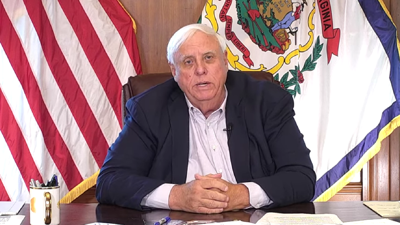


Nearly 300 West Virginia properties owned by Gov. Jim Justice or his businesses, on which they owed almost $400,000 in delinquent taxes, went up for sale in public auctions in June.
Roughly 95% of those properties sold to other buyers for just over $500,000, according to a Gazette-Mail review of state Auditor’s Office data.
Of the 281 properties secured by other bidders, 95 were in Justice’s own name, selling for just over $75,000. Another 15 properties on which roughly $241,000 was due didn’t receive a bid.
The properties in McDowell, Raleigh and Wyoming counties were included in public auctions held in those counties.
Nearly half the properties sold were in Wyoming County, but most in Justice’s name were in McDowell County.
Property taxes are a critical source of revenue for local tax bases, helping fund infrastructure, libraries, parks, public safety and schools.
The listings are the latest indication of financial trouble facing Justice’s business empire as the coal magnate, who inherited his father’s businesses in 1993, mounts a U.S. Senate run.
The original owners may redeem listed properties with added fees until the deed is recorded, a process that usually takes approximately nine months after a tax sale, according to the Auditor’s Office.
Purchasers have 120 days to give the Auditor’s Office their title search. Another 150 days — at minimum — must pass before the office issues the deed to be recorded in a county clerk’s office.
Most of the properties in McDowell and Wyoming counties sold to Pivot Capital LLC, listed by the Auditor’s Office as a Bramwell-based company. Two Raleigh County properties in Justice’s name sold for roughly $13,500 to Elemental Resources LLC, a South Charleston-based real estate investment management company. Most of the Raleigh County properties sold to Marietta, Ohio-based Cato Energy LLC or Charleston-based MAPA LLC.
The Governor’s Office did not respond to a request for comment.
Justice became president and CEO of Bluestone Industries, Inc. and Bluestone Coal Corp. after his father’s death in 1993.
Justice’s net worth rose as high as $1.7 billion after he sold coal company Bluestone Resources to Russian coal producer Mechel in 2009 for more than $400 million plus several hundred million dollars in Mechel stock, according to Forbes magazine.
But since Justice bought back Bluestone in 2015 for just $5 million, his net worth has plummeted, pushing him off Forbes’ list of billionaires in 2021.
In September 2021, Justice said Bluestone Resources had offered Swiss investment bank and financial services company Credit Suisse $300 million and half the value of the Justices’ coal firms to settle about $740 million in outstanding loans.
The Justice family’s companies had been in talks with Credit Suisse after the downfall of London-based Greensill Capital, which loaned the family companies $850 million in May 2018. Justice said he personally guaranteed the loans, putting him on the hook for paying back the remaining balance. Greensill filed for bankruptcy in March 2021.
Earlier last year, Bluestone Resources agreed to pay up to $320 million in recurring payments starting in June to lenders.
In April, Justice and his wife, Cathy, acknowledged debt exceeding $305 million in principal, interest, late charges and attorney’s fees to Virginia-based Carter Bank & Trust in a Virginia circuit court.
In May, Justice family attorneys filed motions in Martinsville (Virginia) Circuit Court to set aside the confessions of judgment, arguing in part that Carter Bank had breached contractual obligations.
In March, a Randolph County Circuit Court filing listed an unpaid sum of $861,035 owed by the governor to Citizens Bank of West Virginia, Inc.
The bank’s move followed a court case in which it said Bluestone Resources defaulted on loans taken out to buy equipment.
In an April administration briefing, Justice said the $861,035 judgment would be paid but dismissed the bank’s move as a “political grandstand.”
Retired miners and the United Mine Workers of America have said the Justice family coal companies have failed to provide contractually promised prescription drug coverage intermittently in recent years, causing miners and their dependents to pay out of pocket or go without critical drugs.
Upon taking office in 2017, Justice said he would put his children — James “Jay” Justice III and Jillean Justice — in charge of his family’s business operations. But the governor has suggested in court proceedings and interviews since taking office that he remains familiar with his coal companies’ operations.
“My son and my daughter and absolutely our companies and everything, will always fulfill obligations, every single one, and absolutely at the end of the day, have we not done it and done it and done it and done it?” Justice asked during a May 31 administration update briefing.
Term-limited as governor, Justice announced a Senate bid on his 72nd birthday on April 27.
Justice has delayed filing a required disclosure of his finances, nearly four months since it was first due.
In May, Justice asked for and received a 90-day extension to file a financial disclosure report, something he’s required to do as a Senate candidate. The new due date for Justice’s report was Aug. 24.
But Roman Stauffer, Justice’s Senate campaign manager, said Justice would use what he called a 30-day “grace period” in the Senate Select Ethics Committee’s reporting requirements.
That 30-day period comes to an end Saturday.
There is a $200 penalty for any required filer who submits a report more than 30 days after the last day of a filing extension period. Failing to file required information at all carries a potential penalty of up to $50,000 and disciplinary action by the committee.
Stauffer pledged Justice’s report would be “accurate and filed within that period.”
Stauffer cited what he called a “broad and very complex” nature of Justice’s business structures as what required additional time to account for in the filing process.


