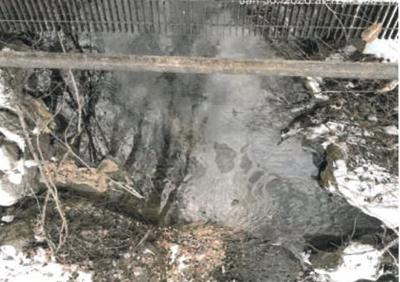
Pictured is what the West Virginia Department of Environmental Protection identified as an oily slick in Reedy Branch, a tributary of Clear Fork, from a leaking transformer in Wyoming County under American Electric Power control in a Jan. 30, 2026 DEP order requiring AEP to submit a corrective action plan in response to the spill.
Pictured is what the West Virginia Department of Environmental Protection identified as an oily slick in Reedy Branch, a tributary of Clear Fork, from a leaking transformer in Wyoming County under American Electric Power control in a Jan. 30, 2026 DEP order requiring AEP to submit a corrective action plan in response to the spill.
The West Virginia Department of Environmental Protection suggested Wednesday night there’s cause for assurance after thousands of gallons of a mixture of oil and water spilled as a result of what Appalachian Power says was an equipment failure at a Wyoming County substation.
The DEP released a statement Wednesday night saying that nearly two weeks after a Jan. 30 spill that the agency reported left an oily slick in Reedy Branch, a tributary of Clear Fork, downstream systems remained intact and were serving as the primary lines of containment.
But a corrective action plan proposed by Appalachian Power parent company American Electric Power as ordered by the DEP obtained by the Gazette-Mail paints a more daunting picture and points to an environmental remediation process expected to take months, with unclear long-term impacts to waterways and aquatic life, including protected species.
The plan proposed in a Monday letter from AEP targets completion milestones of:
March 20: Oil removal from creeks and surface waters
May 15: Initial soil and vegetative debris removal activities and identification of proposed soil sampling locations
July 15: Verification surface sample analysis for targeted cleanup levels
Sept. 15: Aquatic species evaluation and protection actions
The plan states that AEP was still recovering oil inside the substation as of Monday, and emergency oil recovery plans were expected to continue for the next four weeks and finish around March 9.
The remediation strategy included goals of:
Recovering mineral oil-free product and visible sheens from impacted creeks and surface waters
Returning creek water quality to background levels defined by samples collected upstream of oil impacted portions of creeks and associated surface waters
Removing and disposing of heavy oil-impacted soil and vegetative debris.
Meeting DEP soil cleanup standards
AEP reported that when conditions allow, Edge Engineering & Science LLC, a Houston-based environmental consulting group, would work with AEP to assess any long-term impacts to:
The Guyandotte River crayfish, a endangered species whose critical habitat consists of 446 stream miles in West Virginia, Kentucky and Virginia
Other protected species within Clear Fork and the Guyandotte River where contaminants may have impacted the species.
Because crayfish and mussels live on or just above the bottom sediments of waterbodies, the evaluation is slated to focus on whether there are any signs of significant impacts to organisms that live on solely the stream bottom that may have not been directly impacted by the floating contaminants.
Mineral oil often is used to cool electrical transformers.
AEP: Oil sheen reached Guyandotte River
The cause and point of failure within the secondary containment that allowed the oil to be released into the environment are unknown and under further investigation, AEP said in its proposed corrective action plan.
AEP said that the oil spill appears to have percolated through the substation subsurface and exited the station west of the transformer and station fence. Oil impacts then apparently continued to the south and followed contours of a small creek downstream into Clear Fork, according to AEP.
Observed oil sheen and free product impacts further extended to the southwest past the town of Clear Fork and eventually reached the Guyandotte River toward R.D. Bailey Lake, per AEP.
Oil impacts appeared to be limited to surface water, with soil and vegetation impacted but no visible creek sediment or groundwater impacts, AEP said.
DEP Chief Communications Officer Terry Fletcher told the Gazette-Mail Tuesday DEP sampling confirmed the material is a non-PCB mineral oil and that the agency hadn’t observed any impacts to downstream water intakes or aquatic life. Cleanup crews were using vacuum trucks, boats and skimmers to recover material, Fletcher said.
PCBs, polychlorinated biphenyls, are man-made industrial chemicals that can contaminate used oil known to cause cancer and linked to low birth weight and immune system defects.
West Virginia Department of Health Communications Director Gailyn Markham told the Gazette-Mail Thursday that due to the miles of stream with containment measures in place between the spill site and the first downstream public water system intake in the Mingo County town of Gilbert, the Department of Health did not believe there is any imminent threat to public health.
Markham said that out of an abundance of caution, the Department of Health advised Gilbert to add activated carbon to its treatment process and monitor the river for any signs of an oil sheen. Gilbert made that addition, Markham said.
Activated carbon is a material that can filter dangerous chemicals from contaminated water, consisting of granules of coal, wood and other carbon-rich components. The agency has advised additional public water systems further downstream to monitor for sheens, according to Markham.
Markham said there have been no service interruptions associated with the incident.
That’s in stark contrast to what has been the situation in Wayne County, where a mineral oil spill attributed to vandalism at an Appalachian Power substation near Wayne to which the Department of Health alerted the company on Jan. 13 prompted a Jan. 16 “Do Not Consume” order at the direction of Wayne Mayor Danny Grace that lasted until Feb. 6.
The spill devastated swaths of the community, causing residents to turn to bottled drinking water and public shower and laundry facilities during a winter storm and weekslong cold snap.
AEP reports being advised to monitor for crayfish death
Appalachian Power told the Gazette-Mail it had not yet received feedback on the AEP-submitted plan from the DEP as of Tuesday, so changes could be made based on their recommendations
AEP told the DEP in its proposed corrective action plan that remote notifications indicated an issue with the transformer function and oil level at its Clear Fork substation in Wyoming County at about 4 a.m. on Jan. 30. The company says that upon further inspection, an internal transformer failure caused an excessive buildup of pressure inside the transformer which ruptured the sidewall of the transformer, allowing oil to discharge into the secondary containment.
The total volume of oil released inside the station secondary containment system consisted of approximately 10,000 gallons of mineral oil, AEP reported in the proposed corrective action plan, adding that HEPACO, a Charlotte, North Carolina-headquartered environmental remediation contractor acted immediately to contain and recover oil released to the environment.
Follow-up sampling will consist of testing parameters for water planned to include:
Total petroleum hydrocarbons
Oil and grease
Volatile organic compounds, which are common groundwater contaminants that can be transported long distances
pH
Water sample locations include upstream of the substation along Reedy Branch, the mouth of Clear Fork, an inlet of R.D. Bailey Lake and upstream and downstream of containment booms in the Clear Fork area.
AEP said in its plan drones would be used wherever possible to assist with identifying remaining pockets of oil within creek features like natural eddies, fallen trees or areas with accumulated debris that could impede water flow and let oil impacts accumulate on the water surface.
Manpower would be used via air boats, portable fishing boats and other vehicular aid to get to areas where drone access isn’t possible or helpful in identifying pooling oil effects, per AEP’s plan.
Guidance from Edge Engineering and Science and endangered species experts focused on the Guyandotte River crayfish and other sensitive aquatic species like freshwater mussels, according to AEP’s plan, included:
Use of mesh coverings on surface water suction devices
Supporting crews with avoiding disturbance to stream bottom and large slab boulders as well as crayfish habitat during absorbent boom installations
Monitoring for signs of acute mortality of crayfish and other aquatic species in Reedy Branch, Clear Fork and the Guyandotte River
CLICK HERE to follow the Charleston Gazette-Mail and receive