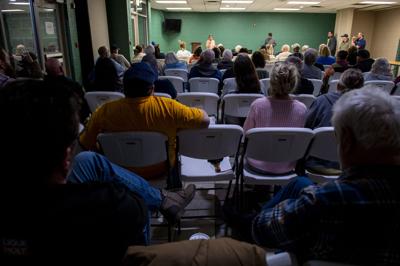
Community members listen during a community meeting about the proposed data centers in West Virginia at the Larry Joe Harless Community Center in Gilbert, Mingo County, on Monday, March 2, 2026.
Community members listen during a community meeting about the proposed data centers in West Virginia at the Larry Joe Harless Community Center in Gilbert, Mingo County, on Monday, March 2, 2026.
LAURA BILSON | Gazette-Mail
West Virginia Gov. Patrick Morrisey and the state Legislature, controlled by a Republican supermajority, have gone to great lengths to cut the people out of the process when it comes to data centers.
Morrisey has insisted the state must become a location for these server warehouses to compete economically in the age of artificial intelligence. The Legislature last year passed a bill cutting locals out of the process, as it pertains to data center locations, and is considering a bill that would make some proposals for data centers (and/or microgrids to power them) unavailable to the public.
The reason? Data centers are unpopular, especially in the West Virginia communities that are set to house them. Data centers create noise and light pollution, suck up massive amounts of water and cause electricity bills to skyrocket wherever they're located. In exchange, they provide few full-time jobs, as they are essentially warehouses for servers processing code.
But there's another reason for cutting people out of the process that is more specific to the whole concept of AI as an industry in general.
Journalist and blogger Cory Doctorow has been making the rounds on podcasts lately talking about his theory that the AI bubble will eventually pop. He has offered some analysis on why it's being pursued so heavily in the first place.
"Bosses really hate workers. They dream about a [work] world without people in it," he said in one interview, referring to why chatbots might be preferable to people for those in power. "If you're a billionaire, you have to -- somewhere in your heart -- not even really believe that other people exist. If you're going to make billions of dollars, you have to do that by hurting thousands if not millions of people. So you have to think that their pain doesn't matter."
One doesn't necessarily have to completely agree with this rationale for it to seem familiar with what's happening around data centers in West Virginia, or what has happened in the state throughout its history as the rich who live elsewhere have exploited West Virginia's resources and people.
Larger, less philosophical problems exist when it comes to AI, including that the industry doesn't make any money and its products are unreliable.
As The Associated Press reported in February, companies such as OpenAI, the maker of ChatGPT, haul in billions of dollars in revenue but also fork over up to $1 trillion in expenses just to power the infrastructure that's needed to support a glitchy product. So, the industry wants to build more data centers to, it is hoped, offset the cost, but the gap isn't even close, at present.
Certainly, AI platforms could improve, but one has to wonder if they'll ever be worth it economically, especially if it requires flooding the country with data centers.
As we wrote last month, the problems around AI seem to point to a need for more investment in human workers and workforce development. No extra electricity required.
But that's where things bump up against the psychology of it all.
As Doctorow says, the purpose of AI isn't to root out the social awkwardness of a Mark Zuckerburg or Elon Musk being told they're wrong or hating having to rely on employees, but that's how they see it and they're the ones investing in it.
It's not so different here in West Virginia. Why listen to people complain when you can just make laws to ensure nothing they say matters and pretend they don't exist?