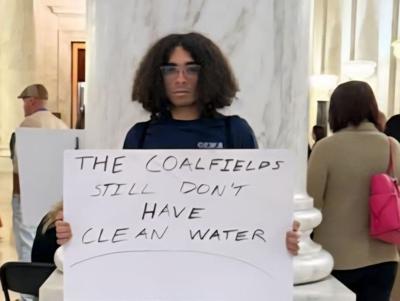
Torli Bush of Webster Springs, Webster County, holds a sign about the need for clean water in the southern coalfields during the 2026 legislative session at the West Virginia State Capitol.
Torli Bush of Webster Springs, Webster County, holds a sign about the need for clean water in the southern coalfields during the 2026 legislative session at the West Virginia State Capitol.
Courtesy photo
Organizers of From Below: Rising Together for Coalfield Justice are planning a Rural Rally for Safe Water during Rural Health Day at the West Virginia State Capitol on Monday.
"The ultimate goal for the Rural Rally for Safe Water is to move the House of Delegates to take action on the Coalfield Clean Water Act,” said Brad Davis, one of the founding members of From Below. "The health and wellbeing of our people and our communities should be their priority."
The Coalfield Clean Water Act, which hasn't been introduced yet this session, would make it easier for shovel-ready projects in nine southern counties to obtain funding from the state’s Rainy Day Fund.
“We are in the midst of an ongoing, decades-long public health emergency because of unsafe water,” Davis said. “It’s imperative our lawmakers provide emergency funding to repair and rebuild our water infrastructure, and they need to do it now. There’s no time to waste. People are sick. People are dying. The people we’ve put in office have the opportunity to help fix this. It’s long overdue.”
Davis, a Mingo County native and current clergy member in McDowell County, said his neighbors and the people he serves deserve better.
“Three of the communities I serve are water compromised, with unsafe or unreliable water service,” Davis said. “I have parishioners who spend upwards of $150 a month on bottled water because they can’t use what comes out of their taps. This is the wealthiest nation in the world, a nation built by our people. To lack access to safe water is a sin against us. Everyone deserves safe water. It needs fixed, and it needs fixed now.”
Although there hasn't been any movement yet on the Coalfield Clean Water Act, the West Virginia Legislature has taken aim at West Virginia waterways this session in different ways. The Senate passed legislation on Feb. 5 that would weaken a standard for how much selenium, an element with toxic effects for West Virginia’s aquatic life, is allowed in fish tissue.
Toxic human exposure can happen when selenium levels build up in ecosystems via leaching from mining waste into aquatic systems and emissions from burning coal or other industrial activities.
The building of data centers in southern West Virginia has also been a recent concern in the coalfields, with citizens holding public meetings to oppose the permits for proposed centers in the area. A panel of state lawmakers has advanced a legislative rule that would keep basic information about proposed “High Impact” data center projects confidential and hidden from public view.
The planned rule approved by the Legislative Rule-Making Review Committee would deem confidential all petitions seeking certification of a high-impact data center and all letters of intent seeking certification of a microgrid district. A high-impact data center could be any data storage or equipment facility with a critical power demand of at least 90 megawatts. A microgrid district, under HB 2014, would be an up-to-2,250-acre zone where electricity generated is used only within or delivered to the wholesale market.
Nancy Peyton-Brown serves as a Regional Weeklies Editor for HD Media’s family of publications.