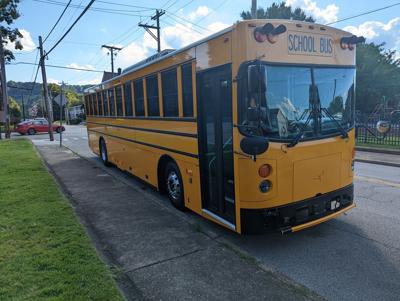
The Kanawha, Cabell and Mercer county school systems will be the first in West Virginia to test electric school buses under a pilot program kicking off soon.
Mark Nestlen, vice president of business development and strategy for GreenPower Motor Co., said Kanawha’s bus will embark Sept. 8 for a 6-week trial, with Mercer’s taking off the day before.
GreenPower is locating an electric bus plant in South Charleston.
Anticipating questions about how electric buses will perform, Nestlen told the Kanawha County Board of Education Thursday evening that “how you really see how it works is you get it out there.” On Friday, one of the buses is to drive from South Charleston to Princeton on one charge.
“The information that’s gained here in West Virginia is going to be tremendous in helping [school districts] across the country,” Nestlen said.
West Virginia Department of Education School Operations Officer Sam Pauley said last week that Kanawha, Cabell and Mercer counties would get to use the electric buses for a roughly 60-day pilot program, in conjunction with the state.
Pauley said it’s part of Gov. Jim Justice’s “commitment” with GreenPower Motor Co., which is providing four buses for the pilot statewide.
“This pilot program is gonna allow county school boards and their personnel to become familiar, kind of get those butterflies out of their stomachs when it comes to electric buses and to see if an electric bus may be something that is right for their county,” Pauley said.
He said the three counties are the first selected to receive the buses.
Kanawha school board member Jim Crawford asked Nestlen pointed questions Thursday about how the buses will work, questioning the required charging time, the cost to charge and whether the batteries are made in America.
Nestlen answered each question positively, suggesting there would be little to no issues. Ric Cavender, another school board member, said the point of the pilot is answering some of those questions.
Crawford eventually said, “these batteries that’s coming from China and other countries is made with slave labor, are you aware of that?”
“Ours do not come from those scenarios,” Nestlen said.
Also Thursday, the board approved paying St. Albans-based Mason & Barry Inc. about $232,000 to upgrade the current panic-alarm security system in every public middle or high school.
Keith Vititoe, Kanawha schools’ executive director of safety and security, said this will avoid possible problems if the software were to become obsolete and will provide all employees the ability to trigger a silent panic alarm from their phones or iPads, with the specific location in the building identifiable by the school.
Vititoe said the feature eventually will be expanded to all elementary schools.
CLICK HERE to follow the Charleston Gazette-Mail and receive