A mix of clouds and sun. A stray shower or thunderstorm is possible. High 79F. Winds SSW at 5 to 10 mph..
Tonight
Partly cloudy this evening followed by increasing clouds with showers developing after midnight. Low near 65F. Winds light and variable. Chance of rain 40%.
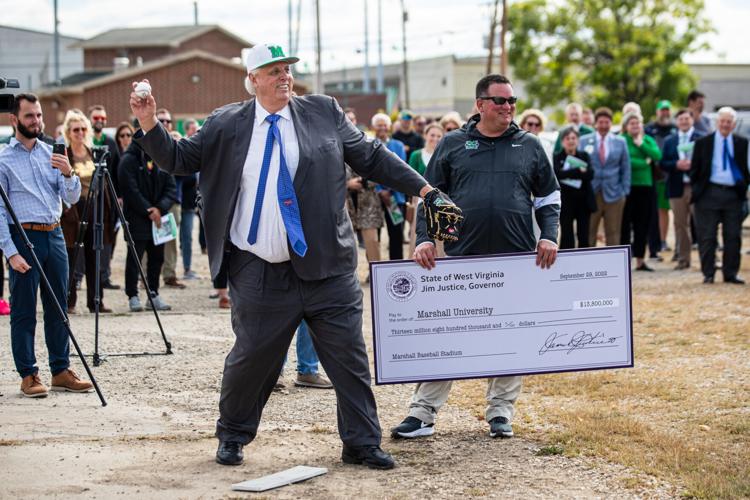
Gov. Jim Justice throws the first pitch at the site of a planned Marshall University baseball stadium after presenting the school with a $13.8 million check for the stadium project during a Sept. 29, 2022, ceremony. But instead of the West Virginia Water Development Authority’s Economic Enhancement Grant program covering the check as the state announced it would, a Governor’s Office-controlled fund that the office transferred $28.3 million in unused CARES Act dollars into supplied $10 million for the project.
Diane Farmer’s water has become a rusty color in recent years after strip mine operations took hold across the road from her home around 2019. She and her disabled husband buy bottled gallons of water to cook, finding their filtering system doesn’t do the job anymore.
Farmer, 73, of Leckie, McDowell County, is supposed to drink at least a gallon daily due to kidney issues, but just getting the water into their home has become a chore.
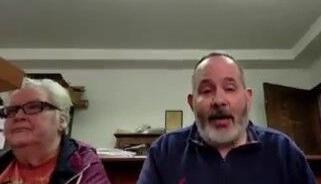
Diane Farmer of Leckie, McDowell County, and the Rev. Brad Davis speak during a Feb. 6, 2025, web event hosted by ReImagine Appalachia.
“It’s becoming a hassle,” Farmer said during a Feb. 6 water quality-focused briefing hosted by ReImagine Appalachia, a regional coalition of economic and environmental leaders. “The only thing we want to do is to be able to have clean water, to be able to go in and start a load of laundry anytime you need to, instead of having to look at the quality of the water that’s coming out through the faucet at that time.”
During the briefing, the Rev. Brad Davis, an elder in the United Methodist Church serving five churches throughout McDowell County, held up a bottle of water he said came out of her tap that day. It was dark yellow, with sediment at the bottom.
“I’ve lived on the same property for 70 years, and just in the last few years has this really become an issue,” Farmer said.
Davis has helped coordinate area water distribution efforts, with over 2,000 cases of water given out since March 2024. Recipients have included residents of the McDowell County city of Gary monthly and — with greater frequency — distributions to residents in Anawalt.
McDowell County Public Service District board president Jerry Stepp has said the district has no funding for what he estimated would be a $7 million expense to cover just the first phase of an upgrade that would include a new water tank and benefit at least 200 to 250 people.
“The funding, the money, is out there,” Davis said. “It’s just a question of directing it to the most needed places and getting these projects funded.”
Just 37% of fund pool went to PSDs
The West Virginia Legislature tried to answer to that question in 2022 by creating the Economic Enhancement Grant Fund to be administered by the state Water Development Authority. That year’s House Bill 4566 established the fund with $250 million in federal American Rescue Plan Act funding to support water and wastewater infrastructure upgrades as well as what the law calls “infrastructure projects to enhance economic development and/or tourism.”
The fund has drawn heavy criticism for supporting non-water and non-sewer projects in a state with disproportionately high rates of drinking water violations and cash-strapped public service districts struggling to provide potable water.
Only 37% of project funding from the Water Development Authority Economic Enhancement Grant Fund via the American Rescue Plan Act has gone to public service districts as of Dec. 19, according to a new Gazette-Mail analysis of fund distributions. Just over $159.8 million out of $432.4 million awarded was set aside for public service district projects.
Just under a third of 161 projects supported by the fund were public service district projects.
Public service districts in counties comprising West Virginia’s southern coalfields with long-festering water quality and access issues — Boone, Lincoln, Logan, McDowell, Mingo and Wyoming — received just 0.59%, roughly $2.5 million, of Economic Enhancement Grant funding via the American Rescue Plan Act combined.
The Water Development Authority has granted over $80 million to non-water and non-sewer projects with that funding — 19% of the $432.4 million awarded, the Gazette-Mail reported last month.
That $80 million included $5 million for Steubenville, Ohio-based College of St. Joseph the Worker, whose inaugural class began lessons this fall. The college combines a bachelor’s degree in Catholic studies with instruction in construction trades.
Gov. Jim Justice throws the first pitch at the site of a planned Marshall University baseball stadium after presenting the school with a $13.8 million check for the stadium project during a Sept. 29, 2022, ceremony. But instead of the West Virginia Water Development Authority’s Economic Enhancement Grant program covering the check as the state announced it would, a Governor’s Office-controlled fund that the office transferred $28.3 million in unused CARES Act dollars into supplied $10 million for the project.
HD Media file photo
During fiscal year 2023, fund awards comprising over $272.5 million not set aside for public service district water or sewer projects included $4.38 million for renovations at the Keith Albee Performing Arts Center in Huntington and $3.8 million for a new Marshall University baseball stadium, Jack Cook Field. Both projects were categorized as “economic development” projects. The fund also supported some non-public service district water and sewer projects.
Davis noted that when helping deliver water door-to-door in Leckie and Anawalt, he has heard refrains of despair.
“[T]hey say, ‘Well, we feel that we’ve been forgotten. We feel like we’ve been abandoned. We feel like our elected officials, the people who have the power to do something about this, just don’t care about us,’” Davis said.
As the southern coalfields contend with deep issues of water mistrust on a long road to recovery from flooding that ravaged the region over the weekend, there’s little sign that West Virginia’s most powerful political leaders are going to prioritize new avenues for investments in reversing worsening water access and quality.
‘A slap in the face to West Virginians’
Water Development Authority executive director Marie Prezioso said in an email her agency had funded all water and sewer projects that applied for funding and could meet American Rescue Plan Act requirements and deadlines.
Prezioso said the authority encouraged water, sewer and stormwater projects to consider funds from other federal and state funding agencies before applying for support from the Economic Enhancement Grant Fund because that fund is limited.
Prezioso indicated the Water Development Authority board approved over $1.3 million for the Boone Public Service District and $3.98 million for the Town of Pineville in Wyoming County from non-American Rescue Plan Act Economic Enhancement Grant funding.
The American Humanist Association last month sued the Water Development Authority in Kanawha County Circuit Court over its $5 million award for the College of St. Joseph the Worker, claiming it is unconstitutional.
“It’s hard for this not to feel like a slap in the face to West Virginians when there are people who don’t have access to clean running water, to clean drinking water, when there are swathes of our state that rely on handouts of bottled water to live their life, day to day,” American Civil Liberties Union of West Virginia legal director Aubrey Sparks said in a phone interview.
Prezioso declined to address the College of St. Joseph the Worker project when asked about it before the state Environment, Infrastructure and Technology Subcommittee Wednesday, saying her attorneys had advised her not to talk about it due to litigation.
Lincoln Co. leader: Water quality concerns ‘quite valid’
Frustrated over constant uncertainty over not just water quality but access to water due to recurring line breaks, Lincoln County resident Scott Pauley started a Change.org petition urging the Lincoln County Commission to allow West Virginia American Water to acquire the county public service district water works. The petition, which drew 389 signatures as of Wednesday, contends water service is in “a dire state,” preventing hydration and hampering firefighting capabilities.
“The money is not there to make sure that we have good water coming out,” said Pauley, 49, a minister at the Washington Street Church of Christ in St. Albans. Pauley said he believes county officials should have raised customer bills 20 years ago to ensure there was enough revenue to fix infrastructure.
The Lincoln County Commission has set a public hearing for March 6 to consider whether to sell Lincoln County Public Service District assets to West Virginia American Water.
Lincoln County Commissioner Josh Stowers said he believes resident water quality concerns are “quite valid” given that he’s a customer himself.
Stowers, who has been on the commission since 2019, said in an email he is “generally leaning in favor of dissolving the PSD and selling the assets” because of the system’s condition and what he said appears to be “clear public sentiment in support of a sell” among the district’s 2,532 water customers with a $12.9 million offer from West Virginia American Water.
Officials also have considered selling Logan County and Buffalo Creek public service district assets to West Virginia American Water, which has acquired local public service districts with increasing frequency in recent years as they struggle to provide reliable water access and quality.
West Virginia American Water spokeswoman Olivia Bailey said the company’s total infrastructure investment would be $175 million over five years for the Lincoln County, Logan County and Buffalo Creek public service districts combined. Customers of those districts would see an increase in their bills that would be phased in over two to three years until reaching the same rates as the company’s current customers, Bailey said.
PSC staff: ‘Gross mismanagement’ in Mingo County
The West Virginia Public Service Commission last month ordered its staff to investigate what a PSC order called the “severely troubled” Mingo County Public Service District. Citing a “concern for public health,” the PSC moved up the deadline (from July 14 to April 14) for completing the investigation, doing so after staff reported customers having gone without water service for “an extended period of time.”
PSC staff had reported discovering district customers experience regular water service outages, inadequate water pressure and discolored and unpotable water.
In a Jan. 15 agency filing, PSC staff said it believed the water utility was “the subject of pervasive lack of management and neglect,” asking the PSC to institute an investigation of the public service district to address “system-wide, gross mismanagement” of district water operations and determine whether appointing a receiver is necessary.
PSC staff said failure to maintain sediment basins at the water treatment plant for years is the root of the problem. The staff concluded the district had failed to abide by state Bureau of Public Health standards, citing state health violations that included failures to:
Submit consumer confidence reports that summarize drinking water quality
Comply with primary drinking water regulations
Have an approved lead and copper sampling plan
Provide customers with boil water notices and notices associated with past violations
Mingo County Public Service District customers have flagged what they say are long-lingering water concerns in public comments filed with the PSC.
“This has been an ongoing problem for years and no one will address the issue,” Lana McCloud of Dingess told the PSC in a Jan. 16 public comment, saying most customers had been without water for at least a week in bitterly cold temperatures and are routinely told they are under a boil water advisory. “We do not feel that our water is safe even when we do have it.”
Wendy Barker of Chattaroy told the PSC in a Jan. 28 comment her area had been without water for 16 days.
“It is sad, we will still have a bill to pay yet we have had to put forth so much money just buying water,” Barker wrote. “We can’t flush toilets, [bathe], cook, and it has never been drinkable. This should have never [come] to this.”
The Mingo County Public Service District said in Jan. 22 and Jan. 24 Facebook posts it was having issues keeping water in its tanks due to overconsumption or possible line breaks. The district said it was having to backflush ice out of intake valves every 15 minutes, which would cause some customers to experience low pressure and outages.
Prezioso said the Mingo County Public Service District hadn’t requested any Water Development Authority Economic Enhancement Grant funding as of Jan. 30.
The Mingo County Public Service District could not be reached for comment.
Bills advancing that would weaken water protections
Asked about water quality concerns in Mingo County at a Jan. 28 news conference, Gov. Patrick Morrisey said “everyone should have access to clean water.”
“We’ve inherited a lot of issues,” Morrisey said. “We’re going to work diligently to try to fix a lot of them, and obviously, clean water has to be very, very high on the list.”
But an opening salvo of executive orders from Morrisey upon taking office last month didn’t address or acknowledge southern West Virginia’s water crisis.
Morrisey’s only mentions of water during his first State of the State speech last week were to call for “utilizing our rich water resources” alongside “using even more coal and gas” for power production and touting “our incredible mix of coal, gas and water resources” to help the U.S. “compete in the world economy.”
In the first week of their annual 60-day legislative session, West Virginia lawmakers have advanced legislation that would weaken water quality protections instead of strengthen them.
The Senate Government Organization Committee on Monday advanced to the full Senate legislation in Senate Bill 269 that would prohibit the state Department of Health from requiring certain backflow prevention assemblies from being inspected more frequently than once in three years.
Backflow prevention assemblies are added to pipes to ensure water flows only in one direction and keep water and wastewater from intermingling. Plumbing experts say backflow preventers should be inspected and tested annually.
From Below: Rising Together for Coalfield Justice, a coalfield social justice initiative of the West Virginia Faith Collective, has opposed a bill that would require the Department of Health to provide water filtration equipment or technology to residents served by a public water source found to exceed any level of contaminant and deemed unsafe.
From Below indicated many southern coalfield residents have found water filters don’t work, calling the bill, Senate Bill 161 introduced by Sen. Laura Hakim Chapman, R-Ohio, chair of the Senate Health and Human Resources Committee, “a very expensive [and] ineffective band-aid” not accounting for compromised well water in a Saturday social media post.
As southern coalfield advocates look for longer-term solutions, Diane Farmer looks for a break.
“The inside of my dishwasher is orange,” Farmer said. “I use every cleaner. I use bleach and everything, but that orange is stained now — all my pipes are probably stained. Everything in my house, my showers, are daily chores to clean and everything like that. It’s just ridiculous.”
Mike Tony covers energy and the environment. He can be reached at mtony@hdmediallc.com or 304-348-1236. Follow @Mike__Tony on X.