A mix of clouds and sun. A stray shower or thunderstorm is possible. High 79F. Winds SSW at 5 to 10 mph..
Tonight
Partly cloudy this evening followed by increasing clouds with showers developing after midnight. Low near 65F. Winds light and variable. Chance of rain 40%.
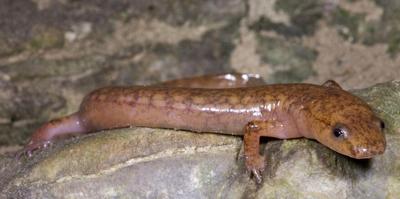
The West Virginia spring salamander is an amphibian in Greenbrier County that was proposed in December to be listed as an endangered species by the U.S. Fish and Wildlife Service.
With a global population estimated at fewer than 300 — all living in the same Greenbrier County cave — the West Virginia spring salamander has been proposed for Endangered Species Act protection by the U.S. Fish and Wildlife Service.
The plan to list the blind, subterranean amphibian as an endangered species follows a 13-year review period that began after the Center for Biological Diversity, the West Virginia Highlands Conservancy and other conservation groups petitioned the agency to consider granting it federal protection.
The West Virginia spring salamander is an amphibian in Greenbrier County that was proposed in December to be listed as an endangered species by the U.S. Fish and Wildlife Service.
DANTE FENOLIO | Courtesy photo
The exceptionally large, light gray salamander is one of only a few species of cave salamanders that undergo complete metamorphosis from an aquatic larvae to a land-dwelling adult. Completely blind during its adult stage, it feeds on insects and other invertebrates living in or near the stream flowing through General Davis Cave, its underground home.
From 1973 through 1988, at least 40 of the rare salamanders were removed from the cave for scientific research purposes. Since then, the population of the species has exhibited “an overall declining population growth rate,” according to the Fish and Wildlife Service.
The cause of the population decline, the agency concluded in its proposal to grant the salamander Endangered Species Act protection, is past over-collection of the salamander for scientific research, “current climate change conditions, including the increased magnitude of major flood events, and threats associated with small population size.”
According to the Center for Biological Diversity, sedimentation from logging also poses a threat to the health of the stream passing through the 2.7-mile-long cave, which could make it uninhabitable for the rare salamander.
The West Virginia Nature Conservancy owns the entrance to the cave, which is gated, and holds a conservation easement on the cave’s passages. The surface area above the cave is privately owned.
The cave is named after Gen. A.W.G. Davis, a West Point graduate and Confederate army veteran who represented Greenbrier County in the Virginia Assembly during the 1850s, on whose land the cave is located.
A public comment period on the proposal will remain open through Feb. 20. All comments will be posted at regulations.gov. Search docket #: FWS-R5-ES-2023 -0179 for comments, and information on this proposal.
CLICK HERE to follow the Charleston Gazette-Mail and receive