A mix of clouds and sun. A stray shower or thunderstorm is possible. High 79F. Winds SSW at 5 to 10 mph..
Tonight
Partly cloudy this evening followed by increasing clouds with showers developing after midnight. Low near 65F. Winds light and variable. Chance of rain 40%.
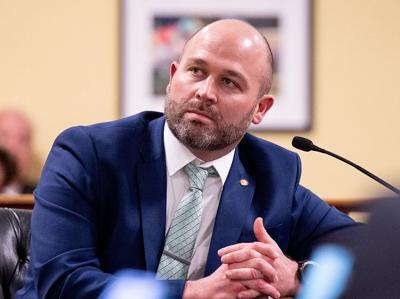
West Virginia Delegate Adam Burkhammer, R-Lewis, is pictured during a Feb. 3, 2026 state House of Delegates Health and Human Resources Committee meeting.
West Virginia Delegate Adam Burkhammer, R-Lewis, is pictured during a Feb. 3, 2026 state House of Delegates Health and Human Resources Committee meeting.
West Virginia lawmakers have before them legislation that would restrict the use of pesticides linked to toxic health effects and subject to outright bans elsewhere near schools throughout the state.
But the Morrisey administration weighed in against the legislation in a recent committee meeting, siding with the state’s agricultural industry and opposing environmental health advocates who say the measure would be a commonsense move to protect children across West Virginia.
House Bill 4907 would prohibit the toxic impact-linked pesticides within 1,000 feet of a school beginning Jan. 1, 2027. The bill’s sole sponsor, Delegate Adam Burkhammer, R-Lewis, said "schools" covered but undefined by HB 4907 would include colleges as well as K-12 institutions.
The pesticides that HB 4907 would bar use of within 1,000 feet of a school include paraquat, a widely used herbicide that at least 74 countries don’t authorize in their markets amid bans and phaseouts, according to a study by University of Edinburgh Centre for Pesticide Suicide Prevention researchers published last year by peer-reviewed academic journal BMC Public Health.
“It is now time for national, regional, and international authorities to pay attention to the scientific evidence of human toxicity and put people’s lives and health ahead of economic and business considerations in regulating paraquat,” the study concluded, citing previous research indicating paraquat damages the lungs, kidneys, liver, cardiac system and other bodily systems, with industry-disputed links to Parkinson’s disease. “Its use should be replaced by other [means] of weed control. This should be a public health priority.”
Dicamba, another pesticide that HB 4907 would ban within 1,000 feet of schools, has been linked to cancers, with National Cancer Institute researchers finding ties to increasing dicamba use and liver and bile duct cancer in a study published in 2020 in the peer-reviewed International Journal of Epidemiology.
HB 4907 would apply the same targeted ban to glyphosate, the world’s most used herbicide which the International Agency for Research on Cancer in 2015 listed as a probable human carcinogen.
At a House of Delegates Health and Human Resources Committee meeting last week at which HB 4907 was considered, Department of Agriculture and West Virginia Farm Bureau leaders spoke against the bill, claiming it would limit farmers’ ability to grow food and that the chemicals are already sufficiently regulated.
But there are alternatives to herbicides targeted by HB 4907, including other less common herbicides that can be used to control most weeds, and nonchemical, natural options like cover crops, mechanical and thermal weeding, and manual removal.
“[J]ust support our children’s right to a clean and healthy environment and to breathe clean air,” Lani Wean, West Virginia field organizer for Moms Clean Air Force, a national anti-air pollution group, urged the committee at its Feb. 2 meeting.
EWG estimates over six dozen schools in HB 4907 range
In bringing about HB 4907, Burkhammer indicated he drew, in part, from experience he has as a licensed commercial applicator. Burkhammer has overseen open-end mowing and herbicide application services, according to a state Ethics Commission filing.
“Recognizing the extensive personal protective equipment that one must wear, it sort of makes sense that if I shouldn't get these chemicals on my skin that we should potentially limit and make sure that those are not on playground equipment or In our playgrounds around our schools,” Burkhammer said. “So just a basic approach of just, again, trying to protect kids as they’re developing, ensuring that we're not allowing potential health concerns to rise.”
Scott Faber, senior vice president of government affairs at Environmental Working Group, a chemical safety and agricultural advocacy group, testified that more than 40 states have adopted what he called “tough” standards for how pesticides can be sprayed at schools, including 10 states with buffer zones like the one that HB 4907 would create.
After the meeting, the EWG shared with the Gazette-Mail a list of 73 schools in West Virginia it said it identified as being located within 1,000 feet of cropland by overlaying locations of schools via the National Center for Education Statistics via with a footprint of land used to grow crops via the Department of Agriculture’s Cropland Data Layer.
The EWG said it removed all fields from the cropland data that weren’t used to grow crops where pesticides may be sprayed, such as forests, pasture or fallow land.
The 73 schools include Elkview Middle School, Sissonville Middle School and Sissonville High School in Kanawha County.
Wean called the 1,000-foot buffer zone that HB 4907 would set “a great start,” noting that children are especially vulnerable to environmental hazards. The U.S. Environmental Protection Agency has found that children’s nervous, immune, digestive and other still developing systems are still developing are less able to detoxify and excrete pollutants compared with adults, and that children inhale almost twice as many pollutants as adults.
“For years, we've allowed these harmful substances to be used too close to the places where thousands of children again are learning and planning on a daily basis,” Wean said.
West Virginia’s Parkinson’s disease death rate in 2023, 10.5 per 100,000 people, was 15th-highest in the nation and higher than any bordering state, according to National Center for Health Statistics data.
Conni Gratop Lewis of Charleston urged the committee to support HB 4907, testifying her late husband had suffered from Parkinson’s disease, eventually requiring a caregiver 70 hours a week at a cost of $6,000 out of pocket monthly.
“While we don't know everything about this terrible disease,” Lewis told the committee, “we do know that it is an expensive one to live with.”
Department of Agriculture and Farm Bureau opposition
But Department of Agriculture Deputy Commissioner Amie Minor spoke against HB 4907, asserting that the pesticide use targeted by the bill already is adequately regulated.
Minor alluded to Integrated Pest Management, or IPM, a pest control approach in all child care centers and facilities required by a 1995 state law, with rules defining the types of pesticides that can be applied and restricting application times when children are present.
Under state law, people applying restricted-use pesticides and businesses applying restricted-use or general-use pesticides must be certified and licensed.
“[There] are protections for children that are already in place,” Minor said.
Minor predicted many more farmlands would be affected by HB 4907 than the EWG has estimated and suggested the legislation would limit how much food West Virginia farmers can grow.
Dwayne O’Dell, West Virginia Farm Bureau director of governmental affairs, said his group opposes HB 4907, touting the state’s IPM program and arguing HB 4907 would undermine the Department of Agriculture’s authority.
O’Dell claimed HB 4907 could be viewed as taking property rights away from farmers, lamenting that a 1,000-foot buffer zone could encompass entire fields near some small schools.
“To lump all those products in [the] same prohibitive practice is illogical to us from a scientific standpoint,” O’Dell said.
Delegate Wayne Clark, R-Jefferson, also spoke against HB 4907, claiming a lack of pesticide use under the legislation could be an insurance liability for farmers.
“I think this significantly harms our businesses in the state of West Virginia,” Clark said.
The House Health and Human Resources Committee, chaired by Delegate Evan Worrell, R-Cabell, has not advanced HB 4907 since the committee considered it on Feb. 2.
At that day’s meeting, unlike the bill’s opponents, Burkhammer perceived the most risk in letting West Virginia’s pesticide regulatory status quo near schools spray on.
“[T]his [legislation] could be one piece of attempting to get West Virginia healthier,” Burkhammer said.
Mike Tony covers energy and the environment. He can be reached at mtony@hdmediallc.com or 304-348-1236. Follow @Mike__Tony on X.