A mix of clouds and sun. A stray shower or thunderstorm is possible. High 79F. Winds SSW at 5 to 10 mph..
Tonight
Partly cloudy this evening followed by increasing clouds with showers developing after midnight. Low near 65F. Winds light and variable. Chance of rain 40%.
Wendy Perrone, executive director of Three Rivers Avian Center in Brooks, Summers County, releases a juvenile osprey in Gauley Bridge, Fayette County, on Thursday, July 18, 2024.
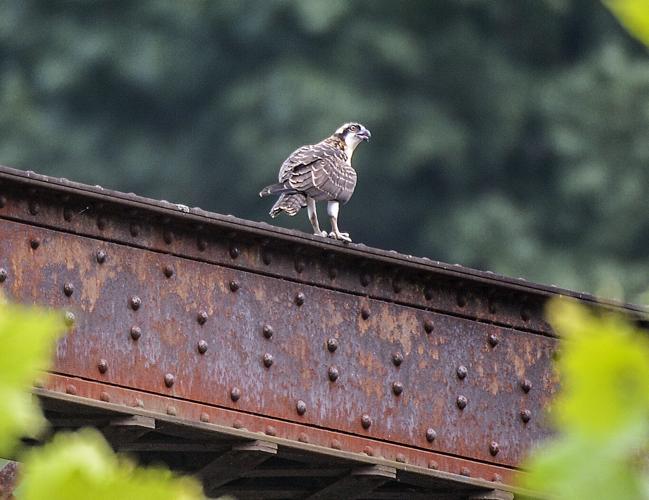
A juvenile osprey was released in Gauley Bridge, Fayette County, on Thursday, July 18, 2024. Here, the osprey is shown perched on an old railroad bridge near its nest.
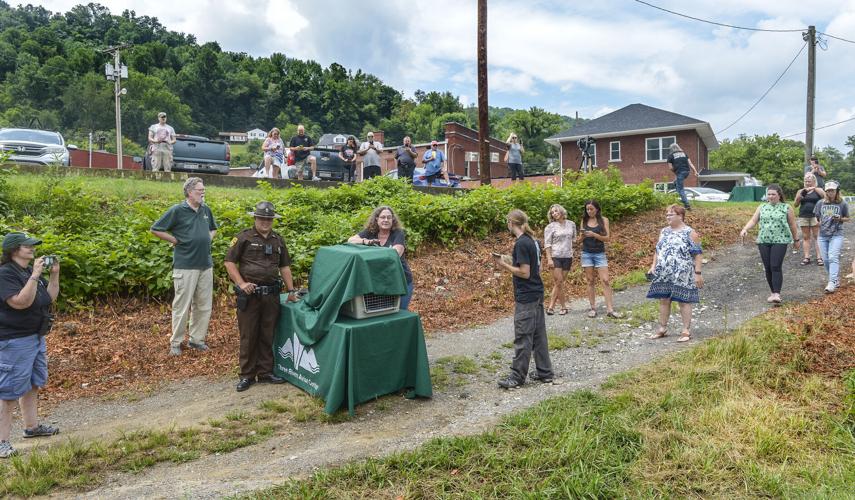
A crowd gathers to watch Wendy Perrone (center), executive director of Three Rivers Avian Center in Brooks, Summers County, release a juvenile osprey in Gauley Bridge, Fayette County on Thursday, July 18, 2024.
Wendy Perrone, executive director of Three Rivers Avian Center in Brooks, Summers County, releases a juvenile osprey in Gauley Bridge, Fayette County, on Thursday, July 18, 2024.
KENNY KEMP | Gazette-Mail
GAULEY BRIDGE — Sometimes, it takes a village to save an osprey chick.
When Beckley nature photographer Kim Ayers stopped in Gauley Bridge on June 7 to photograph the occupants of a long-established osprey nest built atop a train trestle over the Gauley River, she quickly realized something was amiss.
“I could see an adult osprey in the nest that wasn’t moving, except for a wing, which was blowing in the wind, and I could hear the babies — they were so vocal. I knew right then something wasn’t right.”
Ayers had been visiting the nest for years to check on the progress and photograph the activities of the ospreys who made the nest their home. She visited once every few weeks since March, when newly hatched chicks were first spotted at the site.
During Ayers’ June 7 visit, it was apparent that the adult female was dead, and her two offspring needed food and protection.
“I wanted to just stop and cry,” she said. Instead, Ayers called Three Rivers Avian Center at Brooks, in Summers County, and asked for help.
“If not for Wendy and Ron Perrone [who operate the avian center], what would we do when something like this happens?” Ayers said. “I’m so thankful they’re here.”
“When we got the call, we knew we couldn’t make it there by dark, so we started working the phones to find a volunteer who was closer,” Wendy Perrone said.
A juvenile osprey was released in Gauley Bridge, Fayette County, on Thursday, July 18, 2024. Here, the osprey is shown perched on an old railroad bridge near its nest.
KENNY KEMP | Gazette-Mail
Nursing the osprey back to health
The Perrones soon made contact with Matt Carpenter of Fayetteville, a teacher and experienced climber, who offered to ascend the trestle’s rusty steel beams to reach the nest, secure the young birds in bags, and retrieve the remains of the mother osprey, which apparently had been dead for several days.
Carpenter was accompanied at the scene by his partner, wildlife biologist Lindsay Hermanns, and friend Amber Jaxson, who transported the two young osprey in the back of a Mazda to Beckley to meet the Perrones, who brought the birds back to the avian center.
“They heard the call and volunteered,” Wendy Perrone said of Carpenter, Hermanns and Jaxson.
In the weeks that followed, the two young birds feasted on hand-fed culled trout donated by the Division of Natural Resources’ Tate Lohr Fish Hatchery in Oakvale, Mercer County. After maturing enough to eat on their own, they were moved into the Leon Wilson Flyway in the avian center’s flight barn to learn aeronautical skills.
Unfortunately, one of the chicks turned out to be not as strong or resilient as its sibling, and died in early July. The remaining juvenile thrived in its new surroundings and, on Thursday, was ready to return to Gauley Bridge to be released in the wild.
As a crate containing the bird was carried to the release site, a short distance from trestle and nest, an adult osprey — likely its father — could be seen winging over the scene, vocalizing as it soared.
“That’s icing on the cake,” Wendy Perrone said. “It means an adult is still around to show the young bird how to hunt.”
When the carrier containing the young osprey was opened, the bird at first seemed reluctant to venture outside. But after Wendy Perrone held the bird on her arm, it began tentatively flapping its wings, and then slowly became airborne, flying immediately to the top of the nearby trestle, a few feet from its stick-built nest.
“This is such a relief,” Wendy Perrone sighed as she watched the bird taking in the view of the confluence of the New and Gauley rivers, also the birthplace of the Kanawha, from its lofty vista. “It’s a good day.”
A crowd gathers to watch Wendy Perrone (center), executive director of Three Rivers Avian Center in Brooks, Summers County, release a juvenile osprey in Gauley Bridge, Fayette County on Thursday, July 18, 2024.
KENNY KEMP | Gazette-Mail
Ospreys in West Virginia
Ospreys, also known as fish hawks or sea hawks, live along rivers, lakes and coastlines, and can be found in every continent but Antarctica. The birds of prey are smaller than eagles but larger than red-tailed hawks. When on the hunt, ospreys “are a picture of concentration, diving with feet outstretched and yellow eyes sighting straight along their talons” to catch fish, according to the Cornell Lab of Ornithology’s ”All About Birds” website.
While nesting ospreys can now be found along the length of the Kanawha River, as well as West Virginia’s share of the Ohio River shoreline and large reservoirs like Stonewall Jackson Lake, such was not always the case.
No nesting pairs were known to exist in the state as recently as 1981, according to a survey by the Raptor Research Foundation, following decades of unchecked stream pollution and widespread use of the insecticide DDT.
Industrial and agricultural stream pollution caused steep declines in fish populations, creating a hardship for osprey whose primary source of food is fish. DDT entering the ospreys’ food chain and then absorbed in their tissue caused their egg shells to thin and break before incubation was complete.
A nationwide ban on DDT use and passage of the Clean Water Act both took place in 1972, which gradually helped restore habitat and improve reproduction odds for ospreys in the years that followed.
By the end of the 1980s, an osprey restoration effort got underway in West Virginia, starting at Tygart Lake, involving 6-week-old chicks transported from sites in the Chesapeake Bay area and other locales where osprey were relatively abundant. The young ospreys were taken to sites near Tygart Lake’s shoreline, where they were fed and sheltered in screened boxes and allowed to acclimate to their new surroundings, before being released when they had matured enough to be able to fly.
A similar project took place from 1989 to 1995, involving the release of 62 juvenile ospreys from a remote site on Blennerhassett Island, in the Ohio River in Wood County, involving volunteers from DuPont’s Washington Works plant in cooperation with the DNR.
By 1994, three nesting pairs of osprey — all products of the reintroduction effort — had been documented in West Virginia. The population has steadily grown since then.
An investigation is underway by the DNR Police to determine the cause of death of the newly released osprey’s mother.