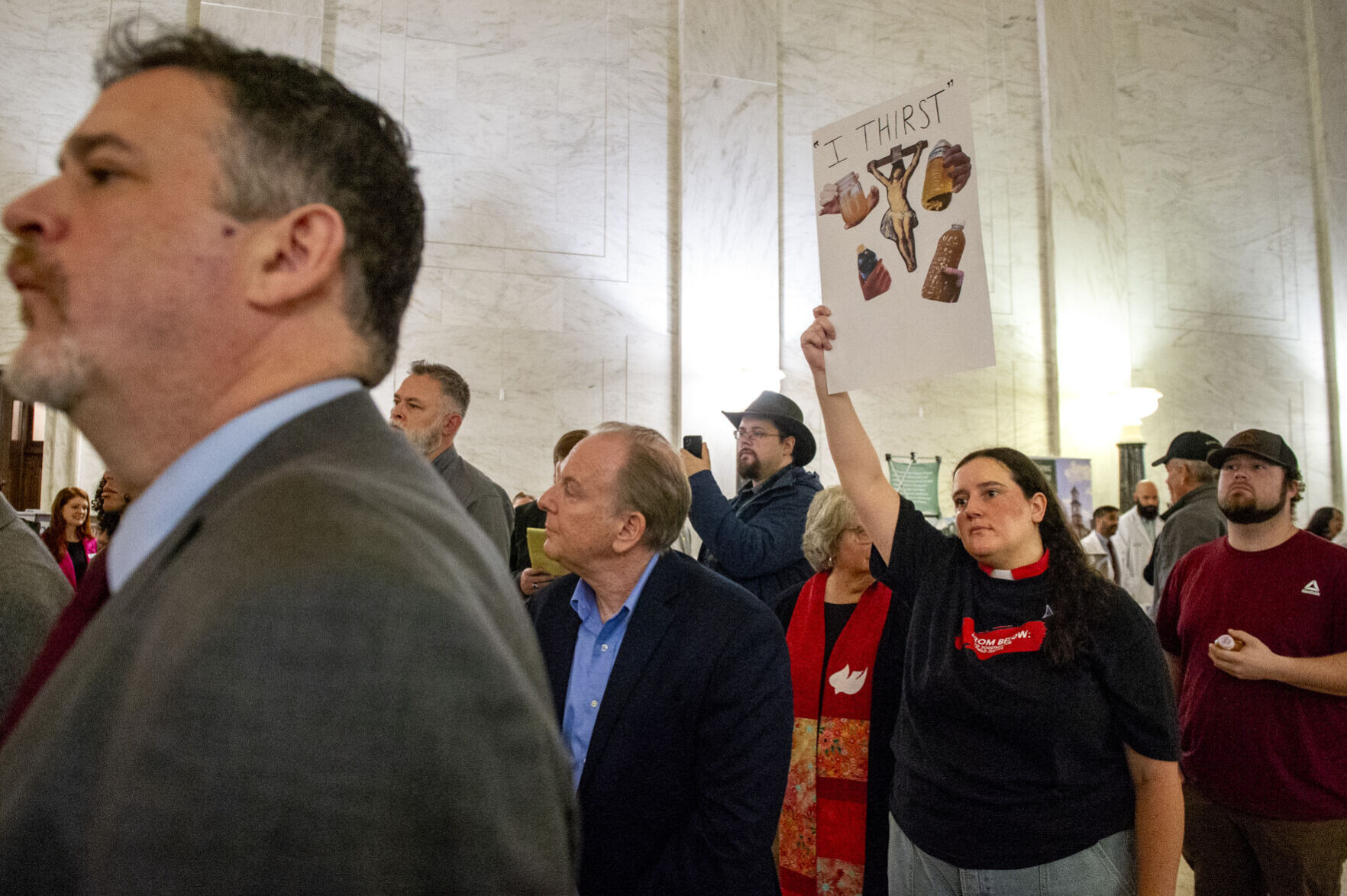
Rev. Caitlin Ware (center right) holds a sign reading “I thirst” at a news conference hosted by From Below: Rising Together for Coalfield Justice at the West Virginia State Capitol Rotunda in Charleston, Monday, Feb. 16, 2026.
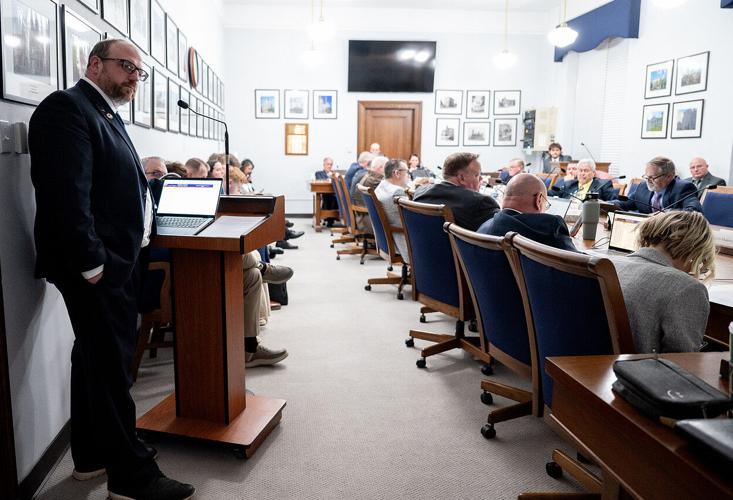
West Virginia Delegate Adam Vance (left), R-Wyoming, stands before the House of Delegates Energy and Public Works Committee at its Tuesday, Feb. 17, 2026 meeting at the Capitol.
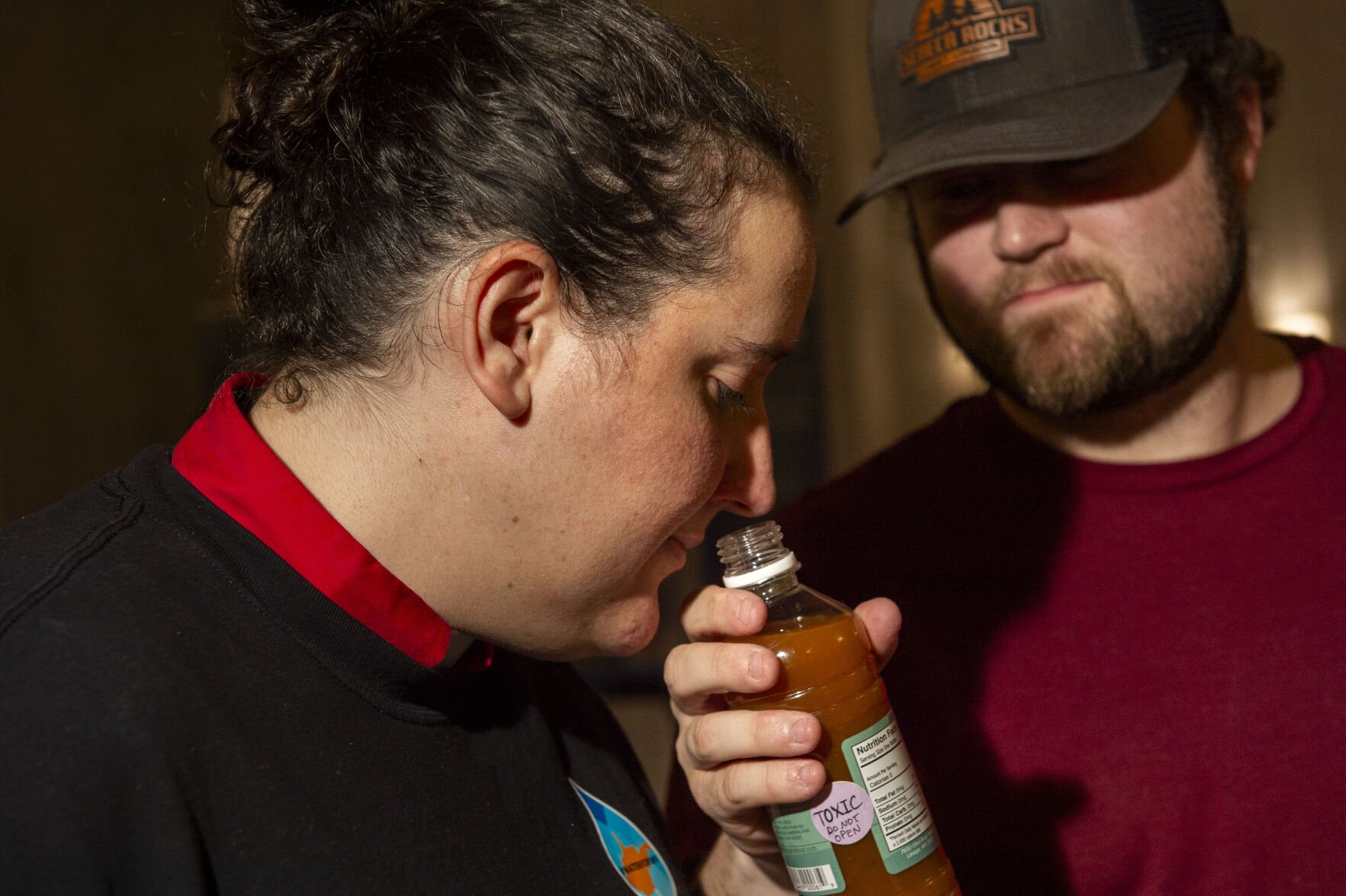
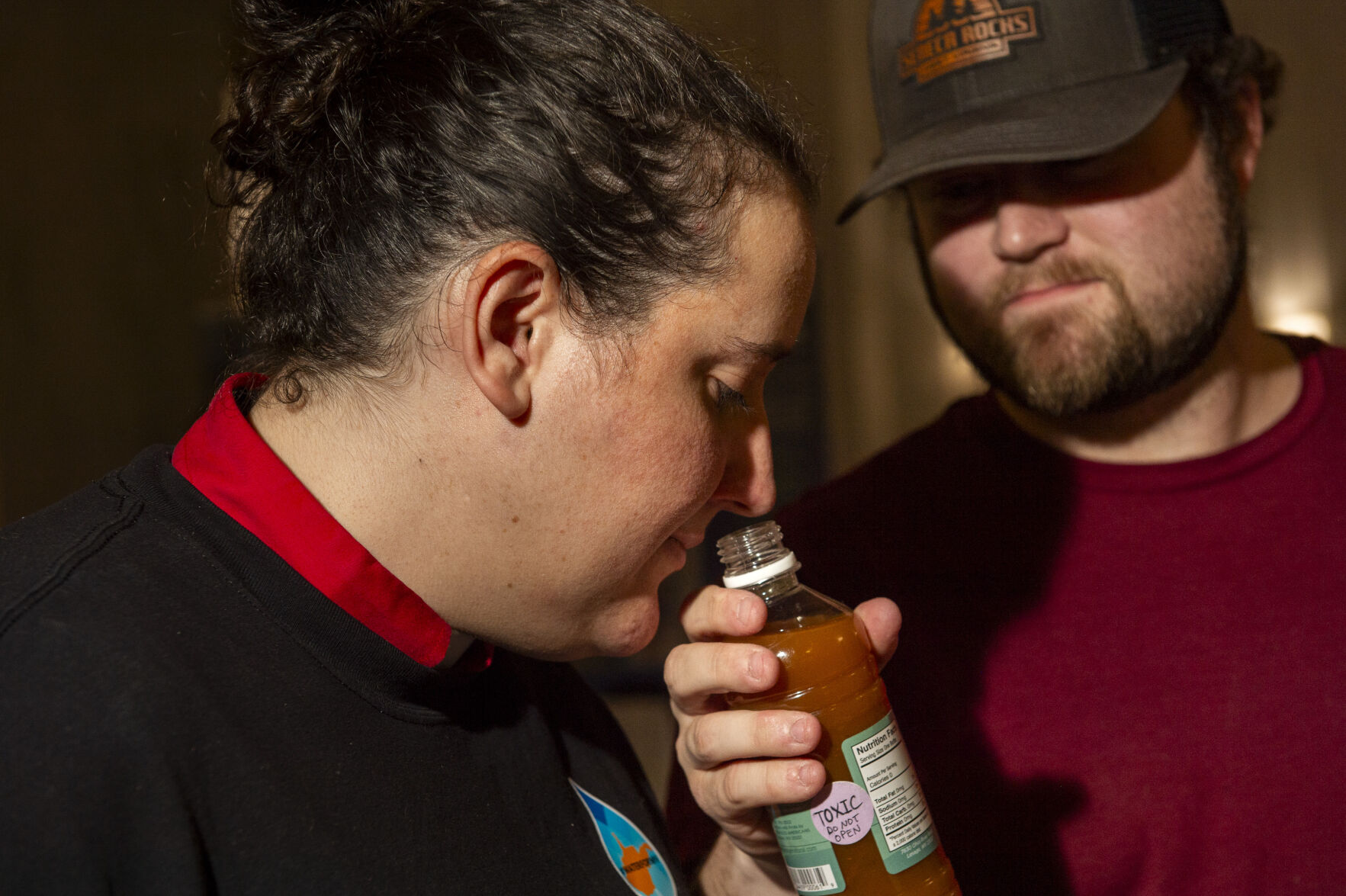
The Rev. Caitlin Ware (left), of Jackson County, smells a bottle of water collected near the Man, Logan County home of Jake Frye (right) after a news conference hosted by From Below at the West Virginia State Capitol Rotunda in Charleston, Monday, Feb. 16, 2026. “It ain’t right, it’s not supposed to smell like that,” Frye said, describing it as metallic.
Rev. Caitlin Ware (center right) holds a sign reading “I thirst” at a news conference hosted by From Below: Rising Together for Coalfield Justice at the West Virginia State Capitol Rotunda in Charleston, Monday, Feb. 16, 2026.
LAURA BILSON | Gazette-Mail
Editor's note:This report was supported by the Pulitzer Center and is part of a Gazette-Mail series on drinking water quality in West Virginia.
The Rev. Caitlin Ware was preaching not in a place of worship, but of woe.
Water woe.
“Here we are in this whitewashed tomb of a Capitol covered in gold,” Ware exclaimed, “and we have a state of people that don't have clean water.”
Ware was airing her grievance in the Upper Rotunda of the Capitol Thursday morning at a media event for the West Virginia Council of Churches’ annual Compassion Calls Us Day at the state Legislature.
Compassion, Ware argued, has been too hard to come by from West Virginia political leaders for parishioners and other southern coalfield neighbors she’s gotten to know as a United Methodist pastor in Jackson, McDowell, Mingo and Wyoming counties.
The Rev. Caitlin Ware (left), of Jackson County, smells a bottle of water collected near the Man, Logan County home of Jake Frye (right) after a news conference hosted by From Below at the West Virginia State Capitol Rotunda in Charleston, Monday, Feb. 16, 2026. “It ain’t right, it’s not supposed to smell like that,” Frye said, describing it as metallic.
LAURA BILSON | Gazette-Mail
Ware is codirector of From Below: Rising Together for Coalfield Justice, a coalfield social justice initiative of the West Virginia Faith Collective that has advocated for greater water infrastructure investment in southern West Virginia.
Speaking at the Capitol Thursday, Ware relayed what it has meant for friends of hers in the southern coalfields to live with discolored, foul-smelling water.
It has meant going to a waterfall when recovering from surgery to get cleaner-looking but potentially bacteriologically compromised water to bring back and boil for bathing because the water at home burns human skin.
It has meant cracking a window open so fumes don’t build up when bathing — in cold water.
It has meant spending $150 every month on bottled water.
It has meant rashes on children’s skin.
“We must repent, we must lament and we must confess,” Ware said. “And here we are today trying to hold this state accountable to do something about it.”
In 2024, West Virginia had the nation's highest percentage of public water systems with health-based Safe Drinking Water Act violations, 29.2%, according to a Gazette-Mail analysis of U.S. Environmental Protection Agency data.
Health-based violations represent the exceedance of maximum contaminant or residual disinfectant levels. Acute health-based violations represent significant short-term health risks that can cause immediate illness.
West Virginia’s percentage of public water systems with any kind of violations has climbed sharply from 32.1% in 2015 to 79.1% in 2024.
The West Virginia Department of Health said in an emailed response provided by Department of Environmental Protection Chief Communications Officer Terry Fletcher that the DOH attributes the state’s comparatively high violation rate to “increased oversight at the state and federal level along with small and disadvantaged public water systems that lack financial resources, have aging or failing infrastructure, lack of system maintenance and overall lack of technical, managerial, and financial capacity.”
The DOH said it lacks water quality data that support a decline in water quality across the state over recent years, despite the EPA data suggesting just that.
Area water testing results have shown levels of iron and manganese well above reporting limits.
The EPA has assigned iron and manganese secondary maximum contaminant levels — guidelines to help public water systems manage drinking water for aesthetic considerations, like taste, color and odor.
But although contaminants aren’t thought to pose a human health risk at the secondary maximum contaminant level, according to the EPA, their presence throughout southern West Virginia and other Mountain State communities makes for water that most wouldn’t call potable.
“This is not only an infrastructure failure. It is a moral failure,” the Rev. Cindy Briggs-Biondi, of St. Mark’s United Methodist Church in Charleston, said at Thursday’s gathering. “It is a basic need. Water is life.”
West Virginia Delegate Adam Vance (left), R-Wyoming, stands before the House of Delegates Energy and Public Works Committee at its Tuesday, Feb. 17, 2026 meeting at the Capitol.
But the West Virginia Legislature has taken steps away from cleaner water in its annual regular 60-day legislative session that ends March 14.
On Friday, the Republican supermajority voted 84-12 — mostly along party lines — to approve an environmental rules package that includes one proposed rule that would weaken a standard for how much selenium an element with toxic effects for West Virginia’s aquatic life is allowed in fish tissue.
Toxic human exposure can happen when selenium levels build up in ecosystems via leaching from mining waste into aquatic systems and emissions from burning coal or other industrial activities.
Excessive levels of selenium are linked to chronic health impacts that include lack of mental alertness and listlessness, skin discoloration and hair and nail loss, according to the U.S. Environmental Protection Agency.
Water quality experts and advocates say West Virginia lawmakers are signing off on the DEP selectively using EPA science to weaken the fish tissue standard while dismissing the EPA’s recommendation for a more protective water limit.
But the DEP has joined the West Virginia Coal Association and West Virginia Manufacturers Association in backing the legislative package, bundled as Senate Bill 256. The package now goes before the Senate for it to concur with a minor change made to the measure on the House side after it sailed through the Senate.
The House on Thursday rejected an amendment proposed by all nine House Democrats that would have guarded against what the West Virginia Rivers Coalition has called the DEP selectively using EPA science to weaken the fish tissue standard while dismissing the EPA’s recommendation for a more protective water limit.
“I think we should be making rules and policies in the broader public interest that protect West Virginians who fish and eat fish from West Virginia waters, and West Virginians who are concerned about clean water across the state,” Deputy Minority Leader Evan Hansen, D-Monongalia, cofounder of Morgantown-based environmental consulting firm, said of the DEP in the only House floor speech on the measure Friday.
The House Energy and Public Works Committee on Tuesday advanced to its markup and passage stage legislation in House Bill 5525 that would create a “Southern West Virginia Clean Water Fund” to be used in water emergencies or to upgrade infrastructure so residences can get clean water.
But HB 5525’s appropriation of $10 million for water quality improvement programs in Boone, Fayette, Greenbrier, Lincoln, Logan, McDowell, Mercer, Mingo, Monroe, Raleigh, Summers, Wayne, and Wyoming counties would be only a tiny fraction of the hundreds of millions estimated to be required for desperately needed water and sewer infrastructure upgrades across the area.
Roughly $1.73 billion is how much a report prepared for the Appalachian Regional Commission and published in August estimated comprised West Virginia’s drinking water needs when accounting for the state’s 414 community water systems — and not the thousands of West Virginians still relying on undocumented private wells or roadside springs thought to harbor greater health dangers.
From Below, the group co-led by Ware, had called for $250 million to be drawn from the state’s Rainy Day Fund for approved, shovel-ready water improvement projects in the southern coalfields, whose utilities have struggled to pay for upgrades to aging, outdated infrastructure amid dwindling customer bases.
From Below and other water quality advocates say the Legislature and Governor’s Office are guilty of long-term underinvestment in southern coalfield drinking water quality.
Of 161 projects awarded as of December 2024 through the state Water Development Authority’s American Rescue Plan Act-seeded Economic Enhancement Grant Fund, just four — 2.5% — were for water or sewer projects in Boone, Logan, McDowell, Mingo and Wyoming counties, according to a Gazette-Mail review.
The Water Development Authority is a revenue bond bank that provides financing for local water and wastewater projects. It drew intense criticism and a lawsuit from the American Humanist Association in October 2024 for approving a grant award of up to $5 million from the Economic Enhancement Grant Fund — a fund that mainly has been used to support water and wastewater projects — for a newly launched Catholic school in Ohio.
“To echo Rev. Dr. Martin Luther King Jr., we do not have time for the tranquilizing drug of gradualism,” the Rev. Brad Davis, Ware’s fellow From Below codirector and elder in the United Methodist Church serving five churches throughout McDowell County, said at a From Below-led “Rural Rally for Safe Water” in front of the House Chamber Monday.
'I'm a realist'
Ware had a different audience Tuesday — West Virginia legislators themselves.
Ware testified to the House Energy and Public Works Committee as it considered HB 5525 that there have been “major funding gaps” between project costs and what communities can pay.
In March 2025, the Lincoln County Commission voted to approve the dissolution of the Lincoln PSD and the sale of its assets to investor-owned West Virginia American Water, by far the state’s largest water utility, pending legal review.
HB 5525’s sponsor, Delegate Adam Vance, R-Wyoming, an underground coal miner, indicated Tuesday that the bill is in his fellow lawmakers’ hands in the House Energy and Public Works Committee.
Delegate Bob Fehrenbacher, R-Wood, a former plant manager at the Chemours Company, a chronic Ohio River water polluter, asked Vance why HB 5525 requires the DEP to adopt drinking water quality standards that meet “or exceed” EPA standards.
“To be honest, delegate, when I went to bill drafting and had the bill put in, I told them what I wanted as far as the fund created and all that, and this was in it, and I knew you guys were a lot smarter than what I am and you could figure things out like that,” Vance said. “Whatever our standards are now, I’m not asking for anything in the state to be lifted above.”
Fehrenbacher, who has favored less stringent environmental regulations as chair of the House Energy and Manufacturing Subcommittee, said HB 5525’s appropriation of $10 million would be “a drop in the proverbial bucket.”
“I’m not sure that we would meet your intended outcome with the proposed funding there,” Fehrenbacher told Vance. “And I guess, collectively, I would suggest that we try to get our heads together and come up with a workable solution [for which] the funding stream will deliver the desired outcome.”
Vance responded that he was “a realist.”
“Other people talked about $500 million, some said $250 million, things of that such,” Vance said. “I’m a realist. I’m not going to come and ask for that kind of money even though we need it. It’s a hard stretch for me to believe that I can get $500 million out of this body, out of the Senate and off the governor’s desk.”
But the Hope Scholarship, the state’s nonpublic school vouchers program that provides families public money to have their children leave the public school system, has been projected by the Morrisey administration to cost roughly $300 million by fiscal year 2027. In September, the state Treasury projected just the 2026-27 school year budget would be $244.5 million if 100% of newly eligible students participated in the scholarship.
That $244.5 million would more than double the $120 million the state averaged in water and sewer project investments per year from 2017 through 2024, according to an estimate in an American Society of Civil Engineers report released in December.
The Legislature did not respond with legislative action in its 2024 session after Vance said in a House floor address that the well water of residents in the Indian Creek area of Wyoming County was contaminated. Vance asked then for “tankers full” of water.
“If I have to beg, I’ll beg,” Vance said during a 2024 House floor session. “But I need some help for my people.”
Vance told the Energy and Public Works panel Tuesday that southern coalfield residents don’t think lawmakers are heeding their water quality needs.
“Not on this specific issue or any issue, to be honest with you,” Vance said. “Every constituent I’ve talked to for four years, number one, it’s water, [they think that] nobody cares about southern West Virginia.”
“My folks feel the same way,” said Delegate Josh Holstein, R-Boone, who became West Virginia Republican Party chairman last year.
'Will we be here possibly next session?'
Assistant Majority Leader David Green, R-McDowell, said at Tuesday’s Energy and Public Works panel meeting that “just throwing money at a situation is not going to be the solution to this problem.”
That’s where the Gov. Patrick Morrisey-pushed HB 5210 comes in.
HB 5210, advanced to markup and passage stage by the panel Wednesday, would allow private utilities to be eligible for low-interest loans through the Water Development Authority. Although it would prioritize issuance of loans to public utilities, it has drawn criticism that it could direct resources away from needy public utilities.
HB 5210 would authorize the state Public Service Commission to order utilities which are exempt from being ordered to acquire a distressed or failing utility to enter into a memorandum of understanding to ensure that the distressed or failing utility continues to properly function while the PSC identifies an alternative acquiring utility.
“Ultimately, at least from my perspective, the intent is to privatize the system,” Davis told the Gazette-Mail. “It seems to me that in essence this would be the Hope Scholarship fund of infrastructure. Public tax dollars will be funding private entities.”
HB 5210 would institute a one-year mandatory improvement period for utilities on an existing state watch list that could be extended to 18 months if the utility makes a “substantial effort to participate.”
The PSC has overseen 25 distressed or failing water or wastewater utility cases under SB 739 since 2020, an average of five per year.
The PSC had determined 30 water and wastewater utilities to be potentially unstable as of Oct. 24, according to a “watch list” of such utilities it prepared as required by state law.
But most cases on the watch list aren’t older than one year, meaning HB 5210 isn’t poised to accelerate a distressed or failing utility designation that allows the PSC to order the acquisition of a utility meeting that definition by what the agency deems the most capable “proximate” utility.
West Virginia Rural Water Association executive director Todd Grinstead declined to comment. West Virginia American Water spokesperson Olivia Bailey said merely that the company was “aware of the bill and following its progress." Water Development Authority acting executive director Brad Sergent did not respond to a request for comment.
“Will we be here possibly next session? I don’t know, though,” Katie Franklin, deputy general counsel for Morrisey’s office, said at Wednesday’s meeting when Fehrenbacher asked if lawmakers would be talking about funding again next session – or in another two or three years. “I really don’t.”
Mike Tony covers energy and the environment. He can be reached at mtony@hdmediallc.com or 304-348-1236. Follow @Mike__Tony on X.