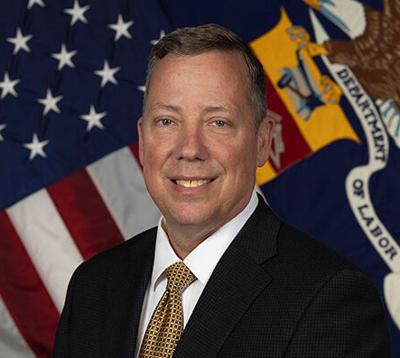
A Charleston native is the U.S. Mine Safety and Health Administration’s temporary leader as it launches a new fight against unions and lung experts looking to preserve the agency’s own landmark rule to protect miners from toxic silica dust.
Joining MSHA as its deputy assistant secretary for policy on April 21 was James McHugh, who had been an attorney at Charleston- based Pence Law Firm PLLC, whose core clients have been coal operators.
An MSHA spokesperson said, on April 18, McHugh would lead MSHA until the Senate confirmation of Wayne Palmer as assistant secretary for mine safety and health.
Palmer, who President Donald Trump nominated to lead the agency, was an executive at an industrial trade group that filed formal comments in favor of weakening exposure limit and penalty provisions in 2023 during the proposal stage of a rule MSHA finalized in April 2024 lowering the permissible exposure to respirable crystalline silica.
The rule finalized under then-MSHA leader Chris Williamson, a Mingo County native, followed years of pressure from miner allies for stronger agency protection amid a sharp rise in black lung disease among increasingly younger miners driven by silica inhalation.
MSHA drew the ire of miner advocates on April 8 by announcing it was pausing the rule for four months, six days before the compliance date for coal mine operators.
MSHA declined to make McHugh available for an interview, asking for questions via email instead. The agency then did not respond to questions about McHugh, the future of the silica rule and any reconfiguration of inspection and oversight responsibilities following a Trump administration notice that leases of 33 MSHA offices have been terminated, including two in Nicholas and Wyoming counties.
McHugh’s background
McHugh had been an attorney at Pence Law Firm from January 2013 until this month, according to his LinkedIn profile.
McHugh has more than 20 years of experience representing businesses, individuals and labor unions in West Virginia in civil, criminal and administrative cases, including MSHA and Occupational Safety and Health Administration-related matters, according to a page on McHugh on Pence Law Firm’s website removed after the Gazette-Mail inquired about McHugh to MSHA.
The new MSHA leader was a prosecuting attorney for Jackson County from January 2009 to December 2012, according to his LinkedIn profile. He retired as a colonel from the Army National Guard, according to his Pence Law Firm and LinkedIn pages.
McHugh is a graduate of Purdue University and the West Virginia University College of Law, per his LinkedIn page.
MSHA fights UMWA, physicians’ efforts to intervene
MSHA on Thursday put up a fight against unions and medical professionals looking to reenact the silica rule.
The agency submitted federal court filings opposing efforts by the United Mine Workers of America, United Steelworkers and American Thoracic Society to intervene in the case.
The unions and, separately, the ATS, an organization of physicians, scientists, researchers and respiratory therapists whose goal is to prevent, treat and cure respiratory diseases, filed motions to intervene last week. The parties cited uncertainty over the rule’s future, questioning whether the agency still supports it.
In its announcement that it was delaying enforcement of requirements in the rule, MSHA cited sweeping Trump administration staff cuts within the National Institute for Occupational Safety and Health and concern they could impact supply of certified respirators and personal dust monitors.
In its court filings fighting the unions and health professionals Thursday, MSHA argued their motions to intervene are untimely and haven’t rebutted a presumption the agency is “adequately representing the public interest” in the case.
MSHA said the concerns cited by the ATS and unions aren’t evidence-based, ignoring that the agency hasn’t changed its legal position on the rule’s validity or indicated it would no longer defend the rule.
The ATS had said in its filing it wants to see the silica rule enforced as soon as possible, predicting enforcement would start improving protections for miners and help lower the burden on resources of physicians trying to treat miners with silica dust-related diseases.
But MSHA cited case law to argue doctors can’t challenge the government relaxing public safety requirements just because more people might show up in doctors’ offices or emergency rooms.
In its new filings, MSHA again cited NIOSH staff cuts, suggesting its compliance date delay is “good government” not meriting intervention.
Production, profits dwarf costs for industry
Industry groups have claimed the silica rule is too onerous.
In an April 2 court filing by industry groups led by the National Stone, Sand and Gravel Association, an executive at one of the nation’s most prominent coal companies with subsidiaries near Davis and Wheeling listed what he indicated were high costs of abiding by the rule.
Kenneth Murray, vice president of operations at Alliance Coal LLC, said his company and its subsidiaries estimated costs of roughly $2.3 million of past and ongoing investments for compliance preparation at company subsidiaries by the rule’s April 14 effective date.
Murray reported one-time expenses of $5 million each at three longwall operations, including Mettiki Coal near Davis and Tunnel Ridge LLC near Wheeling, comprising a $15 million investment. Murray also asserted it would cost $1.9 million annually to support compliance efforts.
Murray’s report projected first-year expenses to comply would exceed $19 million for Alliance Coal.
But Tulsa, Oklahoma-based parent company Alliance Resource Partners L.P.’s total revenue for 2024 was $4.89 billion, according to a U.S. Securities and Exchange Commission filing. That means the first-year silica rule compliance costs projected by Alliance Coal — Alliance Resource Partners’ mining operations holding company — would comprise just 0.39% of its parent company’s 2024 revenue.
Alliance Resource Partners reported $45 million in holdings of bitcoin, a cryptocurrency. That is more than double Alliance Coal’s first-year compliance costs alone.
Alliance Resource Partners sold 33.3 million tons of coal in 2024, meaning its rule compliance costs would amount to $0.57 per ton sold.
American Consolidated Natural Resources, which has subsidiaries that operate West Virginia coal mines, would have considerably lower rule compliance costs, company corporate safety director Edwin “Pat” Brady indicated in the industry groups’ April 2 court filing.
ACNR needed to invest roughly $517,000 in March and April 2025 to prepare to comply with the rule, according to Brady. ACNR also needed to spend approximately $982,000 for the rest of 2025 for compliance, subject to other unknown costs, Brady reported. The company needed to invest roughly $1.5 million annually going forward to comply with air sampling provisions in the rule, per the filing.
St. Clairsville, Ohio-based ACNR has reported producing around 30 million tons of coal per year, meaning first-year compliance expenses quantified by Brady would cost $0.10 per ton of coal produced.
The average annual sale of bituminous coal, which ACNR subsidiary operations have produced, was $97.96 per short ton in 2022, according to U.S. Energy Information Administration data.
MSHA lease termination notices loom over uncertain future
The Trump administration’s hiring freeze and voluntary resignation offers have decreased the MSHA workforce, which is threatened further by lease termination notices it has posted for 33 MSHA field offices in a signal those offices could be shuttered. The Department of Labor, MSHA’s parent agency, has declined to comment on its personnel and lease oversight.
The General Services Administration, which manages federal property and provides contracting options for government agencies, has said it’s reviewing options to optimize federal footprint and building use.
The ATS noted in its filing that black lung cases are rising among young miners, suggesting less time in mines is needed to trigger risk of serious pulmonary disease.
“If the Silica Rule is vacated, absent its protective measures, it is reasonable to conclude that the patient pool of miners with severe silica-related disease will continue to grow, leading to increased patient demand and strain on already-overburdened clinics and ATS members,” the ATS warned.