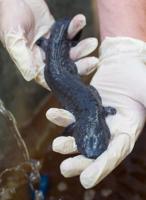
After a decade of legal maneuvering, the eastern hellbender, a salamander known to reside in a number of cool, clear West Virginia streams, is now being proposed for Endangered Species Act protection by the U.S. Fish and Wildlife Service.
In 2010, the Center for Biological Diversity (CBD) and a coalition of conservation groups petitioned the Fish and Wildlife Service to seek endangered species status for the salamander, once known to exist in 626 populations spread through West Virginia and 14 other eastern and midwestern states.
But recent data indicate that only 371 populations now remain, with about 60% in a state of decline and only 12% considered stable, according to the Fish and Wildlife Service.
The eastern hellbender is one of two subspecies of hellbenders known to exist in the U.S. The other subspecies — the Ozark hellbender, which occurs in Arkansas and Missouri — was listed as endangered in 2011. In 2021, a distinct Missouri population segment of the eastern hellbender also achieved endangered species status, but the remaining eastern hellbender populations were denied similar protection.
A court challenge by the CBD and its allies to list all eastern hellbender populations as endangered ensued, leading to an announcement last month by the Fish and Wildlife Service that it now favors Endangered Species Act protection for the salamander, which can grow up to 29 inches long and weigh more than four pounds.
“The eastern hellbender is a unique salamander that plays a crucial role in maintaining healthy freshwater ecosystems,” said Will Meeks, the service’s Midwest regional director. “As key indicators of stream and river health, hellbenders need protection that also will help support healthier ecosystems throughout their range.”
Eastern hellbenders, North America’s largest salamanders, have been known to live up to 30 years, all of it underwater. They spend much of their time dwelling under large, flat rocks on streambeds, from which they ambush their prey, mainly crayfish.
Hellbenders breathe through their skin, which contains numerous folds to increase oxygen absorption. Their primary threats are stream sedimentation, pollution, habitat loss and pet trade collection, according to the Fish and Wildlife Service.
According to the Center for Biological Diversity, hellbenders are considered living fossils because they have changed little over the past 160 million years.
CLICK HERE to follow the Charleston Gazette-Mail and receive