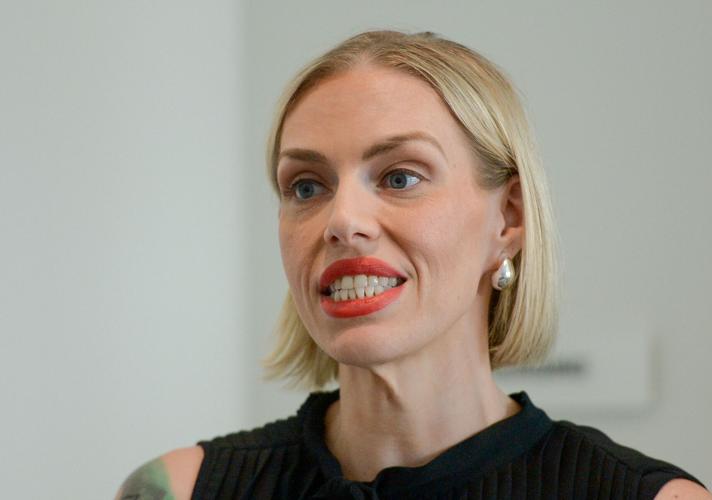
West Virginia Delegate Kayla Young, D-Kanawha, speaks during the opening of a nursing station at the Charleston Coliseum and Convention Center June 12, 2025.
Four members of the West Virginia Legislature signed onto a national bipartisan letter this week opposing a policy under consideration by Congress that would allow the federal government to preempt state regulations on artificial intelligence.
The letter was signed by 280 state lawmakers from across the country, including West Virginia’s own Sen. Patricia Rucker, R-Jefferson, and Delegates Kayla Young, D-Kanawha; Bill Ridenour, R-Jefferson, and Margitta Mazzocchi, R-Logan.
In the letter, lawmakers expressed their “strong opposition” to any federal policy that would prohibit states from implementing and enforcing their own regulations on AI. They also shared concerns over how federal preemptive measures on the technology could undo and undermine laws already in place.
“As state lawmakers and policymakers, we hear regularly from constituents about rising online harms and the growing influence of AI on their lives,” the letter reads. “In the years ahead, AI’s impact will require lawmakers to consider consequential public policy questions, making it essential that states retain the authority to act.”
The opposition to federal preemption over AI comes after a similar provision to stop state regulation was pulled out of the One Big Beautiful Bill Act due to bipartisan opposition earlier this year. That provision would have implemented a 10-year moratorium on state and local AI regulations.
Sen. Patricia Rucker, R-Jefferson.
W.Va. Legislative Photography
“I was one of the people that wrote in protest of the provision that would have preempted AI regulation in the Big Beautiful Bill, so when I saw that they’re attempting to do it again, obviously I still feel the same way. Not much has changed here in the past few months,” Rucker said. “I still feel that it is not acceptable that the federal government is trying to co-opt state’s rights when it comes to this, and no, I am not okay with that.”
Trump considers an executive order
After its failure in the One Big Beautiful Bill Act, national news outlets reported in November that the Trump administration was considering an executive order to ban state regulation on AI. On Nov. 21, Reuters reported that the executive order effort was being put on pause.
Instead, according to Punchbowl News, the executive branch and House Majority Leader Steve Scalise, R-La., want to see the same preemption provision included in the National Defense Authorization Act. That legislation sets the budget and policy priorities for the nation’s military and defense infrastructure over the upcoming fiscal year.
Currently, there is little to no oversight for AI nationwide. Some localities have already passed their own laws to regulate the technology and, in some cases, ban it from being used for certain purposes. They’ve also implemented certain penalties for individuals who use the technology to promote harmful deepfakes, misinformation and more.
Proponents for federal preemption over AI regulation have said they don’t want there to be a patchwork of different policies state-to-state regarding the technology. AI industry leaders — specifically companies that create the AI technology in question — support federal control over regulation as opposed to state control. They worry that state regulation could stifle innovation. Under the current administration, it’s likely that federal regulation would be more lax compared to the approach taken in some states.
Rucker said she’s concerned over the AI industry — dominated by deep-pocketed tech companies and venture capitalist firms — benefitting from a lack of regulation that could ultimately harm regular citizens.
“I know that this push is, again, being pushed by big-money interests and that is very hard for the average American to fight,” Rucker said. “I worry that they’re trying to take advantage of the average citizen not really paying attention to [the National Defense Authorization Act].”
West Virginia Delegate Kayla Young, D-Kanawha, speaks during the opening of a nursing station at the Charleston Coliseum and Convention Center June 12, 2025.
Gazette-Mail file photo
Young said she holds similar concerns. She said it’s easy to boil an issue like this down to politics, but the concerns are much deeper than that and it’s clear that both President Donald Trump and his administration are betting big on AI development as well as political support from the industry’s leaders.
This week, the White House signed an executive order to “accelerate” the use of AI in scientific research. That followed numerous other executive orders meant to increase the use and dependence on AI in numerous sectors, including education, energy and more.
And Trump, as well as other political leaders, have grown closer to those who head AI companies and others that create the hardware they rely on to operate.
“I don’t want to be hyper-political, but Trump has all the billionaires in his pocket on this. This is why they [the federal government] want to regulate it,” Young said. “They want to be able to do whatever they want to do, and a lot of times they want to do it with state and federal dollars, but they don’t want any safety provisions. That’s a problem and it’s one we should be able to confront as elected lawmakers.”
Bipartisan support gives Rucker 'hope'
Young and Rucker both said they were grateful that the fight against federal preemption continues to be so bipartisan. None of the concerns around the industry are partisan, Young said. Rucker said it “gives [her] hope” to see pushback come from both sides of the aisle in time of high political polarization.
“It shows that at the end of the day, people can really win if they put special interests aside, then if we just all focus on putting the people forward — which is our job to do as the government and what we’ve been elected to do as state [lawmakers],” Young said. “We’ve seen that happen and be successful in bipartisan ways. There’s bipartisan AI bills all over the country ... that shows that we can just put the politics aside and put people first, but we need to have the right to do that.”
CLICK HERE to follow the Charleston Gazette-Mail and receive