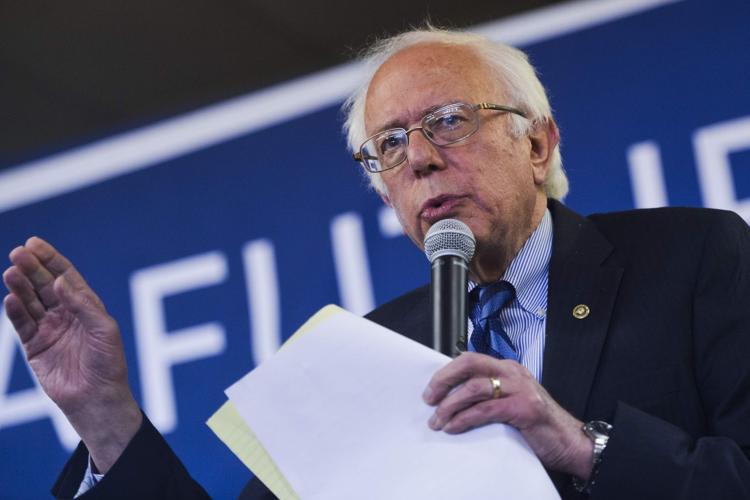
Sen. Bernie Sanders, I-Vt., speaks to a sold-out Charleston Municipal Auditorium at a Feb. 12, 2017, antipoverty town hall.
Gazette-Mail file photo
“Government by the few.”
That’s Merriam-Webster’s first and most succinct definition of oligarchy, the target of a nationwide tour that will bring Sen. Bernie Sanders, I-Vt., to West Virginia this weekend.
Sanders will have more than four words to spare on that form of governance when his Fighting Oligarchy tour hits Wheeling on Friday before heading to Lenore, in Mingo County, and, lastly, Charleston on Saturday.
“[W]hat we are hearing loudly and clearly is the American people say no to oligarchy, say no to authoritarianism and say no to an economy in which the rich are getting richer or working people are struggling,” Sanders said at a Harrisburg, Pennsylvania, tour stop on May 2.
Sanders’ West Virginia journey will come just over a month after President Donald Trump signed into law a far-reaching budget reconciliation package projected by nonpartisan experts to benefit the wealthy by paying for an extension of tax cuts favoring those in the top income brackets via Republican-led Congress’ deep cuts to Medicaid and Supplemental Nutrition Assistance Program funding.
There’s evidence that the rich have gotten significantly richer in West Virginia — and that the government is being shaped by an increasingly smaller share of West Virginians.
The top three household income brackets recorded by the Census Bureau – those making $100,000 or more – comprised 25% of all West Virginia households in 2023, per U.S. Census Bureau data.
In 1950, the top three family income brackets — those making at least $6,000 at the time — comprised only 6.6% of West Virginia families, as categorized in Census Bureau records then.
The Census’ bottom three income brackets — those below $25,000 — comprised 22.1% of West Virginia households in 2023, meaning nearly one in every four households drew an income of only $2,083 per month or less. Those same income brackets comprised 15.2% of U.S. households, nearly seven percentage points fewer than West Virginia’s share.
In Mingo County, the second stop on Sanders’ Mountain State itinerary, 15.4% of households were in the Census’ top three income brackets at $100,000 or higher, dwarfed by the 38.7% of households with incomes under $25,000 in the bottom three income brackets.
The U.S. Gini index, a measure of income inequality, has climbed 20.5% since 1980, according to World Bank Group data.
Meanwhile, the share of West Virginians voting to decide who leads the nation has dropped over time.
West Virginia’s presidential election votes per 100,000 people fell 3.3% from 1952, the year of the state’s highest overall number of votes, to 2024. The U.S. rate grew 13.6% over that span, suggesting that West Virginia’s presidential election voter participation has atrophied amid its long-term population decline.
During his Fighting Oligarchy tour, Sanders has recalled to receptive audiences — many in Republican-controlled states — the coterie of ultrarich people at Trump’s second inauguration, on Jan. 20.
Vermont independent Sen. Bernie Sanders visits McDowell County in 2016 during his campaign for the Democratic Party's presidential nomination.
Gazette-Mail file photo
Sitting in seats usually reserved for the president’s family and previous presidents, that group included Amazon CEO Jeff Bezos, Meta CEO and Facebook founder Mark Zuckerberg and Tesla CEO and X owner Elon Musk, the world’s richest person, who co-launched the Department of Government Efficiency within the Trump administration before departing in May.
“[W]hen we talk about oligarchy, I want you think back three months or so ago when Trump was inaugurated,” Sanders said in his Harrisburg address, noting those and other billionaires had flanked Trump, whose net worth the business magazine Forbes estimates is $5 billion. Amazon and Meta each contributed $1 million to Trump’s inaugural committee.
Last month, the Trump Vance Inaugural Committee Inc. reported having netted donations totaling roughly $240.5 million, a big-money postscript to an election cycle in which megadonors heavily bankrolled both Trump’s and Democratic nominee Kamala Harris’ campaigns.
“I would say the overwhelming majority of Americans — again, regardless of your political view — do not believe that billionaires should be buying and selling politicians,” Sanders said to robust applause at the Harrisburg tour stop.
Research finds 'people like me' discounted
But there’s research to suggest that a privileged few have long been determining the course of a government nominally for all.
“The vast discrepancy I find in government responsiveness to citizens with different incomes stands in stark contrast to the ideal of political equality that Americans hold dear,” political scientist Martin Gilens wrote. “Although perfect political equality is an unrealistic goal, representational biases of this magnitude call into question the very democratic character of our society.”
Gilens, then an associate professor in Princeton University’s Department of Politics, made that observation in a 2004 paper drawing from 754 national survey questions from 1992 through 1998.
Gilens found that when Americans with different income levels varied in their policy preferences, actual policy outcomes strongly reflected the preferences of the most affluent but bore virtually no relationship to the preferences of poor or middle-income Americans.
“Most Americans think that public officials don't care much about the preferences of ‘people like me,’" Gilens wrote in his paper. “Sadly, the results presented above suggest they may be right.”
Gilens and Northwestern University political scientist Benjamin Page found in a 2014 paper that affluent people and corporations have significantly more influence over federal government policy than average citizens.
The researchers used a data set of 1,779 policy issues over a 30-year period to estimate how much influence affluent citizens — organized interest groups — and ordinary citizens each have on policy outcomes. They found that affluent citizens, those at the 90th income percentile, had the most influence, followed by organized interest groups. The preferences of average citizens had no discernable impact on policymaking, the researchers determined.
“If democracy means that all citizens should have a say in shaping government policy, our findings cast doubt upon just how democratic U.S. policymaking actually is,” Gilens said in a 2014 statement.
In “Oligarchy in America: Power, Justice, and the Rule of the Few,” a book published in October 2024, author and Baylor University associate communication professor Luke Winslow wrote that “democratic oligarchy” is an “institutional arrangement in which the ultrarich create a discrete class consciousness based on leveraging the state to accumulate wealth.”
Winslow observed that oligarchs can’t be voted out of office and don’t need to bribe judges because they’re already legally protected.
“[O]ligarchs are different from you and me, but not just because they have more money,” Winslow wrote. “Oligarchs are different because they use that money to bridge the economic-political chasm in a way the rest of us cannot.”
'Corporations have no consciences'
On Sanders’ most recent tour stop, on June 22 in Fort Worth, Texas, he contended there is no political objective more important than ending “this disastrous Citizens United Supreme Court decision.”
In a 5-4 vote along ideological lines, the conservative-majority U.S. Supreme Court in 2010 found in Citizens United v. Federal Election Commission that corporate funding of independent political broadcasts in candidate elections can’t be limited. The majority held that political speech is essential in a democracy, even if the speech comes from a corporation.
In a dissenting opinion, then-Justice John Paul Stevens observed that “corporations have no consciences, no beliefs, no feelings, no thoughts, no desires.”
“Corporations help structure and facilitate the activities of human beings, to be sure, and their ‘personhood’ often serves as a useful legal fiction,” Stevens wrote. “But they are not themselves members of ‘We the People’ by whom and for whom our Constitution was established.”
Those points help explain why “corporate electioneering” is more likely to “impair governmental interests,” Stevens asserted.
The Supreme Court’s Citizens United v. FEC decision enabled “super PACs,” and other outside groups funded by a handful of wealthy donors, to make a pivotal impact on the 2024 presidential election, the Brennan Center for Justice at the New York University School of Law, a law and policy institute, found in a January 2025 analysis.
A super PAC, or political action committee, is an independent expense-only committee that can receive unlimited contributions from individuals, corporations and other PACs. Super PACs may not contribute to or coordinate directly with candidates.
The Brennan Center noted that although Trump trailed Harris significantly in traditional campaign contributions subject to legal limits and required to be disclosed, he outsourced much of his campaign to super PACs and wealthy donor-powered groups.
The Brennan Center said those groups took on core general election functions to an unprecedented degree, including door-to-door canvassing and get-out-the-vote efforts.
"Their activities unquestionably would have been illegal before Citizens United,” the Brennan Center said.
Make America Great Again Inc., a Super PAC, reported spending over $363.4 million in 2024, much of it spent on ads criticizing Harris.
The Brennan Center noted that the donors who funded Trump’s campaign and used other resources to help him, most prominently Musk, played an unprecedented role in his presidential transition, including crafting policy and meeting with world leaders.
In December 2024, Musk’s opposition to a bipartisan plan to avoid a congressional budget shutdown, which included false claims about its contents, set the stage for then-President-elect Trump to come out against the measure, effectively dooming it.
“[F]rom the right to the left, everybody understands that we have a corrupt campaign finance system,” Sanders told the Harrisburg crowd.
Poll finds party split on oligarchy view
Most contributions to the campaign committees of West Virginia’s members of Congress come from out-of-state supporters, with significant backing supplied by other committees rather than individuals.
Of the over $2.88 million in total contributions netted in the 2026 election cycle so far by the campaign committee for Sen. Shelley Moore Capito, R-W.Va., nearly $1.71 million, or 59.2%, has come from political committees, rather than individuals, according to the committee’s latest campaign finance report.
A plurality of voters, including over 60% of Democrats and independents, reported thinking the country is moving toward an oligarchy in polling results published in March 2025 by Data for Progress, a national progressive think tank.
Just 36% of voters said they could confidently explain what the term “oligarchy” means to someone else. But when asked to select the definition of "oligarchy," 55% of voters, including 68% of independents, chose correctly.
When asked to select whether “oligarchy” or “democracy” better describes the U.S., voters were split, with Democrats picking oligarchy by a 32-point margin and independents choosing oligarchy by a 14-point margin. Republicans selected democracy by a 34-point margin.
Sanders has argued for viewing oligarchy through a working-class lens rather than a political party prism. He has signaled he hopes West Virginians see a shot at a fairer future there.
“[I]f we understand that, at the end of the day, 99% is a hell of a larger number than 1%, if we have the courage to go outside of our zones of comfort, talk to other people, talk to your Republican friends, they don’t think that billionaires should get tax breaks,” Sanders said in his May 2 Harrisburg speech. “[L]et us stand together. Let us defeat oligarchy.”
Mike Tony covers energy and the environment. He can be reached at mtony@hdmediallc.com or 304-348-1236. Follow @Mike__Tony on X.