
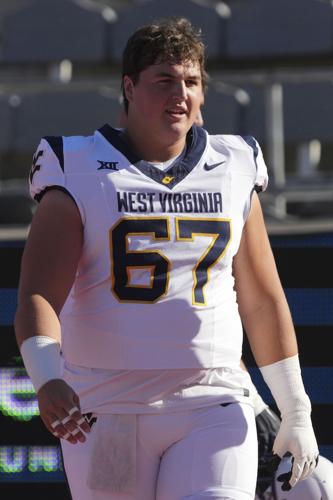


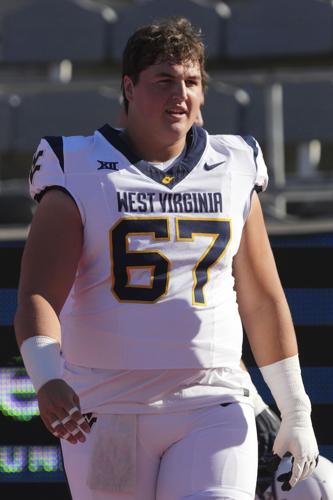
MORGANTOWN — When Landen Livingston was performing a hip-hop dance at a competition in Chicago or putting on a show for the crowd in a parade at Disney World, most probably didn’t look at him and think, “That guy would make a great center.”
But almost a decade after giving up competition dancing as a ninth-grader — when forced to make a choice between dancing and football — West Virginia University’s junior center is looking back on those experiences more than ever.
“I’m very fortunate to have that experience,” explained Livingston, who said he started dancing at the age of 5, a requirement from his mother, and competed across the country in tap, musical theater and hip-hop. “I really feel like that’s been a benefit for me playing offensive line, with footwork and stuff like that.”
While many think about the offensive line being all about power, it’s also critical to have good footwork, agility and speed, especially in the Mountaineers’ new-look approach under first-year head coach Rich Rodriguez.
“This offense really deals with speed, so that’s been a huge adjustment,” said the Leo, Indiana, native, who helped his high school team to enormous success and was rated among the top 20 offensive line prospects in the country.
“As a center, I know that the offense can only go as fast as I get set. So, in my head as the play is going on, I have to make sure I find the ball, find the ref and get set. I know the offense is to be run fast, and that’s something that I try to continue to get better at.”
While going fast — at least the ultra-fast tempo that Rodriguez’s “Spot the Ball” offense requires — is a bit different than what Livingston experienced his first three seasons in Morgantown under Neal Brown, No. 67, who played in parts of seven games last season, sees some clear advantages to WVU’s new style.
“One huge benefit of this offense is that it’s super simple,” he said. “There’s not much to think about, because you’re going so fast.
“We have a lot of playmakers that can make plays. We go so fast, and with all the playmakers we have, it makes it easy. We just get set and keep going.”
When things don’t go as planned, there’s no time to sulk.
“They always talk about a next-play mentality,” he said. “This offense deals with that. Even in practice, if you mess up, it’s on to the next play and you have to bounce back.”
Livingston isn’t only dealing with a new offense, he’s also learning a new role. Last year, the 6-foot-4, 293-pounder often came in the game in the middle of a series, if there was an injury, or late in a game that was already decided. He stayed quiet and learned from some great examples.
“I think I’ve had a great opportunity to have players ahead of me that have taught me a great deal — guys like Zach Frazier, Wyatt Milum, Brandon Yates,” he said. “All those guys have taught me things.”
Now, the student has become the teacher, as one of the lone returners up front for the Mountaineer offense. It’s a major adjustment, but it’s one Livingston is taking in stride.
“A big part of it is being a vocal leader,” he said of his new assignment. “There’s an expectation with all offensive lines throughout the country. The offensive line here needs to be the definition of hard edge. There’s no excuse for us to not have that mentality every play. Trying to instill that into our O-line has been something that we continue to get better at every day — on the field and off the field.”
As one of the few at WVU with experience, Livingston has also taken on the responsibility of bringing the group together.
“As an offensive line, it’s easy to get in that brotherhood mentality,” he explained. “From the day that they got here, we had an instant connection. Those guys are great guys. There’s nobody I would rather have next to me than the guys in that room. I’m fortunate to have them with me.”
In a season filled with change, there’s one thing Livingston wants to see stay the same, and that’s WVU’s production in the run game, anchored by the men up front.
Last fall, the Mountaineers averaged more than 195 yards per game on the ground, and they were even better in 2023, averaging 228.
Rodriguez’s offense at Jacksonville State also relied heavily on the ground game last season, averaging 251.1 rushing yards per contest. For WVU to find success in 2025, similar run production is critical, and Livingston sees no reason why it’s not possible.
“I think we have great backs,” he said, pointing out that in Rodriguez’s offense a chunk of the rushing production also comes from the quarterback position. “I love running the ball, and I’m glad to continue the O-line tradition.”
And if those backs need some help with their end zone dance, their center will be ready with some instruction.


