A mix of clouds and sun. A stray shower or thunderstorm is possible. High 79F. Winds SSW at 5 to 10 mph..
Tonight
Partly cloudy this evening followed by increasing clouds with showers developing after midnight. Low near 65F. Winds light and variable. Chance of rain 40%.
A miner gathers his thoughts before taking part in a Mine Safety and Health Administration rescue mission at the Sago Mine disaster on Jan. 3, 2006 in Tallmansville, Upshur County.
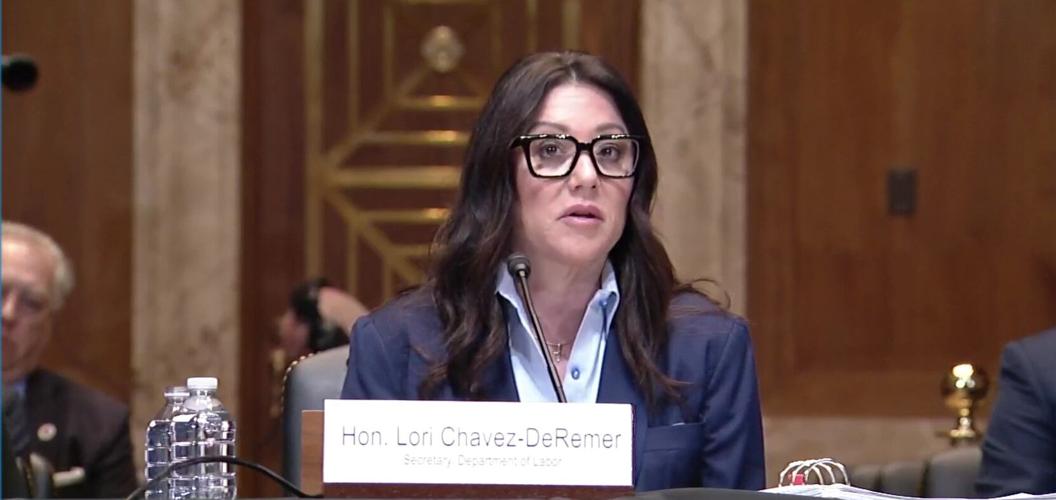
U.S. Department of Labor Secretary Lori Chevez-DeRemer addresses the U.S. Senate Labor, Health and Human Services, Education, and Related Agencies Appropriations Subcommittee at a May 22, 2025 hearing on the department's fiscal year 2026 budget request.
The U.S. Mine Safety and Health Administration has signaled stability for some field offices whose fate has been unclear amid a Trump administration push to dramatically slash the agency’s resources.
A miner gathers his thoughts before taking part in a Mine Safety and Health Administration rescue mission at the Sago Mine disaster on Jan. 3, 2006 in Tallmansville, Upshur County.
HARAZ N. GHANBARI | AP photo
Leases for 34 MSHA offices have been retained and are not closing or being considered for closure, a spokesperson for the Department of Labor — MSHA’s parent agency — told the Gazette-Mail Thursday.
The Department of Labor has been working with the General Services Administration to ensure that MSHA inspectors “have the resources they need to carry out their core mission to prevent death, illness, and injury from mining and promote safe and healthy workplaces for American miners,” the spokesperson said in an email.
The General Services Administration, which manages federal property and provides contracting options for government agencies, did not respond to a request for comment. The agency previously said it was reviewing options to optimize federal footprint and building use.
The Trump administration’s hiring freeze and voluntary resignation offers have decreased the MSHA workforce, which has been threatened further by lease termination notices it posted for 33 MSHA offices in a signal those offices could be shuttered.
Those included offices in Summersville, Nicholas County, and near Pineville, Wyoming County. The former office was no longer posted as terminated on the Department of Government Efficiency’s website at doge.gov/savings Thursday, but the latter still was. The Department of Government Efficiency is a new commission the Trump administration has charged with cutting federal spending.
Department of Labor spokespeople did not respond to requests for comment on the long-term status of the office near Pineville.
U.S. Department of Labor Secretary Lori Chevez-DeRemer addresses the U.S. Senate Labor, Health and Human Services, Education, and Related Agencies Appropriations Subcommittee at a May 22, 2025 hearing on the department's fiscal year 2026 budget request.
Department of Labor Secretary Lori Chevez-DeRemer told the Senate Labor, Health and Human Services, Education, and Related Agencies Appropriations Subcommittee last week she intended for MSHA offices to stay open and retain their leases, adding that such a move would be under the General Services Administration’s purview.
Chevez-DeRemer’s update came in response to Sen. Shelley Moore Capito, R-W.Va., the subcommittee’s chair, who said she was worried office closures would reduce mining inspections.
“It’s tough to get from one place to the other in case of an emergency,” Capito said. “It can really create a lot of lag time if we don’t have [the] MSHA there with our companies and our workers to not just be protective but react in case of an emergency.”
Other MSHA resource cuts loom over miner safety
The horizon for MSHA resources has been dark under the Trump administration.
Carey Clarkson, national vice president with the National Council of Field Labor Locals union that represents MSHA employees, told the Gazette-Mail in March a President Donald Trump-ordered hiring freeze cut off the hiring process for 90 people who had been offered MSHA positions. Roughly 120 more employees were lost after they took a voluntary resignation offer as the Trump administration looks to dramatically downsize the federal workforce.
Clarkson said MSHA barely had enough staff to perform required inspections before those losses, let alone “spend quality time” on mines that need greater enforcement.
MSHA’s 1,747 full-time equivalent positions and $387.8 million appropriated for fiscal year 2023 were 26% and 21.3%, respectively, below their fiscal year 2009 amounts when adjusting for inflation, according to MSHA budget plans for those years.
Those declines were much steeper than a concurrent 13.8% decline in the nation’s mines, meaning MSHA’s resources decreased faster than the mines it was created to regulate.
Much of the agency’s long-term staffing decline came during the first Trump administration. Approved MSHA positions fell 18% to 1,866 full-time equivalents from fiscal years 2016 to 2020.
'Our miners deserve better than to be used as pawns'
The feds’ revelation that many MSHA offices aren’t headed for closure was applauded by miner allies who have been advocating against resource cuts within the agency.
“The idea that anyone would even consider shuttering dozens of MSHA field offices, most of which are located in remote mining communities, shows a fundamental misunderstanding of what it takes to keep miners safe,” United Mine Workers of America International President Cecil Roberts said in a statement Friday.
The UMWA called on the General Services Administration and the Department of Labor to “provide full transparency” about which offices are still at risk, and to stop any remaining efforts to “reduce the government’s mine safety infrastructure.”
“Our miners deserve better than to be used as pawns in a campaign of bureaucratic cost-cutting,” Roberts said.
"I'm happy they're going to keep these MSHA offices open," National Black Lung Association President Gary Hairston, of Beckley, said in a statement Thursday, saying offices near mines are needed so that MSHA can perform safety inspections and respond timely to accidents.
Hairston, who quit mining coal in 2002 at 48 after his black lung diagnosis, called on MSHA to enforce a landmark rule it finalized last year designed to reduce exposure to toxic silica dust that has driven up black lung disease incidence among increasingly younger miners in central Appalachia.
Days before the rule’s compliance deadline for coal mine operators last month, MSHA issued a notice to stakeholders that it would temporarily pause enforcement of requirements in the rule until Aug. 18.
MSHA’s announcement followed a federal court putting the rule on hold Friday at the request of industry groups who argued it was too far-reaching and reported the agency had been unresponsive to their request for a court-issued rule pause.
MSHA’s notice announcing the rule pause cited sweeping Trump administration staff cuts within the National Institute for Occupational Safety and Health, saying they could impact supply of certified respirators and personal dust monitors.
The rule lowered the permissible exposure for respirable crystalline silica to the limit recommended in 1974 by the NIOSH.
Feds renew legal fight versus unions over silica rule
Department of Labor attorneys dug in on Tuesday in the Trump administration’s fight against unions looking to preserve the silica rule in federal court, submitting a filing asking the U.S. Court of Appeals for the Eighth Circuit to deny a pending motion by the UMWA and United Steelworkers to reconsider the court’s denial of the unions’ previous move to intervene in the case.
The unions have questioned MSHA’s argument that the unions’ requested intervention would potentially delay the case, saying the only issues they would possibly reopen are those which have created delays in the silica rule’s effective date.
Dr. Drew Harris, University of Virginia pulmonologist and medical director of the Stone Mountain Health Services' black lung program serving southwest Virginia, approves of the feds moving away from some cutback plans but said Thursday that more work is required to halt a black lung crisis.
“[W]e need all the support and resources available to protect coal miners from dangerous dust exposure,” Harris said in a statement.
CLICK HERE to follow the Charleston Gazette-Mail and receive