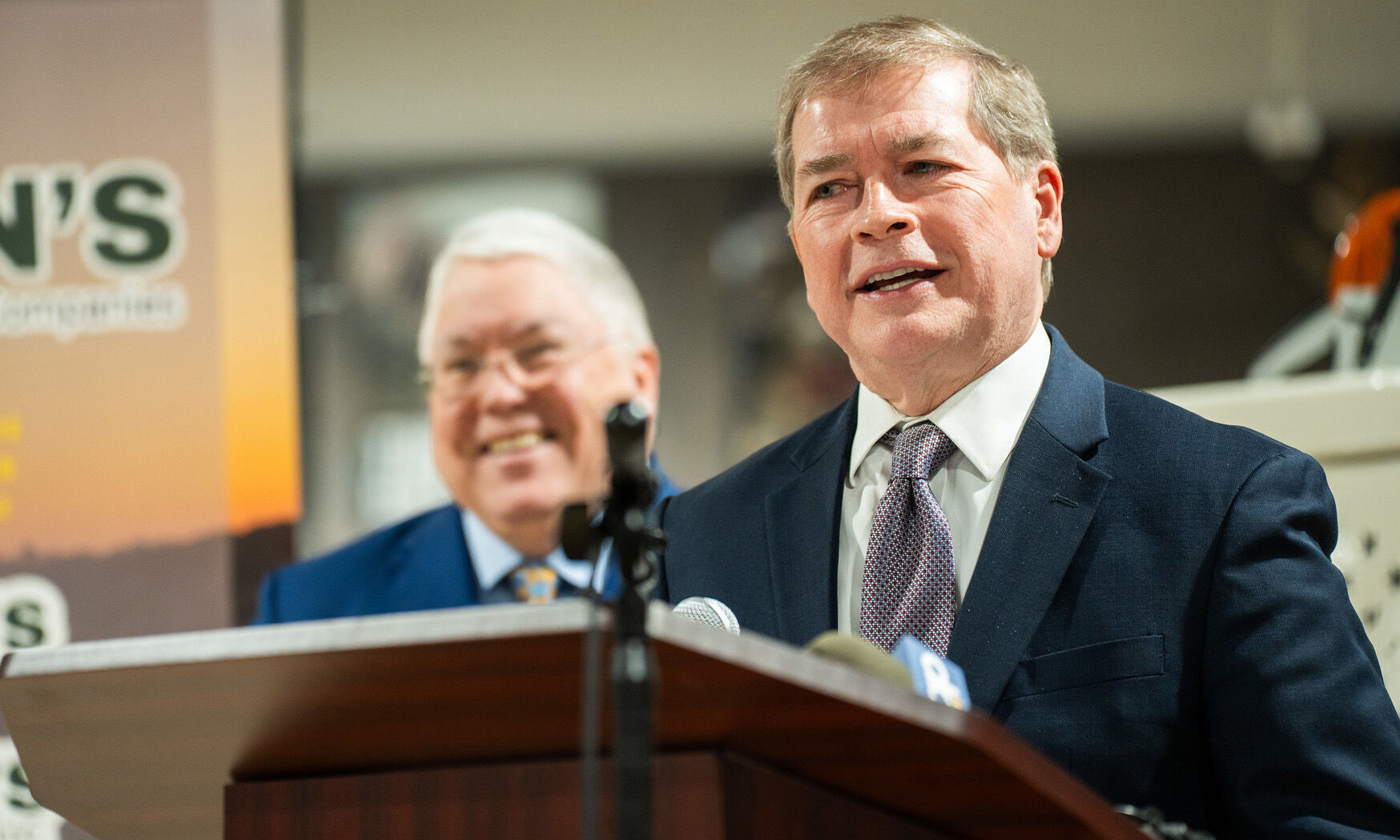
Anti-tax advocate Grover Norquist (foreground) and Gov. Patrick Morrisey are shown, on Thursday, Jan. 29, 2026, at Green’s Supply Depot in Parkersburg.
Anti-tax advocate Grover Norquist (foreground) and Gov. Patrick Morrisey are shown, on Thursday, Jan. 29, 2026, at Green’s Supply Depot in Parkersburg.
Courtesy photo
With national anti-tax advocate Grover Norquist at his side, Gov. Patrick Morrisey pledged Thursday to work with the West Virginia Legislature to implement a 10%, across-the-board reduction in state income taxes by the end of the year.
"We have to continue to double down on investing in our economy and ensuring that the free market works, and one of the best ways to do it is lowering the state income tax," said Morrisey, speaking at a news conference held at Green's Supply Depot in Parkersburg.
Morrisey first floated his tax-cut plan on Jan. 5. The governor said Thursday the "improved regulatory and tax environment" that has taken shape during his first year in office played a role in landing more than $4 billion in commitments to build two natural gas power generating plants and a coal reformation plant in the state in recent months.
"When you see such progress, you have to keep doubling down on the type of policies that are going to make your state more attractive than the other states you touch," Morrisey said. "We have to have stronger economic policies and lower taxes than Ohio, Kentucky, Pennsylvania, Virginia and Maryland."
While a 5% income tax cut has been built into the state's budget for the coming fiscal year, Morrisey has asked the Legislature to work with him to reduce state income taxes by another 5% by the end of the year, which he said was a "realistic proposal."
"There's growing support in the Legislature for a 10% across-the-board income tax cut," he said.
Pushback on Morrisey’s tax plan
Speaking following Morrisey’s Jan. 5 tax cut announcement, Kelly Allen, executive director of the West Virginia Center on Budget and Policy, told the Gazette-Mail, “I’m shocked to hear [Morrisey’s] analysis that there’s extra money lying around that we can turn into tax cuts when the need is obviously so great.”
Allen described the state’s collection of $128 million in 2025 above general revenue fund estimates — a fund which is largely driven by both consumer sales tax and personal income tax collection — as not being “a surplus in terms of everything is well funded, and we have all this money left over that we don’t need for schools, Medicaid or other public services.”
When asked following Morrisey’s State of the State address on Jan. 14 if a 10% reduction in personal income tax is affordable, State Treasurer Larry Pack was hesitant, telling the Gazette-Mail, “I think we have to really see what his budget priorities are. If we can figure out how to do it, I think we need to do it. But we have to have a bigger margin than $128 million.”
Norquist: State tax cuts can make W.Va. attractive to new residents
After detailing his tax-cut plan, Morrisey invited Americans for Tax Reform President Grover Norquist — who he said he has known for decades — to speak.
"We live in a country that was started as a tax revolt," Norquist said. "The British decided they were going to tax us a little more, and we asked them politely to go away, and then we started shooting at them, and they left," he joked.
Historically, income tax cuts at the federal level, Norquist said, "have led to strong economic growth, more investment, and more people working with better pay."
Income tax cuts at the state level, Norquist said, can make states with lower taxes more attractive "to people who are deciding where to work, where to start a company or where to invest in a factory or a power plant. If you have decided to do business in the United States, there are still 50 decisions to make."
But income tax cuts may be less impactful in lower-income states like West Virginia since they are regressive by design, generally yielding more dollar savings for those with greater incomes.
Income tax cuts also may hamper long-term economic growth by swelling budget deficits. Critics, like Allen, hold that governments should avoid income tax cuts because they may disproportionately benefit wealthier households, but instead pay down public debts that have been used to justify spending cuts to public services, including programs targeted by the Trump administration like Medicaid and Supplemental Nutrition Assistance Program.
Norquist said there are currently eight states with no income taxes, and another 12 states that have committed to gradually taking their income tax rates down to zero, "among which, West Virginia is among the leaders."
With income tax reduction efforts underway in West Virginia and all its bordering states but Virginia, "this region is en route to tremendous growth and opportunity," Norquist said.