
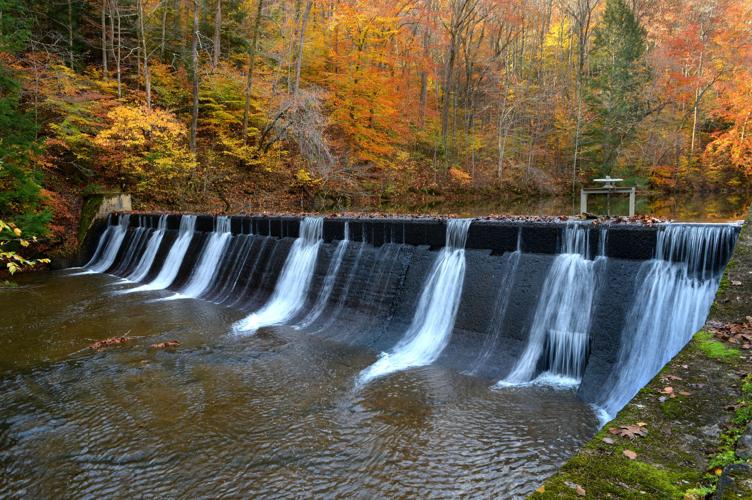

A plan to bring trout fishing to a section of Davis Creek upstream of Ellison Lake at the main entrance to Kanawha State Forest includes the removal of the dam creating the 2.2-acre pond.
Removal or breaching of the dam would improve the fishery and solve a costly problem of silt build-up — currently more than eight feet deep — in the pond behind it, according to state Department of Environmental Protection and Division of Natural Resources officials.
“We’re looking at the choice between what is essentially a dead pond versus a healthy stream,” said Ed Maguire, environmental advocate for the DEP. Maguire said the pond now holds only about 18 inches to two feet of water, due to the more than 30,000 cubic feet of silt that has accumulated beneath it.
As a condition of its permit to surface mine a 413-acre tract that included the headwaters of Davis Creek tributaries that flow through the forest below the dam, Keystone Industries agreed in 2014 to dredge the pond at its expense, once mining activity ended. In 2016, following a series of violation notices and temporary cessation orders, the DEP signed a consent order with the coal operator that brought activity at the KD#2 mine to a halt, except for reclamation work.
Some dredging did occur at the pond since then, Maguire said, but it soon became evident that there was not enough undeveloped flat land within the forest to dispose of the silt. Hauling the silt to an off-forest site on narrow access roads posed safety and logistical problems, and added to the cost of dredging the pond.
While the mine operator would have borne the cost of an initial dredging of the pond, estimated at $300,000 to $500,000, the pond receives enough silt to require repeated dredging every three to five years, Maguire said.
Meanwhile, as Maguire and others pondered the pond’s silt problems, a stream improvement project for Davis Creek between the pond and the forest’s swimming pool parking lot was in the planning stage as a candidate for construction through a grant from the DEP’s In Lieu Fee Program. The program allows DEP permit holders to mitigate for activities that harm the environment by paying a fee into a funding pool that finances substantial remediation work, rather than having permit holders complete smaller remediation projects on their own.
Maguire said the coal company that initially pledged to dredge the pond of silt has agreed to pay a yet to be determined assessment into the In Lieu Fee Program’s funding pool.
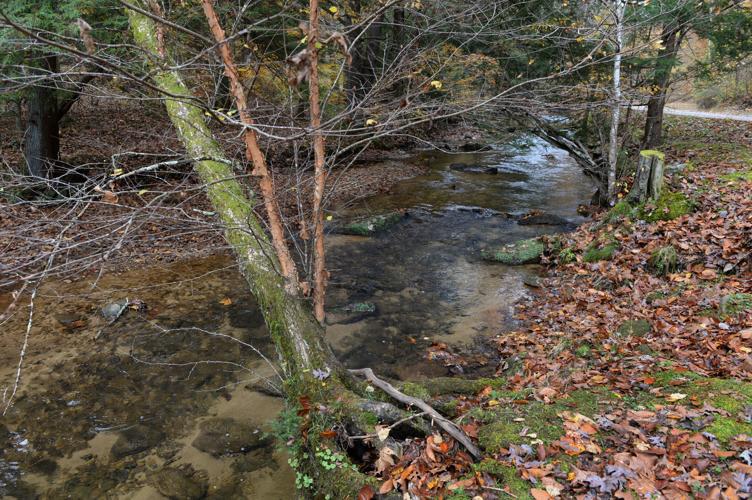
By removing the dam, the pond’s silt problem would be solved, and aquatic life in Davis Creek would be able to travel up and down the stream without impediment. Additionally, another 1,000 feet or so of trout-oriented stream improvements would be added to Davis Creek in the footprint of the pond to give Kanawha State Forest nearly one mile of trout stream enhanced with structures designed to create pools, maintain channels and stabilize banks.
At the site of the pond, a deep channel about half as wide as the current pond is envisioned, and will be made accessible to the Class Q anglers who use the current pond through the installation of ramps and piers.
Roger Wolfe, an engineer with the DNR’s planning, engineering and maintenance division, said Davis Creek’s water quality, flow rate and summer temperature in Kanawha State Forest is more than adequate to support a trout population.
With the planned stream structures, “we’ll have four to five times the habitat that’s here now,” he said. “The vision is to add to this project over the years and eventually improve Davis Creek for trout fishing as far upstream as it goes” in Kanawha State Forest.
In recent years, a few anglers have tried their hand at catching trout in Davis Creek above the dam, with some success, said KSF Superintendent Kevin Dials. Some of the fish being caught are escapees from the DNR’s once-yearly trout stockings in the pond. Others are suspected to be former fingerling trout raised from eggs by students in area schools taking part in Trout Unlimited’s Trout in the Classroom program, for which Davis Creek in KSF is a major release point.
Having a trout stream within a 15-minute drive of most of Charleston is expected to bring urban anglers to the stream to give it a try, and the stream should also draw capital city conventioneers interested in wetting lines after a day of meetings.
Some residents living downstream of the pond have expressed concern about the possible removal of the dam due to the threat of flooding. But Maguire said the 12-foot-high concrete structure, built by the Civilian Conservation Corps 78 years ago to create a swimming pond and beach, never included flood control among its functions, since it lacks a freeboard.
In fact, the pond was never officially used for swimming, either, due to high bacteria levels or a lack of upstream sewage systems.
Dials said many of those who consider the pond an iconic feature of the KSF landscape have already let him know that they disapprove of any plans to remove it. “We went through the same thing with the swimming pool when we had to close it,” he said.
“It is beautiful to look at when you’re driving by,” Wolfe said. “But it’s 18 inches of water over 10 feet of mud. It’s not a great place for fish to live in.”
It is expected to take 18 months to two years or more for the project, recently approved by a federal-state inter-agency review panel, to get the clearances needed for a final decision by the Huntington District of the U.S. Army Corps of Engineers. Several public hearings and informational sessions are anticipated.
Among other agencies, the State Historic Preservation Office will be tasked with signing off on the project, since the dam and pond were built by the CCC in a historic district listed on the National Register of Historic Places.
CLICK HERE to follow the Charleston Gazette-Mail and receive


