Tucker County resident Amy Margolies testifies at a West Virginia Air Quality Board hearing at West Virginia Department of Environmental Protection headquarters in Charleston on Dec. 3, 2025.
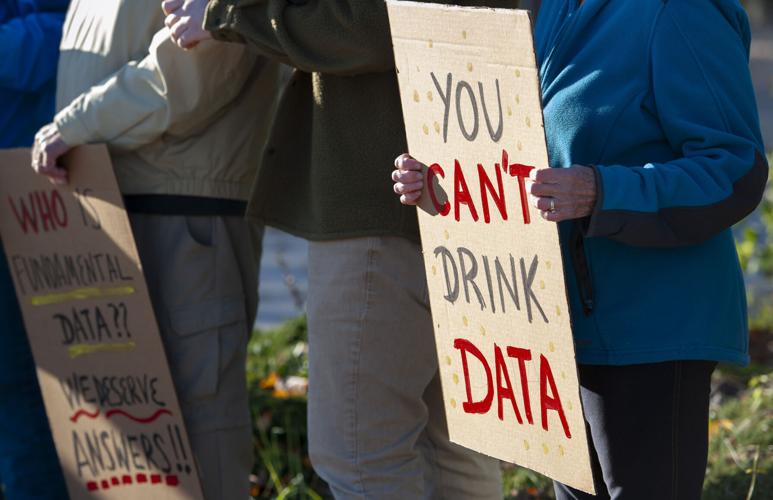
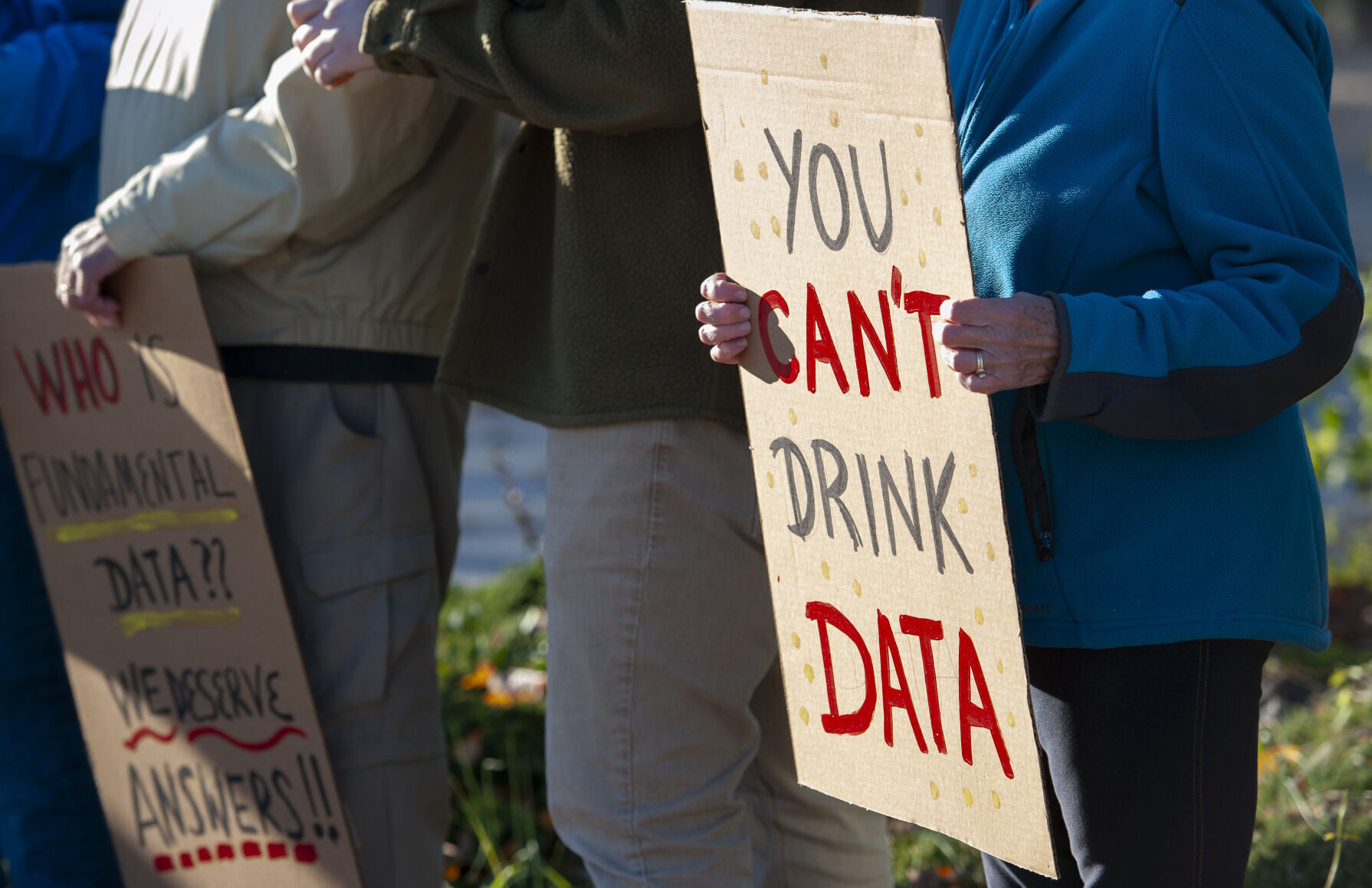
Protesters hold signs before a West Virginia Air Quality Board hearing held on Nov. 5, 2025, in response to community and environmental advocates' appeal of state Department of Environmental Protection approval of an air quality permit application for an expected data center in Tucker County at the DEP's headquarters in Charleston.
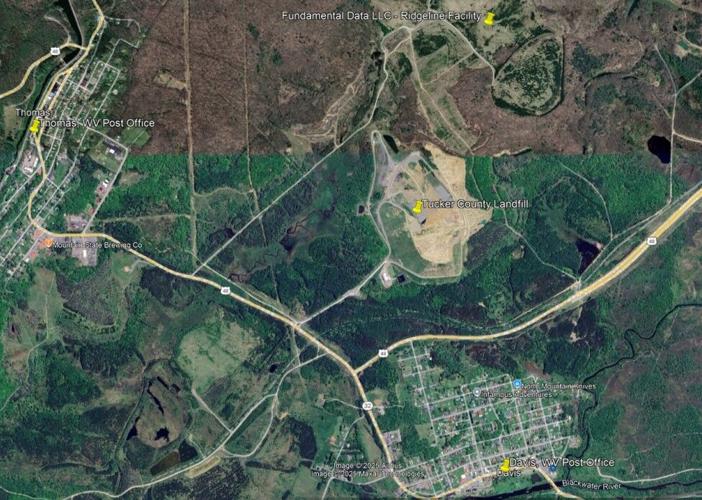
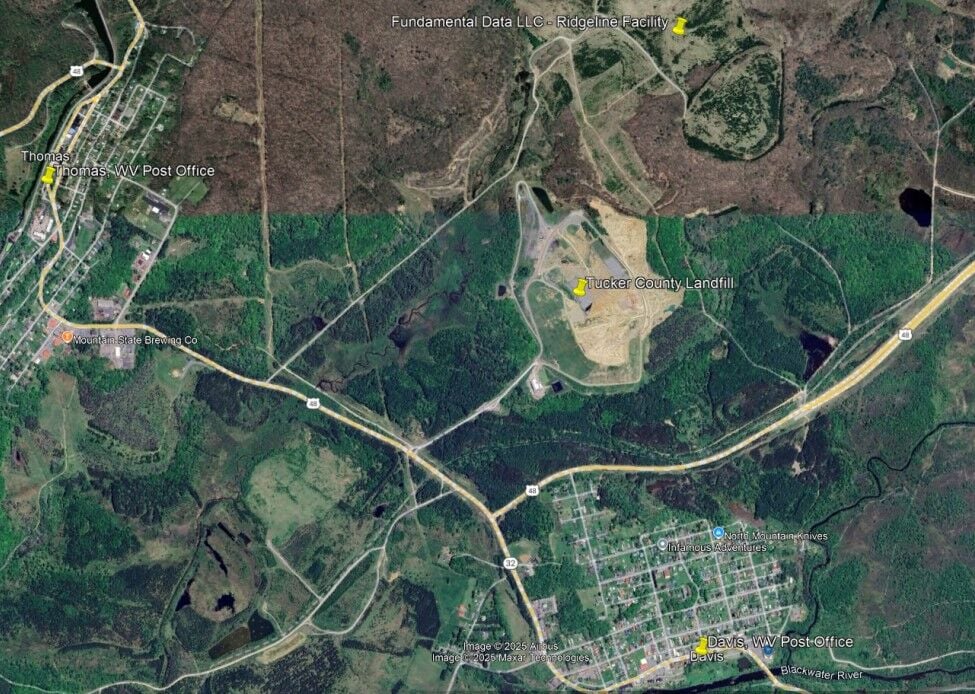
Pictured is a Google Earth aerial view of the site of a proposed gas-fueled turbine power facility in Tucker County West Virginia Department of Environmental Protection engineering evaluation, signed June 17, 2025, of a pending air quality permit application for the site from Fundamental Data LLC. The map includes markers for the proposed Fundamental site, the Tucker County Landfill and the Thomas and Davis post offices.
W.Va. Department of Environmental Protection | Courtesy photo
Pictured is a Google Earth aerial view of the site of a proposed gas-fueled turbine power facility in Tucker County West Virginia Department of Environmental Protection engineering evaluation, signed June 17, 2025, of a pending air quality permit application for the site from Fundamental Data LLC. The map includes markers for the proposed Fundamental site, the Tucker County Landfill and the Thomas and Davis post offices.
W.Va. Department of Environmental Protection | Courtesy photo
West Virginia’s decision-makers are further rolling out a welcome mat for data center developers.
But they’re keeping confidential to West Virginians what developers might be knocking on the state’s door — and what environmental baggage they might bring inside.
A panel of West Virginia lawmakers on Wednesday advanced a rule that would keep basic information about proposed “High Impact” data center projects confidential and hidden from public view, casting aside transparency concerns from West Virginians who fear they’ll have adverse financial and environmental impacts.
And on Thursday, a quasi-judicial state review board denied a bid by community advocacy groups to throw out a permit that the West Virginia Department of Environmental Protection granted to an expected data center operation in Tucker County that has kept the configuration of the proposed facility and information on turbines and pollution control devices it plans for the facility confidential.
“We are up against a system that clearly prioritizes corporations over people and public health at nearly every turn,” Olivia Miller, interim executive director of the West Virginia Highlands Conservancy, said in a statement responding to the review board’s decision.
It was the West Virginia House of Delegates Energy and Public Works Committee that, on Wednesday, advanced to markup and passage stage House Bill 4983, a measure authorizing the Department of Commerce to issue a legislative rule to set the framework for certifying a high-impact data center or microgrid district under another controversial piece of legislation, last year’s House Bill 2014.
HB 2014 is a 2025 state law that has drawn widespread opposition by stripping communities of local control and requiring most of the property tax revenue the projects would generate from local taxing bodies, a move estimated to cost counties and school districts millions.
The planned rule advanced by and within the Energy and Public Works Committee would deem confidential all petitions seeking certification of a high-impact data center and all letters of intent seeking certification of a microgrid district. A high-impact data center could be any data storage or equipment facility with a critical power demand of at least 90 megawatts. A microgrid district, under HB 2014, would be a zone up to 2,250 acres where electricity generated is used only within or delivered to the wholesale market.
It was the West Virginia Air Quality Board that on Thursday issued an order denying a wide range of the objections that Tucker United, a coalition of Tucker County residents and allies, the West Virginia Highlands Conservancy and the West Virginia Chapter of the Sierra Club filed in an appeal challenging the DEP’s September approval of an air quality permit application from Purcellville, Virginia-based Fundamental Data LLC for a gas turbine-powered facility near the town of Davis and city of Thomas in Tucker County.
The facility is expected to increase the concentration of air pollution in communities in Tucker and Grant counties as well as surrounding communities. The Air Quality Board rejected the community groups’ arguments that the DEP’s Division of Air Quality unlawfully granted Fundamental Data the right to have information in its permit application redacted as confidential business information.
The board also rejected the groups’ argument that the Division of Air Quality, or DAQ, unlawfully held the facility qualifies as a “synthetic minor source” of air emissions subject to less stringent regulations than major sources.
Tucker County resident Amy Margolies testifies at a West Virginia Air Quality Board hearing at West Virginia Department of Environmental Protection headquarters in Charleston on Dec. 3, 2025.
LAURA BILSON | Gazette-Mail file photo
“We believe in freedom, local control, and one set of rules,” Amy Margolies, a member of Tucker United, said Friday in response to the board’s order.
As a witness for the community groups in a hearing in their case against the DAQ in December, Margolies testified that her children’s school is less than 1½ miles from the proposed site.
The Air Quality Board’s order and advancement of the rule supporting the framework of HB 2014 — which had been requested by Gov. Patrick Morrisey — come as West Virginia legislators consider another bill requested by Morrisey – HB 4013, which would offer a multiform tax break to new data center, telecommunications, “data/information processing,” “technology intensive,” manufacturing, research and warehouse enterprises that invest at least $2.5 million or create at least 10 new full-time jobs in the state.
“Regular West Virginians are expected to follow the law and pay their taxes,” Margolies said, “while wealthy developers and tech companies get carveouts, secrecy and special treatment.”
Protesters hold signs before a West Virginia Air Quality Board hearing held on Nov. 5, 2025, in response to community and environmental advocates' appeal of state Department of Environmental Protection approval of an air quality permit application for an expected data center in Tucker County at the DEP's headquarters in Charleston.
LAURA BILSON | Gazette-Mail file photo
HB 4983 is in line with HB 2014’s mandate that any information provided by a data center that it identifies as confidential business information is exempt from the Freedom of Information Act. The law requires the Department of Commerce secretary to make available to the governor and Legislature a list of all certified high-impact data centers “and all relevant information,” with specifically identifying information to be removed to ensure confidentiality.
The planned rule advanced by the committee provides for appeal of the Department of Commerce secretary’s actions regarding a request for microgrid district certification, with all parties to be afforded an opportunity for hearing after at least 10 days' written notice — despite the planned rule’s emphasis on confidentiality.
House Minority Leader Pro Tempore Kayla Young, D-Kanawha, proposed an amendment during a Legislative Rule-Making Review Committee meeting last week that would have required the Department of Commerce to provide a redacted version of filings for public view when a developer applies for certification.
“[I]f the public wants to appeal, there's no way for them to appeal something that they don't know exists,” Young said.
But Department of Commerce Deputy Secretary and Office of Energy Director Nicholas Preservati took issue with Young’s amendment proposal, which the committee subsequently rejected.
“I don't think it's good practice for the agency to be determining what's confidential and what's not,” Preservati told the committee, saying disclosure could create a competitive disadvantage for applicant companies.
Delegate Evan Hansen, D-Monongalia, argued during Wednesday’s Energy and Public Works Committee meeting that HB 4983 should require that developers provide information to be made public regarding planned water withdrawals.
Large data centers can consume 3-5 million gallons of water per day — roughly 5-8% of the total amount withdrawn for public water supply throughout West Virginia in 2023, according to DEP data.
Hansen indicated at Wednesday’s meeting he would offer an amendment to add a water withdrawal reporting requirement to HB 4983.
Hansen, deputy minority leader and founder of Morgantown environmental consulting firm Downstream Strategies, has offered separate legislation in HB 4832 that would require owners of proposed high-impact data centers to submit to the DEP an analysis of:
Potential water quantity and quality impacts to state water resources for the proposed data center
The volume of water to be withdrawn, whether a state water pollution control permit will be required for water returns
If so, the expected pollutants regulated by the permit.
The state has set a DEP-overseen minimum reporting threshold of 300,000 gallons withdrawn from surface or groundwater sources in any 30-day period for water users. But Hansen's aim is to require data centers to disclose planned water withdrawal information before those withdrawals occur.
Fundamental Data breaks silence in response to new order
Groups challenging Fundamental Data's permit argued that:
The DAQ’s May 2025 decision to grant Fundamental Data the right to have information in Fundamental Data’s permit application redacted as confidential business information was unlawful
The DAQ failed to fully consider fugitive emissions sources as well as all possible pollutants
The DAQ unlawfully permitted the facility as a “synthetic minor source”
The DAQ failed to include sufficient compliance testing requirements in the permit
The Air Quality Board says in its order that Fundamental Data seeks to construct a data center powered by a natural gas and diesel-powered facility. Fundamental Data has been quiet about its plans for the site, not responding to requests for comment and not having a presence at DEP or community meetings regarding its proposal.
The Air Quality Board order acknowledges that a previous decision the board made has been appealed by the community groups to the West Virginia Intermediate Court of Appeals. In that September decision, the Air Quality Board dismissed a June appeal by the groups challenging the DAQ’s authority to grant Fundamental Data the right to redact information in its application.
The DAQ approved the permit application in August as a minor source, meaning the facility is to limit its emissions to fewer than 10 tons per year of any single hazardous air pollutant, 25 tons of aggregated hazardous air pollutants and 100 tons of any other regulated pollutant.
But the proposed facility has the potential to emit 99.35 tons per year of nitrogen oxides, and project critics have both objected to Fundamental Data’s air emissions projection calculations and contended the company didn’t make public enough information to properly evaluate those calculations.
At a December hearing, Margolies and the heads of the West Virginia Chapter of the Sierra Club and West Virginia Highlands Conservancy testified on their groups’ behalf.
West Virginia Highlands Conservancy president Marilyn Shoenfeld, a resident of the town of Davis near the proposed facility, estimated that school, library, food pantry sites and a new affordable housing development are all located within a mile of the proposed facility.
Shoenfeld estimated that school, library, food pantry sites and a new affordable housing development are all located within eight-tenths of a mile from the proposed facility.
Davis Mayor Al Tomson, a 26-year cancer survivor, said what he’s learned about toxic emissions has made it likely he would move himself and his family away if Fundamental Data sets up operations as proposed.
Ranajit “Ron” Sahu, an environmental and chemical engineering expert, testified that pollutants were underestimated in the permit because formaldehyde and other hazardous air pollutants are produced in larger quantities during startups and shutdowns because of incomplete combustion and less effective pollution controls at low temperatures.
Sahu contended the permit should require use of continuous emission monitoring systems for all pollutants for which those systems are available.
Former DAQ employee Jerry Williams testified as a DAQ witness that Fundamental Data’s confidential business information claims underwent DEP legal review. Williams and Joseph Kessler, a DAQ permitting program manager, testified in defense of parametric monitoring, which uses parameters other than direct emissions requirements to demonstrate compliance.
The board concluded:
A protective order it granted in November allowing the groups’ counsel access to all information in Fundamental Data’s application allowed the groups to present their case
The groups failed to provide evidence to support their objection to the DAQ granting the permit as a synthetic minor pollution source
The DAQ didn’t violate state statute by not requiring air dispersion modeling
Tucker County residents and leaders had urged the DEP to pursue air dispersion modeling for the facility. But in its response to comments released Friday, the DEP noted it doesn’t require modeling for new minor sources.
In that response, the DEP called dispersion modeling “resource intensive” and said it therefore uses federally established major-source thresholds for determining when modeling is required
Last month, a Tucker United-commissioned report via the Harvard T.H. School of Public Health's Dominici Lab was released estimating Fundamental Data’s planned operation could inflict up to $35 million in health-related damages.
The Air Quality Board did direct the DAQ to include two additional stack testing events into the permit’s requirements to take place during the second and sixth years of operation at the site, citing concerns that compliance is based on just one round of stack testing to show each turbine is operating as claimed by manufacturer data on which the permit is based.
In a statement released by Fairfax, Virginia-based Khoury Public Relations and Media Group Thursday, Fundamental Data welcomed the Air Quality Board’s order.
“Fundamental Data recognizes the significance of this project to nearby communities and remains committed to responsible operations and thoughtful communication as the project moves forward,” the company said. “This milestone sets the stage for what comes next at Ridgeline, and we look forward to sharing more in the near term.”
Fundamental Data did not respond to a request for additional comment.
DEP Chief Communications Officer Terry Fletcher said the DAQ would reissue the permit consistent with the Air Quality Board’s order and declined further comment.
The Air Quality Board’s order doesn’t bode well for two other appeals pending before it of DAQ air quality permit approvals for data center-linked operations in Mason and Mingo counties, for which hearings are scheduled in March and April, respectively.
'The imbalance is undeniable'
An emergency legislative rule providing the framework for HB 2014 filed in November to ensure that potential projects had a legal framework while the proposed rule passes through the legislative process originally limited a microgrid district to be certified by the state under the rule to 2,250 acres of “nearly contiguous property” and defined “nearly contiguous property” as two or more parcels of property separated by up to 1 mile at their closest point.
But as modified by the Legislative Rule-Making Review Committee, “nearly contiguous property” was expanded to mean two or more parcels forming a group in which the closest point between any parcel and another parcel in the group is up to 4 miles.
Tomson predicted to the Gazette-Mail Friday the previous definition would have prevented the proposed Ridgeline facility from being built less than a mile from Davis and an elementary and middle school.
“The imbalance is undeniable,” Tomson said. “Power plant and data center developers are consistently favored, while the public interest is repeatedly subordinated. Laws and regulations are bent, diluted or rewritten to accommodate private industry at the expense of the people they are supposed to protect. This has become the status quo in West Virginia — and until it changes, communities will continue to pay the price.”
Like Tomson, Margolies senses her community is being caught beneath a welcome mat being rolled out across West Virginia for data centers from Charleston — and that they’ll get walked all over if they don’t keep fighting.
“The state hands out tax breaks and special deals to data center companies – but we’re the ones who pay the price,” Margolies said. “For them, it’s just another project, but for us, it’s our lives."
Mike Tony covers energy and the environment. He can be reached at mtony@hdmediallc.com or 304-348-1236. Follow @Mike__Tony on X.