Sunshine and clouds mixed. A stray shower or thunderstorm is possible. High 79F. Winds SSW at 5 to 10 mph..
Tonight
Partly cloudy this evening followed by increasing clouds with showers developing after midnight. Low around 65F. Winds light and variable. Chance of rain 40%.
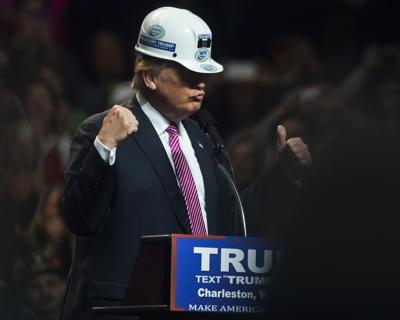
Wearing a coal miner's hard hat, Donald Trump flexes at a rally during his first presidential run at what was then called the Charleston Civic Center on May 5, 2016 after receiving an endorsement from the West Virginia Coal Association.
Wearing a coal miner's hard hat, Donald Trump flexes at a rally during his first presidential run at what was then called the Charleston Civic Center on May 5, 2016 after receiving an endorsement from the West Virginia Coal Association.
Gazette-Mail file photo
West Virginia is the country’s fifth-largest energy producer, but federal funding critical to ensuring a productive energy future for the state has flatlined even amid critical infrastructure needs that threaten its place as a power provider.
That’s the combined takeaway from two new reports that warn failures to diversify West Virginia’s anachronistically coal-heavy resource portfolio could sap the state of energy it needs to make long-sought economic and manufacturing progress.
One report, released Thursday by ReImagine Appalachia, a regional coalition of community and environmentalist groups, tracks what it concludes has been a dangerous flatline under the Trump administration of federal funding for West Virginia, along with Kentucky, Ohio and Pennsylvania, aimed at modernizing the region’s energy infrastructure while transforming the region into a hub for clean technology manufacturing.
“We fought for and we won transformative investments,” ReImagine Appalachia program director Dana Kuhnline, one of the report’s coauthors, said on a press call highlighting the report Thursday. “And as many on this call can attest to, the region got to work creating community-led, ground-up projects with a really exciting new vision and new opportunity for Appalachia, for our workers and for our lands. And what we've seen in the last year since [President Donald] Trump took office is a wholesale attack on all of that.”
The other report, released Wednesday by the American Society of Civil Engineers, gives West Virginia a D+ grade for its energy infrastructure, one of many subpar grades for the state throughout a report card that evaluated its overall infrastructure system.
The report recommended that West Virginia diversify its energy mix, modernize its infrastructure and invest in innovation.
The Trump administration, supported by a Republican-majority Congress and West Virginia’s congressional delegation through the One Big Beautiful Bill Act enacted in July, has taken steps to keep West Virginia from accomplishing all three of those goals.
“[A] ‘D+’ grade is not where we want to be,” Tabitha Lafferre, American Society of Civil Engineers West Virginia Section president, said in a statement.
The ReImagine Appalachia report, published in conjunction with the Keystone Research Center, a Harrisburg, Pennsylvania-based public policy analysis group, followed an April 2025 report the organizations released finding federal legislation had prompted a surge of more than $23 billion in investment in the four-state region between 2022 and 2024, including both public and private funding for manufacturing and deployment of greenhouse gas-reducing technologies.
The report found that even more investment — $23.7 billion — was in a pipeline to be spent.
It also found that federal climate infrastructure investments started to wane in the first quarter of 2025 under a Trump administration that has been hostile to renewable energy, cutting funding for previous Biden administration and Congress-approved initiatives to grow renewables in moves that have triggered legal challenges from Democratic-led states — but not West Virginia.
The region was set to create 92,282 jobs because of clean energy investments, with two-thirds of those jobs still outstanding, meaning they have not yet been created and could be lost, the report found.
West Virginia’s 1st Congressional District, represented by Republican Rep. Carol Miller, alone has $2.17 billion in clean energy funds outstanding, the report found.
“[A]s the Trump administration turns away from modernizing the nation’s and region’s energy and manufacturing infrastructure, decreases federal funding, and establishes unpredictable tariffs instead, private investments will likely decline and projected climate infrastructure jobs in our region are at risk,” the report warns.
'Clearly jeopardized by the U-turn'
The One Big Beautiful Bill Act curtailed a wide array of tax incentives for renewable energy investment and production, and the administration has further obstructed greener energy since then by requiring approval from Interior Secretary Doug Burgum for wind and solar projects under federal permitting review.
Trump’s Environmental Protection Agency in August announced it is terminating the Solar for All program, through which the West Virginia Office of Energy had been selected for a $106.1 million award that was expected to lower residential energy bills for state consumers.
In March, leaders supporting an enterprise launched last year to deliver capital and technical assistance to hundreds of community leaders to establish climate and clean energy projects in underserved rural and coal communities, said the EPA had moved to terminate a grant supporting it, stalling nearly $300 million in funding requests from community lenders across Appalachia and rural America.
That enterprise, the Green Bank for Rural America, was launched by Appalachian Community Capital, a Virginia-based lending intermediary, after it was selected by President Joe Biden’s EPA last year for a $500 million award out of $20 billion allotted through a grant competition for greenhouse gas reduction funding enabled by the 2022 Inflation Reduction Act signed into law by Biden.
Trump’s Department of Energy disbanded the Interagency Working Group on Coal and Power Plant Communities established under the Biden administration to improve economic conditions for communities dependent on fossil fuels — like those throughout West Virginia.
The Interagency Work Group had recommended prioritizing the 25 U.S. Bureau of Labor Statistics areas of the country most affected by coal-related declines in the near term for federal investment. Five were in West Virginia.
The ReImagine Appalachia report noted the Interagency Work Group had established “Rapid Response Teams” that coordinated with energy communities to set up a network of targeted assistance for energy communities.
The Trump administration has prioritized coal industry support, with Trump’s Department of Energy in October pledging $625 million to boost the industry and the EPA concurrently announcing a proposal to extend deadlines for steam electric power plant operators to comply with existing regulations.
But although renewable energy has been cheaper to deploy than coal for years, the Trump administration and Congress have prioritized coal over renewables, phasing out solar and wind tax credits through the One Big Beautiful Bill Act.
The ReImagine Appalachia report noted an estimate the law would trigger a projected annual $130 residential energy cost hike in West Virginia by 2030, citing an analysis of U.S. census and Energy Innovation LLC data. Energy Innovation is a San Francisco-based climate policy firm.
“What is clearly jeopardized by the U-turn in federal policy is once-in-a-generation federal investments that targeted coal country and other energy communities, making Appalachia more attractive to private investors than it has been in decades,” the report states.
'We're still missing opportunities'
The ReImagine Appalachia report says that Solar Holler, a Huntington-based solar developer and installer, had seen 70% of its business access tax incentives for residential solar recently, with annual growth of 20-30%. But rather than continued growth in 2026, the company expects its business to remain flat due to expiring residential tax credits and increased costs of solar panels stemming from regulations in the One Big Beautiful Bill Act.
Those regulations disqualify projects using solar, wind and other technologies from getting full tax credits if they don’t meet minimum thresholds for avoiding use of manufacturing components from prohibited foreign entities.
China would be a prohibited foreign entity, a designation effectively blocking the tax credit for a wide array of projects since China is the chief importer of many material components to the U.S., which nonetheless needs to grow its renewable energy production to localize its supply chain away from China.
”Solar remains cheap and fast, so it's not going away. But we're still missing opportunities,” Kuhnline said.
The ReImagine Appalachia report notes that the loss of solar and wind projects due to the One Big Beautiful Bill Act and other federal-level changes are expected to slow deployment at a time when energy demand is growing largely because of data centers and artificial intelligence.
A report by the Department of Energy’s Lawrence Berkeley National Laboratory published last year projected data center demand growth to double or triple by 2028.
“We've lost thousands and thousands and thousands of jobs, and they’re not coming back anytime soon,” Rob Bair, president of the Pennsylvania State Building and Construction Trades Council and a member of the International Brotherhood of Electrical Workers, said during the ReImagine Appalachia press call. “But on the reverse side of the coin, we also have to say, 'OK, is there something we can do to capture some of these jobs?' We know data centers and AI are coming.”
Bair said he has been reaching out to data center developers to let them know there’s a way around what he said have been 24-to-36-month wait times to get gas-fired turbines for their projects.
“What I explain to my data center developers who have the money is I can rapidly deploy solar,” Bair said. “I can work around the dismantling of the Solar for All program and craft bills inside our states that incentivize people that are sitting on millions of panels to deploy them on all these million-square-foot warehouses we have in our transportation sector and build out 3 to 5 gigawatts of solar power much faster than I can even put a gas-fired turbine on.”
'Renewable and storage deployment should grow'
The American Society of Civil Engineers report card notes power outage frequency and duration metrics in West Virginia remain above national averages, with utility poles, transformers and conductors commonly exceeding their service life.
Undergirding the state’s power system is a fleet of coal-fired units comprised of boiler components, steam turbines, environmental-control systems and fuel-handling equipment that often require “major overhauls,” the American Society of Civil Engineers noted.
Spare parts for older units are increasingly difficult to get, the group observed, with control system obsolescence complicating routine maintenance and troubleshooting for units commissioned between the 1960s and 1980s and facing growing maintenance backlogs.
Long-term trends for the coal industry show a “gradual decline tied to market competition, geological complexity, and shrinking workforces,” the report warns.
As maintenance becomes more complicated for the state’s coal-fired fleet, ratepayers are held liable, the report notes.
“Rate adjustments resulting from fuel-cost recovery, storm restoration surcharges and environmental-compliance riders contribute to volatility,” the report adds.
West Virginia finished worst in reliability and overall performance in a ranking of electric utility performance among all states released in 2022 by the Citizens Utility Board, an Illinois consumer advocate group.
“Renewable and storage deployment should grow,” the report recommended, saying West Virginia should leverage untapped wind potential, hydropower upgrades, emerging solar opportunities at brownfields and former mine sites, as well as develop pumped-hydro and battery-storage facilities.
The American Society of Civil Engineers report pointed to a renewable-powered aerospace manufacturing facility under development by BHE Renewables in Raleigh County as an example of how advanced manufacturing and modern distribution infrastructure can pair with renewable and storage resources for industrial growth.
“Diversifying the generation mix will strengthen resilience,” the report concludes.
“We still need power,” Bair said. “We need hydro. We need wind and solar. You know it has to be part of it.”
Morrisey standing by Trump amid energy cuts
But West Virginia leaders have stood by the Trump administration in its attacks on renewable energy.
Drew Galang, press secretary for Gov. Patrick Morrisey, indicated in August that Morrisey didn’t share community and environmentalist groups’ concern over the EPA’s Solar for All cancellation.
Galang, then deputy press secretary, in an email, called Solar for All “more beneficial for states that have abundant solar resources like Arizona and Florida” and “not as beneficial for states that have limited solar resources like West Virginia."
Morrisey’s office on Friday denied a Sept. 8 Gazette-Mail Freedom of Information Act request for copies of an analysis of impacts of the One Big Beautiful Bill Act alluded to by Department of Revenue Secretary Mark Muchow during a Sept. 7 Joint Government and Finance Committee meeting.
Governor’s Office Deputy General Counsel Katie Franklin said in a letter the analysis falls under a state exemption for internal correspondence.
Morrisey pledged in a Friday news conference the results of the report would emerge when he submits his proposed state budget on Jan. 14 for the start of the 2026 regular West Virginia legislative session.
Constraints on renewable energy put West Virginia in a worse position to achieve Morrisey's goal of more than tripling West Virginia's energy capacity by 2050.
Energy Innovation projected that a House of Representatives-approved version of the One Big Beautiful Bill Act that was less aggressive in renewable energy cuts than the final version would result in the loss of 2,000 jobs in West Virginia by 2030 and nearly 3,300 jobs by 2035, due to a drop in new domestic energy and manufacturing investments.
Rep. Riley Moore, R-W.Va., hailed the House’s passage of its version of the bill in May as a blow to the “Green New Scam.”
Bair sounded a different tone Thursday, saying with an administration change, “that money could come back.”
“And we need to be prepared for it,” Bair said.
But Bair cautioned there are energy and manufacturing shortages today that can’t be put off.
“You can’t ignore it anymore,” Bair said.
Mike Tony covers energy and the environment. He can be reached at mtony@hdmediallc.com or 304-348-1236. Follow @Mike__Tony on X.