Sunshine and clouds mixed. A stray shower or thunderstorm is possible. High 79F. Winds SSW at 5 to 10 mph..
Tonight
Partly cloudy this evening followed by increasing clouds with showers developing after midnight. Low around 65F. Winds light and variable. Chance of rain 40%.
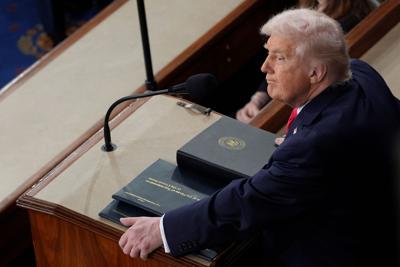
President Donald Trump delivers the State of the Union address to a joint session of Congress in the House chamber at the U.S. Capitol in Washington, Tuesday, Feb. 24, 2026.
President Donald Trump delivers the State of the Union address to a joint session of Congress in the House chamber at the U.S. Capitol in Washington, Tuesday, Feb. 24, 2026.
PABLO MARTINEZ MONSIVAIS | AP photo
President Donald Trump had a lot to say during the one hour and 47 minutes he took to deliver the longest State of the Union address in U.S. history Tuesday night.
The numbers behind economic and energy struggles looming large in West Virginia in the last 13 months since Trump began his second term, though, say something too.
Key figures contradict Trump’s claim Tuesday night of a “roaring economy [that] is roaring like never before.”
Employees impacted by WARN notices in West Virginia increased sharply in the first year of Trump’s second term, according to a Gazette-Mail review of the notices reported by WorkForce West Virginia. Named for the Worker Adjustment and Retraining Notification Act of 1988, WARN notices are designed to provide advance notice of qualified plant closings and mass layoffs to workers to allow them adequate time to seek other employment or retraining opportunities.
More than 2,300 employees were affected by WARN notices reported by WorkForce West Virginia in 2025, according to agency records — nearly double the roughly 1,200 affected in each of the two previous years and more than quintuple the roughly 400 affected in 2022 under former President Joe Biden. All of last year’s employee layoffs and terminations under the WARN notices were expected to be permanent at the time they were issued, per the notices.
Mining layoffs played a significant role in last year’s rise of WARN notice-impacted employees.
Last year brought a June announcement from Core Natural Resources, Inc. subsidiary Itmann Mining Company LP that 234 workers were expected to be terminated at its Itmann Mine #5 and Itmann Preparation Plant in Wyoming County, including 48 electricians and 27 roof bolter operators.
It also brought a May announcement from Coal-Mac LLC that the company planned to terminate 104 employees at its Cub Branch Mine, Eagle 3 Mine and Snap Creek Loadout in Logan County, including 27 rock truck drivers and 13 dozer operators.
West Virginia’s number of WARN notice-impacted employees is on pace to rise further in 2026 after two notices in the past four weeks covering 530 workers at seven Greenbrier Minerals LLC mines and facilities in Logan and Wyoming counties controlled by Coronado Global Resources, Inc. and 199 workers at Mettiki Coal LLC in Tucker County – including 31 mechanics and 20 roof bolter operators.
Mining and logging jobs decreased 1.9% by 400 from December 2024 to December 2025, according to Workforce West Virginia data — contributing to a 0.33% decrease in total employment.
Total unemployment in West Virginia grew 12.3% in the same span, per the data.
Trump has presented himself as a champion of coal, making moves to boost the struggling industry that supporters in coal-reliant West Virginia have applauded. Those moves have included Trump’s Department of Energy in October pledging $625 million to boost the industry and the EPA concurrently announcing a proposal to extend deadlines for steam electric power plant operators to comply with existing regulations.
Last week, Trump drew more praise from coal supporters by weakening limits on coal-fired plants for emitting mercury and other air toxics — a move poised to increase greenhouse gas emissions that drive harmful climate change as well as respiratory and neurological damage in adults and children.
But Trump trade policy has been a natural obstacle for West Virginia’s metallurgical coal industry.
The U.S. Energy Information Administration said in October announced that U.S. coal exports declined 11% from the first half of 2025 to the first half of 2024 because of reduced exports to China. U.S. exports to China dropped after China imposed a 15% additional tariff on imports of U.S. coal in February and a 34% reciprocal tariff on imports from the U.S. in April, the EIA said.
China was the world’s top exporter in 2024 of metallurgical coal, which is coal used for steel production.
West Virginia is the top metallurgical coal-producing state in the U.S., exporting 67% of the metallurgical coal produced in the state in 2023, according to EIA data.
The Congressional Research Service reported in August that the volume of global metallurgical coal exports in February 2025 declined by approximately 18.8% year on year, citing an analysis by S&P Global Market Intelligence.
Those figures didn’t stop Trump from claiming a “stunning economic turnaround, the biggest in history” during his State of the Union speech Tuesday.
“I used these tariffs, took in hundreds of billions of dollars to make great deals for our country, both economically and on a national security basis,” Trump said.
More pain at the pump under Trump
Local energy prices have climbed under Trump — including at the pump.
Gas prices have increased from $2.852 to $2.864 per gallon for regular gas in the Charleston area in the past year, according to AAA data — a 0.4% increase.
Trump claimed during his State of the Union address that gasoline is “now below $2.30 a gallon in most states,” but the AAA national average Tuesday was $2.975 — 29.3% above Trump’s $2.30 assertion.
“Nobody can believe when they see the kind of numbers and especially energy, when they see energy going down to numbers like that,” Trump said at another point without specifying what figures he was referencing.
W.Va. electricity prices climbing under Trump
The price of electricity for West Virginia residential customers increased 2.3% to 15.41 cents per kilowatt-hour from 2024 to 2025, according to preliminary EIA data released Tuesday, consistent with a 2.5% increase nationally.
For West Virginia commercial customers, the price of electricity rose 1.1% in the same span to 11.75 cents per kilowatt-hour, with a steeper climb of 3.8% for the state’s industrial customers to 8.11 cents per kilowatt-hour.
West Virginia’s electricity prices have risen more sharply than the national rate since 2010 amid the state’s increasingly anachronistic dependence on coal-fired power, growing 75.3% versus a nationwide clip of just 49.9%, according to EIA data.
West Virginia’s share of electricity derived from coal has hovered near 90% in recent years, far above any other state, causing consumer advocates in the state to press the state’s coal industry-favoring leaders to embrace cheaper, more cost-effective energy resources like solar and wind hindered by Trump moves to hobble their industries.
Trump’s Environmental Protection Agency in August announced it was terminating the Solar for All program through which it, under Biden, selected the West Virginia Office of Energy to receive $106.1 million to deliver solar power to low-income and disadvantaged residents.
The EPA had estimated under Biden that the average low-income household benefiting from a Solar for All program would experience approximately $400 in annual savings from their electricity bills. Low-income households across the country would realize over $350 million in annual household savings from all 60 grant recipients' programs, totaling over $8 billion in cumulative savings for over a standard solar project 25-year life, the EPA had projected.
West Virginia’s solar resources have been limited by state leaders through them not enabling community solar, an arrangement other states have approved that has slashed energy costs. Community solar arrangements allow customers to receive solar energy without having to install their own solar energy system. Customers typically benefit from energy generated at an offsite array.
The Trump-pushed, West Virginia congressional delegation-supported One Big Beautiful Bill Act enacted in July gutted clean energy tax credits, setting up a projection from San Francisco climate policy firm Energy Innovation LLC that a version of the bill similar to the one that passed would increase household energy spending in West Virginia by an average of nearly $160 per year in 2030 and more than $410 per year in 2035 due to increased capital, fuel and operating expenses.
Little more than half an hour into his speech Tuesday night, Trump stopped to question the very word of “affordability” as used by Democrats who have been critical of his moves.
“[A] word — they just used it. Somebody gave the word to them,” Trump said.
Mike Tony covers energy and the environment. He can be reached at mtony@hdmediallc.com or 304-348-1236. Follow @Mike__Tony on X.