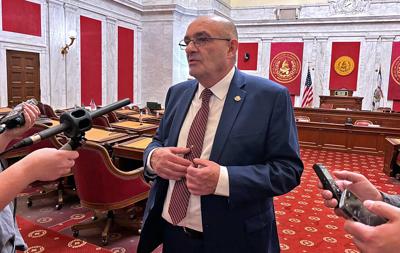
Sen. Randy Smith, R-Tucker, speaks to reporters on Sunday, Dec. 8, 2024, after being nominated by fellow Republicans to be the next West Virginia Senate president.
That was the reflection the retired coal miner all but certain to become the West Virginia Senate’s next president offered on how he arrived at that position of power moments after his fellow Republicans nominated him to lead the GOP-supermajority chamber Sunday.
Sen. Randy Smith, R-Tucker, speaks to reporters on Sunday, Dec. 8, 2024, after being nominated by fellow Republicans to be the next West Virginia Senate president.
AMELIA FERRELL KNISELY | West Virginia Watch
“I’m not your typical Senate president type, because I’ve been blue collar, working class,” Sen. Randy Smith, R-Tucker, told reporters on the Senate floor moments after he was picked, noting that he spent 22 years as a mine section foreman.
But Smith, chairman of the Senate Energy, Industry and Mining Committee, has drawn heavy support from coal and other fossil fuel executives, as well as electric utilities charging some of the nation’s most sharply increasing rates during his committee leadership.
And although Smith told reporters Sunday he is “smart enough to know that times are changing” when it comes to energy, he has used his chairmanship to try to turn back the clock on the energy transition in West Virginia, supporting legislation to promote coal through educational programming and force private companies to make decisions that benefit coal-fired plants.
“I love coal,” Smith said.
Smith did not respond to a request for comment for this story.
In 2021, Smith opposed a failed amendment to create an advisory committee to develop and recommend a plan for coal communities in legislation he supported that ultimately required coal-fired power plants owned by public electric utilities to keep at least 30 days of coal supply under contract for the lifespan of those plants.
Smith lamented that Senate Bill 542, which originally included further-reaching reforms to keep West Virginia’s dwindling fleet of coal plants operating as long as possible before it was amended, had “already been butchered with not only a butcher’s knife, but with a hatchet, too.”
Initial SB 542 reforms that didn’t make the final legislation included requiring in-state power producers to maintain 2019 coal consumption levels and making utilities keep a 90-day coal supply under contract.
Smith made clear during a 2022 committee meeting he didn’t want to see coal replaced as the centerpiece of the state’s electric power portfolio.
“I just feel that we’re putting our state and our country in jeopardy with our national security, with our power grid because of the feel-good movement,” Smith said.
During a January 2023 Joint Standing Energy Committee meeting that focused on community solar, an arrangement enacted in 22 states in which multiple households typically slash their electricity costs by buying solar from shared systems, Smith met speakers’ pitches for the program with scorn.
“[I]sn’t it just sort of a smoke-and-mirrors thing at this time?” Smith asked about solar energy.
West Virginia’s installed solar capacity in 2023 ranked 49th nationally, according to the Solar Energy Industries Association.
Coal comprised 91% of West Virginia’s electricity generation in 2021, far more than any other state.
State ratepayers faced a 90% climb in average residential electricity retail price from 2005 to 2020, per U.S. Energy Information Administration data. Only Michigan had a greater increase by percentage.
West Virginia had the nation’s highest emissions of carbon dioxide in pounds per megawatt-hour of electricity, 1,925, in 2023, according to U.S. Energy Information Administration data.
Last year, Smith led sponsorship of legislation in SB 609 that requires state approval for utility and non-utility fossil fuel plants to be decommissioned or deconstructed.
SB 609 drew opposition from Energy Efficient West Virginia, the West Virginia Energy Users Group — a coalition of large industrial energy users — and other ratepayer advocates seeing it as undue interference with market forces driving coal assets to dwindle nationwide. Critics objected to the potential under SB 609 for the authority to force private companies to keep plants open.
Under SB 609, the state Public Energy Authority can approve the decommissioning or deconstruction of a plant only after an analysis by an authority-approved third party that evaluates the social, environmental and economic impact of those steps and potential alternatives.
Smith was a vocal opponent of a 2023 state appropriation for a company to commercialize new battery technology at its Weirton facility. The Legislature signed off on a bill to give $105 million for Form Energy’s planned plant on the site of the old Weirton Steel property. Smith cited grid stability as a reason to stick with coal.
Smith seized upon the grid instability amid Winter Storm Elliott around Christmas 2022 as evidence West Virginia should continue its reliance on coal-fired generation for electricity.
“I’m going to do my part to keep the coal plants running just so we’re there to pull your butt out of the sling when something like this happens,” Smith told Mid-Atlantic power grid operator PJM Interconnection’s Asim Haque after a 2023 presentation from Haque to state lawmakers on grid stability challenges during that storm.
But Haque said coal was responsible for roughly 16% of outages during the storm, second-highest among generation fuel types and well behind natural gas. PJM said that wind and solar resources performed as near-term forecasts projected, even as an extremely high rate of generation-forced outages emerged that PJM didn’t expect.
Experts say batteries could store excess production from intermittent solar and wind generation and release it when demand rises, allowing the grid to operate with stability.
Meanwhile, West Virginia’s reliance on coal hasn’t kept the state from having some of the worst electric reliability figures in recent years.
The state finished dead last in reliability and overall performance in a ranking of electric utility performance among all states released in 2022 by the Citizens Utility Board, an Illinois consumer advocate group.
Appalachian Power’s West Virginia coverage area ranked in the highest 3% of all 958 listed utilities nationwide in outage minutes per year and outage minutes per interruption, as well as the highest 9% in non-momentary electric interruption frequency in 2021, according to U.S. Energy Information Administration data.
During the 2024 legislative session, Smith sponsored SB 230, which if passed, would have created a governor-administered West Virginia Coal Marketing Program powered by $1 million from the general fund to expand West Virginia’s coal markets and facilities.
Other failed legislation that Smith sponsored included: