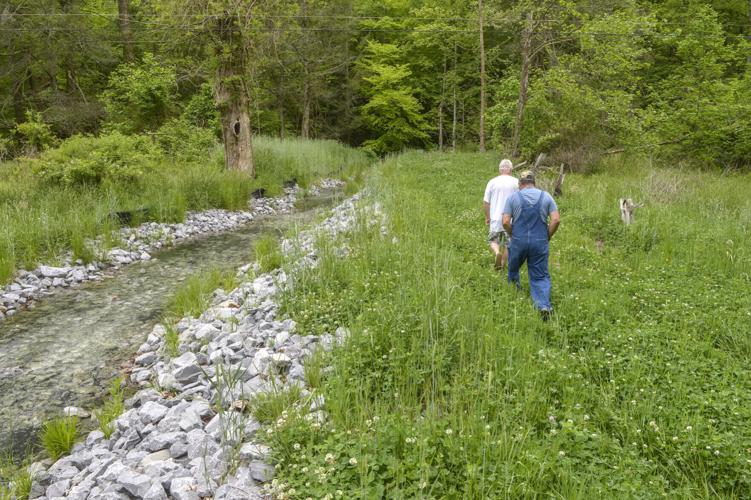
Richard Altizer (white shirt) and Kevin Christian walk near a waterway near the home of Tina and Jamie Christian, in the Pineville area of Wyoming County, on May 8, 2024.
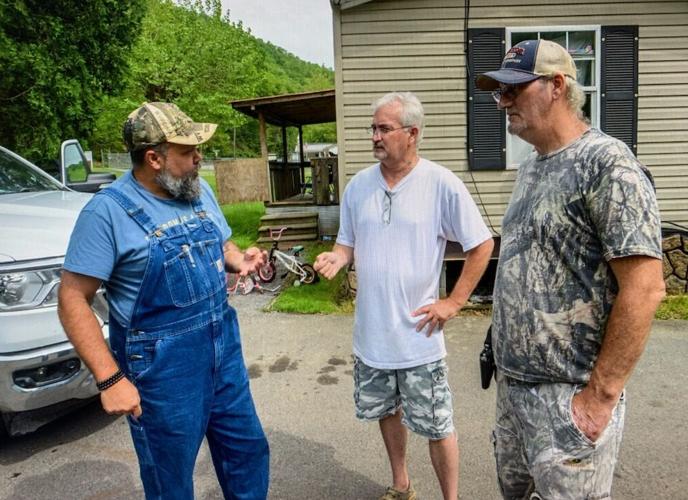
Kevin Christian (left), Richard Altizer and Jamie Christian talk outside the latter’s Welch-Pineville Road house in Wyoming County on May 8, 2024. Altizer said neglect from state leaders and coal firms is wreaking havoc on people’s lives. “This is a national disaster,” he said.
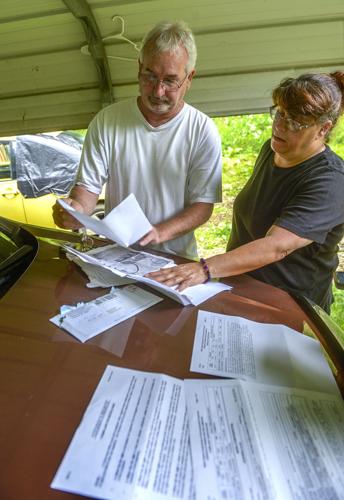
Richard Altizer and Alice Workman pore over mine maps and West Virginia Department of Environmental Protection paperwork outside Workman’s home in the Raccoon Hollow area of Wyoming County on May 8, 2024.
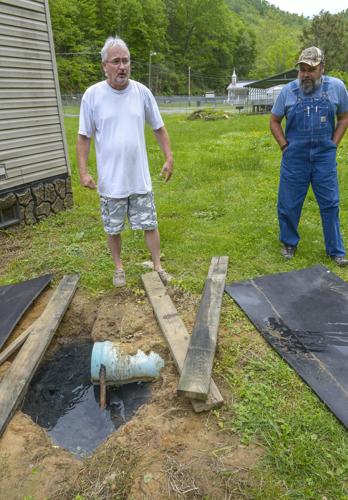
Richard Altizer (left) and Kevin Christian stand outside the Wyoming County home of Tina and Jamie Christian on May 8, 2024. They are near where a well erupted and discharged mine water that flooded the Christians’ yard in February 2023.
Richard Altizer (white shirt) and Kevin Christian walk near a waterway near the home of Tina and Jamie Christian, in the Pineville area of Wyoming County, on May 8, 2024.
Gazette-Mail file photo
Editor’s note: This is the second in a series of stories about a water crisis in southern West Virginia.
PINEVILLE — It breaks Tina Christian’s heart to leave her home of nearly 30 years.
But she feels she has no choice.
“We can’t risk our health, and especially the health of our grandchildren,” Christian, 53, said.
Christian is one of many Wyoming County residents attributing life-changing health setbacks to coal mining operations they say has poisoned and destabilized their backyards, upsetting the local ecosystem by killing deer, fish and other wildlife and producing a rotten-egg smell pervading their homes.
For Tina Christian and her husband Jamie, the trouble started on Feb. 16, 2023, when an “artesianing” eruption — an unauthorized discharge of mine water — flooded their yard from the nearby Pinnacle Mine Complex.
The West Virginia Department of Environmental Protection issued a cessation order to the permittee, Pinnacle Mining Company LLC, after finding the artesianing behind the Christians’ Welch-Pineville Road home was “creating an imminent danger to the health or safety of the public or can be reasonably be expected to cause significant, imminent harm to the environment,” according to the February 2023 order.
“This was a lake right here,” Jamie Christian, 48, said while standing in a backyard fouled by a sulfuric smell and sunken nearly a foot in some places, which Tina attributes to mining.
"Our lives were totally turned upside down in less than 24 hours,” Tina said nearly a year and a half later. “ … It has been a nightmare since.”
For Tina, that nightmare has meant headaches, dizziness, ringing ears, bumps breaking out on her tongue and a venous ulcer.
For Jamie, that nightmare has meant concerns about elevated lead and cadmium in his blood and a damaged lawnmower when hitting a low spot when mowing the yard.
“You have to be careful,” Tina said. “If you step in a low spot, it could twist your ankle in the dark.”
Tina said water from the geyser fried their heat pump and furnace under their trailer home, forcing them to use wood heat in the winter and three small window air conditioners and fans throughout what has been a sweltering summer. Tina has lymphedema, and oppressive heat for weeks on end has caused her leg to swell. Black mold is growing under the Christians in their home.
Jamie said kidney and liver cancer recently has claimed the lives of his Indian Creek area neighbors since the geyser hit.
“We have to get out of here,” Tina said.
Indian Creek area residents: DEP is unresponsive
The Christians are among many residents of Wyoming County and neighboring McDowell County — two of the poorest counties in the nation — who say state political leaders and regulators have failed to protect them from mining operations.
“We just know they’ve done everybody in this whole area dirty,” Pineville area resident Chuck Simpson said, referring to mining operations he said have taken place under his and his neighbors’ homes resulting in gas explosions.
Residents have reported tap water ranging from orange to black ruining their clothes, in addition to causing skin rashes while breathing in coal dust from mining operations that coats their homes and roads.
DEP spokesperson Terry Fletcher said data collected by the agency hasn’t indicated any public health or safety issues related to mine water discharges in Wyoming or McDowell counties exist. Fletcher said results show parameters associated with coal mining activity are meeting state water quality standard criteria for both aquatic life and human health.
But area residents have little faith in what they say has been an unresponsive DEP.
Richard Altizer and Alice Workman pore over mine maps and West Virginia Department of Environmental Protection paperwork outside Workman’s home in the Raccoon Hollow area of Wyoming County on May 8, 2024.
KENNY KEMP | Gazette-Mail file photo
“The DEP hasn’t done very much,” said Alice Workman, Simpson’s girlfriend, standing outside their home. A DEP geologist concluded a well outside their home hadn’t been sunk after observing water nearly 50 feet below the top of the well in an agency investigation report they disagree with, in part, since she said an Alpha subsidiary representative admitted the company sunk the well.
Area residents like Richard Altizer, a neighbor of the Christians who has led water distribution efforts and posted videos to social media criticizing DEP oversight in the area, have taken it upon themselves to help each other in the face of what they say has been a long-term pattern of neglect from state leaders as the coal industry wreaks havoc on their land and their lives.
“This is a national disaster,” Altizer said.
Gov. Jim Justice-owned Bluestone Resources Inc. is one of three coal companies that have fought for nearly a year and a half in court to avoid responsibility for cleaning up the mess near the Christians’ home and preventing further discharging.
“I don't think it's going to be any politician or any government entity that is going to swoop in and save us,” said the Rev. Brad Davis, an elder in the United Methodist Church serving six churches throughout McDowell County who has coordinated area water distribution efforts. “Because — quite frankly — the folks here in these communities here, this region, have been abandoned and forgotten by each and every institution that you can think of, including the government on all levels, across party lines. Nobody is coming to save us.”
Passing the buck in court
In March 2023, the DEP sued Pinn MC Wind Down Co., a firm formed through a reorganization of the Pinnacle Mining Co. after its parent company, Mission Coal, filed for bankruptcy, to force permittee Pinnacle Mining Company LLC to respond to an order to address the discharge.
Pinnacle responded to the DEP’s lawsuit by suing Bluestone in June 2023 after a Wyoming County Circuit Court judge ordered Pinn MC Wind Down to monitor the artesianing well property and prevent the pooling of the artesianing water around the Christians’ residence.
In January 2024, Alpha responded to a third-party complaint Bluestone filed against it by denying that it “owed any duty to Bluestone.”
Richard Altizer (left) and Kevin Christian stand outside the Wyoming County home of Tina and Jamie Christian on May 8, 2024. They are near where a well erupted and discharged mine water that flooded the Christians’ yard in February 2023.
Gazette-Mail file photo
In May 2024 — 15 months after the artesian well of water sprang up from in their yard, the Christians filed a lawsuit of their own against Pinn MC, Bluestone and Alpha in Wyoming County Circuit Court, seeking compensatory damages, prejudgment interest and attorney fees and costs.
Legal counsel for the three coal companies did not respond to requests for comment.
Tina Christian said she and Jamie haven’t received a penny despite the damage to their home. They’ve been looking for a new place but can’t do anything until they’re paid for their damages.
“[A]nd we don’t know then how much we will get,” Tina said.
Coal companies invested in status quo
Meanwhile, the coal companies and Gov. Jim Justice all have notched wins, even as the Christians have lost so much.
Pinn MC has kept avoiding responsibility, racking up 15 unabated DEP violations that date back to 2020 on the permit covering the artesian well as of June 27.
An unabated April 2020 violation was for failing to initiate reclamation activities within 30 days, and final backfilling and regrading within 180 days of completion of underground operations.
An unabated April 2022 violation was for failing to take measures fencing, capping, sealing or reclaiming the site to protect the public from all open shafts and pump holes.
Since February 2023, the month of the Christians’ artesianing well incident, Alpha’s stock price has soared, rising 101% according to Google Finance figures.
Alpha has made political investments in its future by showing heavy support for coal industry defender and frequent environmental protection opponent Patrick Morrisey, West Virginia’s three-term attorney general considered the frontrunner in the 2024 race for governor.
Alpha executives and legal counsel contributed over $14,000 to Morrisey’s gubernatorial campaign in the second quarter of 2024, according to Morrisey’s campaign committee.
Morrisey has been a key opponent of U.S. Environmental Protection Agency attempts at aggressive action to address climate change, leading a coalition that prompted a 2022 landmark U.S. Supreme Court decision finding the EPA had acted beyond its authority in assuming “major policymaking power” to reshape the nation’s energy sector.
The conservative court held that the EPA doesn’t have the authority to shift the nation’s power generation to lower-emitting sources than coal.
Morrisey has been a critic of what he has argued is federal overreach from the EPA and other administrative agencies, generally defending states’ rights to determine their own energy and regulatory agendas.
In West Virginia, that has meant propping up the coal industry.
Energy Innovation LLC, a San Francisco climate policy firm, released a report this month finding a West Virginia Public Service Commission order that coal-fired power plants operate at a capacity factor — or use rate — of at least 69% is uneconomic, ignoring cheaper market options for utilities and their captive ratepayers.
The PSC order has drawn criticism from energy experts and environmental advocates as arbitrary overreliance on coal-fired power that risks driving up fuel and environmental health costs for which customers are liable.
West Virginia’s residential rate increase of 3.7% in compound annual growth from 2010 to 2023 was fifth-highest in the nation and higher than all states except California outside New England, according to Energy Innovation’s report. The PSC did not respond to a request for comment on the report.
State legislators gave no response on the floor of the House of Delegates when Assistant Majority Whip Adam Vance, R-Wyoming, an underground coal miner, begged for help in a March floor speech. Vance told his fellow lawmakers the well water of residents in the Indian Creek area of Wyoming County was contaminated.
Vance told his fellow delegates two people in the community died from and five were diagnosed with cancer in the past year.
“Not saying that water is what it comes from, but people down there have started questioning and asking,” Vance said.
In his speech, Vance asked for “tankers full” of water.
State lawmakers have ignored calls to more aggressively shore up funding for state gas and oil well inspectors amid a years-long inspector shortage. In 2022, weakened state water quality standards for cancer-linked chemicals, including banned insecticides.
Kevin Christian (left), Richard Altizer and Jamie Christian talk outside the latter’s Welch-Pineville Road house in Wyoming County on May 8, 2024. Altizer said neglect from state leaders and coal firms is wreaking havoc on people’s lives. “This is a national disaster,” he said.
KENNY KEMP | Gazette-Mail
Deflecting blame from coal companies
On an overcast afternoon six days before the May primary, Republican long-shot gubernatorial candidate Kevin Christian of Calhoun County toured Tina’s and Jamie’s yard and surrounding areas of Indian Creek after learning about the couple’s troubles from Jamie the night before at a political gathering in Welch. Tina said Jamie later discovered after meeting Kevin that night they were distant cousins.
Kevin Christian, a former underground miner, recalled in a Facebook post two days later the fumes immediately made him ill, and he shared a GoFundMe page set up by Logan County native Terra Vance in late February to raise money to buy safe drinking water for people in Wyoming and McDowell counties. The page had raised $11,607 from 221 donations as of Wednesday.
While walking through the Indian Creek neighborhood, Christian questioned many state politicians’ focus on cultural “red meat” issues like the gender inclusivity of public restrooms.
“It’s absolutely a smokescreen. You tell me when a transgender kid has ever killed somebody [through] cancer,” Christian said. “ … They’re all talking about ‘woke,’ while we’re all going broke.”
Kevin Christian finished in sixth place in the Republican primary won by Morrisey six days later.
Davis, the McDowell County pastor, has served churches throughout the state and has noticed a tendency among local residents to deflect blame away from the coal industry when it comes to environmental degradation that he also noticed among Parkersburg area residents who he said defended DuPont there.
The EPA said DuPont failed for more than two decades to report data indicating health risks from industrial chemicals known as PFAS resulting from manufacturing at a facility near Parkersburg.
After PFAS used to make Teflon-related products at what was DuPont’s Washington Works facility near Parkersburg starting in 1951 discharged into water supplies, people living in the area experienced increased rates of testicular and kidney cancer, thyroid disease and pregnancy-induced hypertension.
Wyoming County Commission President Jason Mullins declined to criticize the coal industry in an interview and complimented the DEP.
“I think they’ve done a pretty good job, especially in the last few years, of staying on top of these mines and making sure they're doing what they're supposed to,” Mullins said.
Mullins hadn’t heard of water distribution efforts like those spearheaded by Altizer, the Christians’ neighbor.
Altizer said county officials haven’t bought water for area residents and that leaders have shied away from helping because they “know the governor is involved.”
Davis recalled a parishioner saying the community was up against a “giant.”
Is that giant the coal industry or government?
“The simplest way to answer that would be, ‘Yes,’” Davis said.
Disconnect with the DEP
Fletcher said most mining discharges in the area comply with the federal Clean Water Act and attributed the area’s groundwater historically showing elevated levels of metals to natural geological conditions.
That’s no consolation to area residents who say the DEP has missed opportunities to protect and communicate with them.
Fletcher said flow observations during a complaint investigation did not show any stream loss associated with deep mining operation. That investigation followed Altizer sending a video showing water entering a mine from a roof fracture as alleged proof that an aquifer serving a residence in Raccoon Hollow had been breached, according to Fletcher.
Fletcher said any water infiltrating into an active Alpha area mine is pumped out to settling ponds prior to being discharged through approved water pollution control outlets monitored for water quality parameters linked to mining activities. That setup stops any water pressure from building up inside the mine, Fletcher asserted.
Fletcher said the DEP hasn’t identified or been provided any physical evidence to verify claims of dead fish or animals despite rampant concerns about them in the area.
The DEP attributes a white substance coating the stream in areas of Indian Creek to sulfate-reducing bacteria that live in oxygen-deficient environments.
Hydrogen sulfide produced by sulfate-reducing bacteria is toxic to intestinal cells and can drive intestinal cancers and inflammatory bowel disease. Hydrogen sulfide smells like rotten eggs at low concentration levels.
Altizer said he believes foam in area creek waters is industrial cleaner used in the mining process. Altizer cited independent testing showing “Surfactants” above a method detection limit but below a practical quantitation limit that represents a higher standard for achieving quantitation with acceptable reliability.
Fletcher defended placement of hay bales in an artesian discharge channel, saying it was designed to provide sediment control in the channel by dissipating channel velocity and prevent excess sediment from entering Indian Creek.
But Altizer pointed out an unimpeded flow of water in the area around hay bales near the Christians’ home.
Fletcher acknowledged groundwater in the area shows elevated iron and manganese, which he noted when reduced by naturally present bacteria can cause odors, discoloration and buildup of a slime-like precipitate.
High levels of "nuisance contaminants'
Leigh-Anne Krometis, an associate professor and public health researcher at Virginia Tech who has studied central Appalachian water access and quality, observed drinking water throughout the region has such high levels of “nuisance contaminants” like iron and manganese that it’s not what she would call “potable water.”
Studies Krometis has conducted have found many central Appalachian residents don’t trust their discolored water, traveling miles away to roadside springs to consume bacteriologically compromised water.
West Virginia public service districts often are cash-strapped, their resources limited by dwindling customer bases.
“One of our main concerns — and I'll make this clear — is getting water and sewer [service] to all areas of Wyoming County,” Mullins said.
In 2021, Rep. Carol Miller, R-W.Va., who represents the southern coalfields, and Rep. Alex Mooney, R-W.Va., voted against the Infrastructure Investment and Jobs Act, signed into law by President Joe Biden with support from Sen. Joe Manchin, I-W.Va., and Sen. Shelley Moore Capito, R-W.Va. The bipartisan law invested nearly $31 billion in upgrades to water treatment plants, water distribution and piping systems, PFAS treatment and lead pipe replacement.
Miller and Mooney both were re-elected by wide margins in 2022, with Mooney defeating then-incumbent Rep. David McKinley, R-W.Va., one of just 13 House Republicans who voted for the infrastructure law, to represent a newly redrawn district in that year’s primary.
'Power to make change'
Still enduring a legal battle that has lasted nearly the entirety of this congressional term, Tina Christian isn’t seeking office. She just wants a home where she’s safe again.
“Yes, this is a terrible situation, but we have faith that God will provide,” Tina said.
God will provide more for West Virginians through each other, Davis suggested, with a commitment to real change.
“There has to be a community-wide effort to win the people in these affected communities and these affected households,” Davis said. “When folks start to come together and organize and realize that — together — they have power to make change, I think that's when you will start to see the wheels of change start turning.”
CLICK HERE to follow the Charleston Gazette-Mail and receive