

“We have been abandoned and forgotten.”
“The increase in kidney cancers, the children that had been born with massive defects. We can’t let that part be forgotten.”
“Developers walk away after they’re done polluting and residents are left to deal with the left-behind garbage.”
“To me, it’s more important to stop pollution from happening than responding to it after it happens.”
Those were quotes from 535 attendees of 31 community listening sessions hosted by the Ohio River Basin Alliance and the National Wildlife Federation from June 2022 to May 2023. The water resource advocate groups were seeking input throughout the basin for an Ohio River restoration and protection plan.
The groups and their community listening partners, which include the West Virginia Rivers Coalition, Friends of the Tug Fork River and Friends of the Cheat, have been hoping for what National Wildlife Federation Ohio River restoration director Jordan Lubetkin says must be a “federal intervention” to restore and protect the Ohio River basin’s waters.
What basin defenders throughout the 14-state footprint are hoping for is federal investment like the $368 million in support the House of Representatives has allotted for a Great Lakes restoration initiative in a pending appropriations bill. The Ohio River Basin Alliance intends to present a comprehensive restoration plan to Congress later this year that would enact the plan’s recommendations.
“It’s really a catalytic moment where these kinds of multi-million-dollar infusions from the federal government can really accelerate progress in terms of longstanding issues like backlogs on dam removal or acid mine drainage remediation or habitat improvements,” Lubetkin said during a webinar Tuesday on a report his group and the Ohio River Basin Alliance published last month on their findings from the sessions.

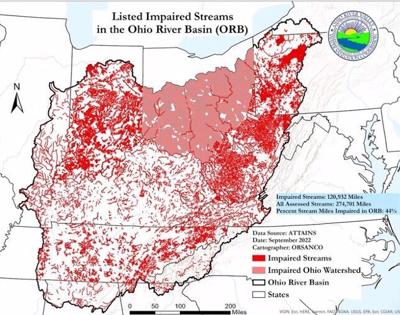
Pictured is a slide during a National Wildlife Federation webinar presentation on a plan to secure federal support for restoring the Ohio River basin. The slide shows an especially high concentration of impaired waters in West Virginia.
National Wildlife Federation presentationThe number one theme the report listed was people seeing threats to their waters all around them — with threats to local drinking water being a “top concern.”
Concerns around toxic chemicals like PFAS — man-made, cancer-linked chemicals with a toxic legacy in West Virginia — plastic pollution, pharmaceuticals, coal ash waste and other contaminants are “top of mind for many residents,” the report noted.
The report found people believe polluters aren’t being held accountable, with concern about mine waste leading to acid mine drainage and toxic pollution like widespread PFAS contamination in drinking water.
“One of the most salient topics that came up in the course of these conversations was the tie between environmental health and economic health,” Lubetkin said.
Water debate spills over at Capitol
Concern over water quality in one of West Virginia’s most poverty-plagued corners spilled onto the floor of the state House of Delegates Thursday.
Delegate Adam Vance, R-Wyoming, an underground coal miner, said in a House floor address the well water of residents in the Indian Creek area of Wyoming County was contaminated.
“The water is smelling now. There’s people that can’t bathe. There’s people that can’t drink water,” Vance said.
Vance told his fellow delegates two people in the community died from and five were diagnosed with cancer in the past year.
“Not saying that water is what it comes from, but people down there have started questioning and asking,” Vance said.
Vance asked for “tankers full” of water.
“If I have to beg, I’ll beg,” Vance said. “But I need some help for my people.”
Taking steps toward safe water
Community advocates say drinking water in Wyoming and McDowell counties has been emerging in shades of gray, brown and black, smelling like paint thinner and causing skin rashes.
Terra Vance, who hails from Logan and many generations of coal miners, set up a GoFundMe page at bit.ly/waterfundraiser to raise money to buy safe drinking water for Wyoming and McDowell residents. Vance said independent tests have shown lead, arsenic and aluminum levels hundreds of parts per billion over allowed limits.
Driving water quality concerns in the area has been water the Department of Environmental Protection has said has come from an old well head on property owned by Bluestone Resources Inc., a coal company controlled by Gov. Jim Justice, next to Indian Creek. The water has been artesianing, or being forced to the surface by pressure underground.
DEP spokesperson Terry Fletcher said Friday a house well stopped artesianing in July after the DEP was issued a preliminary injunction requiring Pinnacle Mining Company, to which the DEP had traced the water, to perform site mitigation. Bluestone has denied responsibility for the water discharge, saying it doesn't own the mining rights.
Fletcher said Pinnacle-submitted quarterly discharge monitoring reports have been submitted as required and in compliance other than a December 2023 reading showing elevated total iron levels. The DEP is looking into that issue and will collect its own sample, Fletcher said.
Fletcher acknowledged some residents insist there is something wrong with the water discharging from the artesian outlet in Indian Creek and don’t believe the DEP’s sampling results. But he added the sampling conducted by the agency indicates the water quality within Indian Creek is within permissible limits.
Fletcher said the DEP doesn’t have the authority to designate whether water discharging into Indian Creek is safe to drink.
The Department of Health, which oversees drinking water compliance and enforcement, did not respond to a request for comment.
The poverty rates of Wyoming and McDowell counties were 25.3% and 37.6% last year, far exceeding the national poverty rate of 11.5% the year before.
Stories you might like
- WV House passes data center enticement bill that would keep project details hidden
- WV legislative session set to fund only 'drop in the bucket' for clean drinking water
- WV Senate fast-tracking bill that would weaken protection from oil, gas tank spills
- NextEra changes tune on MARL project rate impacts for APCo, WPCo customers
“The coal and natural gas industries have created horrifying living conditions for West Virginians who have suffered exploitation and poverty to power the country and keep the lights on for over 150 years,” reads the GoFundMe page to support buying water for Wyoming and McDowell county residents.
The page, supported by environmental and community activists, had raised $4,031 of its $6,000 goal in a day as of Friday afternoon.
As water quality concerns fester in West Virginia’s most vulnerable communities and throughout the Ohio River basin, the standards the DEP uses to regulate water quality and its consideration of key permitting approval for one of the region’s most prominent polluters are drawing heavy scrutiny.
DEP lacking in human health criteria
The DEP is taking comments through March 4 on water quality standards that environmentalists have criticized for years as outdated and incomplete.
The DEP will file any proposed revisions with the Secretary of State’s Office in the spring or summer and include a public comment period and hearing, Fletcher said.
The agency is preparing its triennial review of water quality standards as required by the federal Clean Water Act. It will determine changes to be proposed in 2024 for the 2025 legislative session.
In 2015, the United States Environmental Protection Agency revised 94 criteria representing levels of chemicals not expected to cause adverse impacts to human health to reflect the latest scientific information, including toxicity factors.
In 2022, the EPA encouraged the DEP to propose adopting human health criteria for 41 parameters, including insecticides, herbicides and benzidine, a manufactured chemical and human carcinogen, for which the DEP has had no criteria.
Fletcher said the DEP proposed to adopt updated human health criteria for only 55 parameters in 2022 primarily due to their prevalence in permits issued by the agency. Fletcher said the remaining parameters aren’t as prevalent and that the DEP is considering the EPA’s recommendations.
The EPA also in 2022 said the DEP should reconsider its use of fecal coliform as an indicator of illness to swimmers. The EPA noted it has discouraged the use of fecal coliforms as indicators of fecal contamination since 1986. The federal agency has said E. coli is a more specific indicator of health risk from recreational water contact in fresh water than total coliforms.
Fletcher said the DEP is considering replacing the fecal coliform criteria with one for E. coli to identify and control bacteria.
The West Virginia Rivers Coalition has called on the DEP to implement a water quality standard for ionic pollution from surface mines. Asked for a response, Fletcher said the DEP relies on narrative water quality criteria to identify streams where elevated ions stress aquatic life.
Order would allow discharge of possible carcinogenThe DEP is considering approving a consent order proposed by Chemours, a chronic PFAS polluter, to allow a tenant at its Belle facility, Optima Belle LLC, to discharge treated process wastewater into the Kanawha River — an Ohio River tributary.
Chemours told the DEP a planned process at the facility would result in the discharge of two new chemicals, including possible carcinogen ethylbenzene.
The proposed consent order would allow Chemours to discharge over six times an EPA human health criterion for ethylbenzene.
The West Virginia Rivers Coalition has campaigned against the proposed consent order.
“West Virginians deserve transparent and accountable environmental regulation. I implore the WVDEP to prioritize the well-being of our community and safeguard the integrity of the Kanawha River,” the Rivers Coalition said in a formatted comment it encouraged supporters to sign protesting the proposed order.
Fletcher said the order limit is based on the internal dilution of ethylbenzene prior to it going through the onsite treatment system and then ultimately into the Kanawha River. The Kanawha River will dilute the discharge even further and ensure the discharge limit meets water quality standards, Fletcher said.
In another move drawing scrutiny from water quality supporters, the DEP is considering approving a Chemours application to build and operate wastewater treatment disposal systems to directly discharge processed wastewater and cooling water from its Wood County facility into the Ohio River.
The DEP has scheduled a virtual public hearing on the application for 6-8 p.m. Monday.
Application documents list perfluorooctanoic acid, better known as PFOA, as among the chemicals to be discharged from an outlet. DuPont began using PFOA to make Teflon-products at the site in 1951.
PFOA was replaced at the facility by DuPont with HFPO-DA, which has been used there as a polymer processing aid since 2013, per the EPA. Chemours, which was spun off from DuPont in 2015, took over the site that year.
After PFOA used to make Teflon-related products at the Washington Works facility discharged into water supplies, people living in the area experienced increased rates of:
- Testicular and kidney cancer
- Thyroid disease
- Ulcerative colitis
- Pregnancy-induced hypertension
In 2021, DuPont, Corteva Inc. and the Chemours Co. settled for $83 million in multidistrict litigation over PFOA contamination of drinking water supplies. The companies also agreed to establish a cost-sharing arrangement and escrow account of up to $1 billion to support future legacy PFAS liabilities coming from before Chemours was formed as a spinoff of DuPont’s performance chemicals division in 2015.
The Ohio River Basin Alliance and National Wildlife Federation report mentions PFAS 14 times.
“Toxic PFAS contamination is front-of-mind for many communities,” the report notes.
No response on the House floor
Relief from toxicity was front of Vance’s mind as he concluded his floor speech Thursday.
“We need some help desperately, and I’m asking,” Vance said amid a legislative session in which water quality has not been a focal point.
The House responded to Vance’s speech by moving on to floor announcements. House Judiciary Vice Chairman David Kelly, R-Tyler, announced a committee meeting had been rescheduled. Then the House recessed.
CLICK HERE to follow the Charleston Gazette-Mail and receive


